Archive for the ‘Shmuppreciation 2012’ Category
Parodius Series (Konami)
There’s been a lot of build-up for the Parodius series, especially because I mentioned it was my favorite series and not one iteration (except maybe technically Otomedius, but I consider it a different series) came out in the United States. Unfortunately there really isn’t much to say because the game completely parodies the Gradius series and thus it follows the exact same formula. There is also the fact that I cover the series quite well in the Cute ‘Em Up article on this very web site. Furthermore, since it has been such a scattered series there are only a handful of titles but they span almost every console in both Europe and Japan. Why the series never released in the United States is really anyone’s guess. Some say it’s because so many of the bosses are either mildly sexual or blatantly mock American culture. Others say that the regionalization team for Konami wasn’t that great and didn’t want to worry about what to trim and what not to trim to get through our audience. Whatever the reason, and mind you the Japanese don’t have the best track record with US localization, we haven’t ever received a single one.
Parodius
As most would guess, the first title in the series is called Parodius, but it began life on the MSX microcomputer system only in Japan. At this point it was more cartoon-like and lacked any of the risqué sexual innuendo that the series has always been known for. Mind you, this sexual undertone is rather innocent and in other countries doesn’t even make a gamer blush. In the innocent United States, our parents would have probably gone nuts. Regardless of the content or the controversy, one thing remains constant: Parodius titles are fun and challenging versions of Gradius. Contrary to popular belief, this game was released solely on the MSX with no ports save for the various collections that had it as an option on Playstation, Saturn and PSP.
DoDonPachi Series (Cave)
Welcome to import week on Shmuppreciation and what better way to begin than with the quintessential Cave shooter that started it all: the DoDonPachi series. Those that have been following our “shmup of the day” may have noticed that last week I regarded Raiden as being a primitive version of the “danmaku” (bullet hell) shmup, well the DoDonPachi series would mark the actual beginning of this genre. You’ll notice with this game that big explosions, massive enemies and large pink bullets are just par for the course in this addicting and animated shmup. While the story is not any more diverse than any series we’ve discussed, this was probably the first shmup where I followed each iteration’s story. Although tough as nails, the DoDonPachi series (and pretty much all shmups by Cave) is just so fun and makes you feel so powerful at times that your drive overwhelms the difficulty curve. You keep failing but you don’t seem to care.
Worldwide Arcade Distribution
DonPachi is the first game in the series, although all sequels carry the DoDonPachi name and thus is the true main title for the series. It was developed by Cave, the first title since the separation of developer Toaplan (the only game I’ve played by them was the somewhat similar NES shmup Tiger Heli) closed down and spawned 4 smaller dev studios. DonPachi ran first generation proprietary hardware that appears to be specifically designed for dynamic vertical arcade games. It released in 1995 to a crowded arcade space and thanks to Atlus (a known publisher for localizing and releasing Japanese games in America) even made it to the United States.
M.U.S.H.A. (Compile)
Today is yet another Sunday for Shmuppreciation month, which I feel is a time to play shmups and not spend all day reading about them. It is for this reason that I have chosen a game that needs little introduction: M.U.S.H.A. In Japan, this is part of a larger series known as Aleste, but given that only two titles came out in the US, seemingly almost unrelated, and its roots stem to the Japanese MSX and rare PC-Engine Super CD titles I have avoided the series personally and will do the same in this write-up. For technical reasons, the game is known as Musha Aleste: Full Metal Fighter Ellenor in Japan and in the US it has the acronym title that stands for “Metallic Uniframe Super Hybrid Armor”. Basically the game deals with mechs that can power up guns and shields, not normally a topic I’m very fond of, but this particular title was made into a vertical shmup. You play as the main character Terri (Ellenor in Japan, hence the title), who is the last living mech pilot to protect a space colony named “Little Japan” from obliteration by a series of mechs. As a result you blast through a bunch of levels filled with a bunch of things that explode in impressive ways.
Thanks to the Sega Genesis architecture, shmups perform quite well on the system and M.U.S.H.A. is no exception. There will be tons of enemies, power-ups and bullets on screen but this title won’t skip a beat in keeping up with all of them. In truth it functions much like the 19xx series in terms of how you pick up power-ups and how enemies act, but with a lot more variety to situational combat as well as much improved level design. For a long time this rare title was seen as an expensive “holy grail” of Genesis/Mega Drive shmups, but thanks to Virtual Console this can be had in any region for a low (and great) price. I, of course, jumped the gun and hunted down an expensive original version prior to its release on VC, thus decreasing the value a few short months after purchase. It’s okay though, this game is well worth the money.
Darius Series (Taito)
Of all the shmups I mention this month, the toughest to actually play the way it is intended will be Darius (pronounced “dah-rai-us”). This title premiered in arcades in 1986 by developer Taito and featured a super wide 3-screen arcade cabinet. The first monitor would be centered like you’re used to, but the other two would be at slight angles on either side, using mirrors to create one straight wide view. As a result the way you play the game is completely different because there’s a lot more to see coming and going around you. Nowadays you could do a decent job emulating it on widescreen televisions, but no one has decided to do it yet. Because of this visual mode it doesn’t work all that great on MAME and I highly recommend trying one of the home ports or later arcade ports, which were designed around 4:3 televisions.

Sample screen from original arcade format of Darius
Darius isn’t only significant for having a super wide screen resolution, otherwise it would have died in obscurity as a one-off coin-op. It breaks the mold of the traditional shmup in many ways, including the fact that the player picks which level to play next. Much like Castlevania III it is impossible to see all 28 levels in one playthrough, in fact you will only see 7 in any one completion, but eventually you can piece together every level. Seafood haters out there will also note the interesting crustacean look to the enemies in the series. Your ship, the Silver Hawk, comes equipped with a cannon, bombs/missiles for ground attacks and a force field, all of which are upgraded by, you guessed it, power-up items dropped by destroyed enemies. Each level ends in a boss battle, although the size of the bosses isn’t quite the scale as I was used to with other shmups.
Silpheed (Game Arts)
If I mention the game Silpheed, those who aren’t Sega CD fans probably won’t be familiar with the game. On the other hand, if I mention a very similar title that came out at about the same time I know most gamers will instantly recognize it, Star Fox. While both are on-rails shmups, Star Fox had a new perspective directly behind the ship or in the cockpit, not to mention that there were many more SNES consoles than Sega CDs at the time. That doesn’t mean that Silpheed should be discredited; it offers some of the best polygonal graphics of the time without the groggy slowdown and keeps the traditional vertical shmup perspective. Oh yeah, did I mention it originally came out in 1986?
As a brainchild of Takeshi Miyaji (you know him better for his RPG franchises like Lunar and Grandia), this title released on the Japanese PC-8801 in 1986 and in 1988 made the jump to the Fujitsu FM-7. At that time Sierra took notice of it and ported it to the US (along with a rough translation) for the MS-DOS format. At the time the game featured pre-rendered graphics to create the polygonal effects we see in early 3D games like Star Fox. It wasn’t until the game was ported to the Sega CD/Mega CD in 1993 and actually featured polygonal graphics for all of the ships in the game, a feat for the time that was somewhat common in Sega CD titles.
At this point Silpheed is a rudimentary and quite easy shmup, but it retains the roots of the genre better than titles it’s often compared to like Star Fox or Star Wars Arcade. I’m still amazed with the graphics, especially when you know the game was already 7 years old when it came to the Sega CD and yet has a lot of similar dialogue to Star Fox – is there really a chance Nintendo “borrowed” choice phrases? If you have a Sega CD and you’ve avoided this title because it either didn’t look fun or had some of the most generic cover art you’ve ever seen, it might be worth giving this inexpensive game a chance.
Axelay (Konami)
You’ve heard this very web site make consistent statements about the unfortunate slowdown that plagues almost all SNES shmups. Some say it was the limited amount of processing power (literally half that of the Genesis), while others claim that the increase in graphics meant that developers wanted to push the visuals at the expense of the framerate. Whatever the reason, Axelay, developed by Konami, the very company responsible for the SNES port of Gradius III that slows to a crawl around every corner, has absolutely no slowdown. It’s like a miracle of programming – the game does not slow or stutter and is a strong and competent shmup with horizontal and vertical (behind the ship) levels, much like Life Force. As far as I know, it’s the sole reason we have to say “most” SNES shmups slow down, because one alpha title soars above the rest: Axelay.
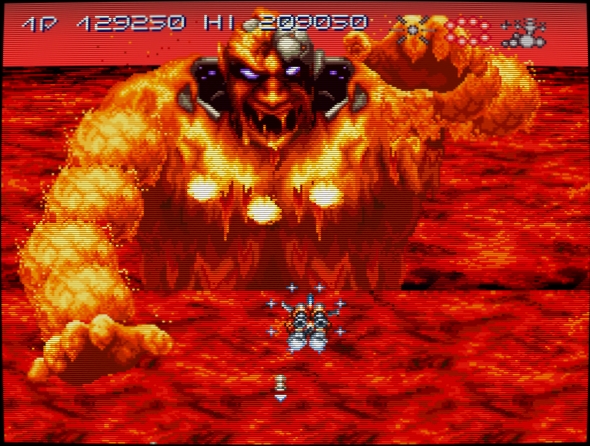
Vertical/behind the ship level
It’s pretty much your typical shmup story, and given the fact that this is no series nor does it have ports, there’s really nothing to note other than aliens attack humans and we send a space ship in to kill them. What is notable is that the Konami team that programmed Axelay was none other than “support program”, better known as Hideo Ueda and Kazuhiko Ishida, but many companies wouldn’t allow programmers to be revealed for fear they would get recruited to competitors. In this case, Ueda and Ishida instead went on to help create their own competitor: Treasure – best known for Gunstar Heroes, touted by some as the best game on the Genesis, and more prominent contemporary shmups such as Bangai-O, Radiant Silvergun, Ikaruga, Gradius V and Sin & Punishment. Turns out those two programmers that made a fast and smooth shmup on the SNES were actually on to something.
Raiden Series (Seibu Kaihatsu/Moss)
Raiden (pronounced “rhy-den”, not “ray-den” like in Mortal Kombat) doesn’t really need an introduction, as an arcade game that came out worldwide in 1990 many people are probably familiar with it, but for what it is it’s perhaps best to take a second look. You see, it’s probably the first game in the famed “bullet hell” genre (or danmaku), although since you’re more dodging bullets rather than weaving in and out of them it may be an archaic example. This doesn’t make the game any less fun, though, it basically takes the conventions of the vertical shmup that started with titles like 1942 and integrates much more bullets. This title also supports co-operative play and respawns instead of checkpoints.
The reason I like this particular series is that it rides the “just good enough” wave on so many levels. It’s not particularly hard, although the gameplay footage below makes it seem far too easy compared to when I play it. It doesn’t have much of a power-up system, so the concept of a single life playthrough is not necessary. It also has a ton of non-shooting enemies, big blinky ships and massive bosses that don’t do much to feel like a true powerhouse, especially when compared to the short lifespan of most bullet hell titles.
Bullet Hell Shmups
This is going to be a really short blog post with some videos, so those of you who like flashing lights and hate these word things will be in heaven. “Bullet Hell” shmups (also referred to as “danmaku” by the Japanese and fans of the genre) usually refers to vertical perspective (based on vertical raster effects from arcade monitors of the 70s, 80s and 90s) where a single ship is more concerned with dodging bullets rather than enemies. Sure, enemies still play their part, but they prefer to do it from a distance. It’s pretty hard to bump into an enemy in early bullet hell titles, but thanks to developers like Treasure and Cave, those rules are quickly broken.
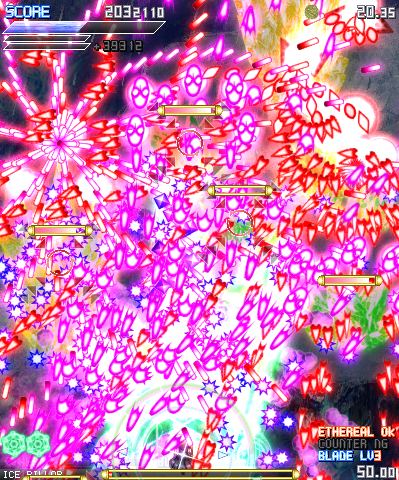
Bullet Hell, get it?
R-Type (Irem)
Irem is a developer that was quintessential in the 80s for many of the classic games we know and love, especially on the NES. It is no shock to me that I just recently found out that among classics like Kung-Fu, Kid Nikki: Radical Ninja and the only playable version of a Ghostbusters video game (Ghostbusters II), that they are also responsible for the impressive shmup R-Type. For many gamers, you’ve probably seen footage of R-Type or played a game based on it at one point or another in your life. Furthermore, it has spanned the test of time and continues to see releases even nowadays. In the late 1980s, with its impressive graphics and a first boss that looked rather close to the xenomorph in the movie Aliens, it was all about making the newest port and getting that screenshot into gaming magazines. R-Type was ported to so many consoles that the number of ports is longer than the coverage on the versions themselves.
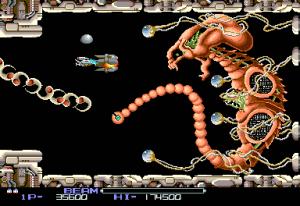
The infamous screenshot that every port wanted to look like.
Salamander (Konami)
I can’t stress this enough, Salamander is my favorite shmup of all time. It’s not that the game is unique, it’s clearly a spin-off of Gradius and in the United States Konami pretends that this game, renamed Life Force here, is the second game in the Gradius series. It’s not the challenge or anything like that, honestly the game is one of the easiest shmups. Nope, it’s just so much fun to play and the little tweaks over the Gradius formula just keep it on the top of my list.
Salamander adjusts the power-up bar that Gradius established, which appeared to be popular enough to include it as an option in all future Gradius titles moving forward. It also adds co-op gameplay, the second ship being the “Lord British” although in this title there is no difference to the power-ups or gameplay. Instead of your deaths returning you to a checkpoint, your ship automatically respawns when a life is lost. In addition all the cold mechanical machine settings of the Gradius series are instead replaced by organic styled levels and bosses. In Japan and Europe, the game released as Salamander and both versions are essentially identical. In the United States, we received a version called Life Force that added a plot about being inside an alien complete with cut scenes, more organic themes to the bosses and level names that sound like body parts. Japan later released their own version of Life Force that included most of these elements and changed the soundtrack. Unlike Gradius, Salamander switches between horizontal shooting levels and vertical shooting levels, even in its ports.
 Gaming History 101