Posts Tagged ‘castlevania’
Review: Castlevania II: Simon’s Quest (NES)
 Console: Nintendo Entertainment System (NES)
Released: 1988
Developer: Konami
Publisher: Konami
Famicom? Yes (as Dorakyura Tsu: Noroi no Fuin – English Translation: Dracula 2: The Seal of the Curse )
Instruction Manual: Not necessary – Link
Difficulty: Moderate
Played it as a child? Yes
Value: $4.80 (used) $195.00 (new) (pricecharting.com)
Price: $15-$20 (used) $400.00-$1,000 (new) on eBay
Digital Release? Yes – Virtual Console (NES version) – $5.00
What are you supposed to do?
Control Simon Belmont through an open world and collect the five scattered body parts of Dracula and a magical cross. Once all of these items have been discovered, Simon returns to Dracula’s castle and assembles the parts to fight and kill Dracula, who has put a curse on Belmont. Depending on how fast you can complete the game, you will be given one of three endings.
Review
 In Konami’s follow-up to Castlevania, the developer attempts to refine the game mechanics and make the sequel quite different from the original, as many NES games at the time were doing, with RPG elements. Simon Belmont can level up, purchase upgrades and weapons from townspeople, and freely explore an open world. The gameplay of fighting enemies remains mostly the same, however with the new open world format there is little direction as to where to go but blocked paths and out of reach ledges due to not having the right item streamlines it into a somewhat linear experience. In addition, day and night cycles keep the player on their toes as night time removes the safety of villages and doubles the strength of enemies. At face value the concept of this game was great, but there are some big issues that prevented us from enjoying it then and now.
Review: Castlevania (NES)
 Console: Nintendo Entertainment System (NES)
Released: 1987
Developer: Konami
Publisher: Konami
Famicom? Yes (as Akumajo Dorakyura)
Instruction Manual: Not necessary – Link
Difficulty: Hard
Played it as a child? Yes
Value: $12.87 (used) $55,000.00 (new) (pricecharting.com)
Price (eBay): $15-$20 (used) $1125.00 (new) NOTE: This copy is revision A and thus has a lower value.
Digital Release? Yes – Virtual Console (NES version) – $5.00
What Are You Supposed To Do?
This is a linear action platformer. Many attribute the Castlevania series as an RPG or action RPG, whereas aside from the second title in the series, it has never really been. With no real inventory to maintain and no story elements to speak of, this original title is all about jumping and killing enemies.
Review
Castlevania released early in the NES life cycle and for that time seemed to be the culmination of everything you would want in a video game. Hitting store shelves early summer of 1987, most NES gamers had either just gotten or were hoping to get the console in the near future and word was getting around that this was one of the pivotal titles to play. You control a hero, Simon Belmont, who has vowed to hunt Dracula in his own castle. In the game you encounter all types of horror staples such as bats, zombies, and Medusa heads all while tackling large scale boss battles with famous monsters like Frankenstein, the Mummy, and even Death himself (aka: the Grim Reaper). As a young boy, this sounded like the most amazing game in the world and I was even happier to find out it delivered on all fronts. Castlevania is a difficult and wild ride through a haunted castle of horrors that holds up even today, albeit at the cost of your sanity with the Dracula battle.

Feature: Castlevania Retrospective

Few titles that started life on the NES still exist today. Of those titles there are even fewer that weren’t developed by Nintendo. Konami is one of the few companies that has a list of titles like this, although many of them suffer from very few updates and recent iterations such as the Metal Gear (Solid) series and Gradius. Castlevania does not have this problem. In fact, it still seems to withstand the test of time and despite trying to reinvent itself so many times, celebrates at least mild success with each new iteration. As a gamer who got his first console, an NES, in 1988, I have literally grown up alongside the series and played most titles it has to offer. If you don’t know Castlevania or have never played a single game, this will hopefully explain why you need to.
Day 7
On the seventh day of Christmas my memories gave to me…
Mode 7 Graphics!

Mode 7 is a complicated process that is oh so easy to explain, the most notorious user of this graphical style being the SNES. It was impossible to not notice Nintendo’s push to boast mode 7 graphics in its advertising and even if you were able to ignore it, the launch games for Christmas 1991 and beyond. Basically the SNES was capable of seven different graphical modes, some adding multiple layers (up to 4) and others allowing you to manipulate and rotate a single layer (mode 7). It was a way to fake 3D and depth in early games and while Nintendo wasn’t alone, consoles like 3DO were expensive and the Genesis required the Sega CD add-on to feature graphics like mode 7. If that was all jargon to you, it was the ability to make the screen rotate and zoom on pixels.
 When you played Pilotwings, your character wasn’t actually falling into a perceived depth, the world that was created below was just zooming and rotating as you pressed d-pad buttons. If you pay attention you’ll notice your character stays fixed in the middle of the screen, like an early arcade racer. Pilotwings wasn’t alone either, almost every early SNES game had mode 7 graphics as some sort of flashy show-off gimmick. When Bowser flew at the screen in Super Mario World or a foot soldier was tossed toward you in Turtles in Time, these were mode 7 graphics at work. When the logo of Actraiser did a dance across the screen mode 7 was responsible. Most notably was the ability to see racers both close and off in the distance with a sense of realism in Super Mario Kart, especially with that technically stunning opening sweep of each racer from Lakitu’s camera perspective.
 As for me, when I finally got a SNES in 1994, the first game I wanted to play was none other than Super Castlevania IV. As an avid fan of the Castlevania series I had thoroughly played the first three games to their challenging conclusions. Even in early Nintendo Power issues I had been dazzled by the high-end graphical style of Castlevania IV and it remained a game I couldn’t wait to play. Not only did this title seem more manageable – the multi-directional whip made killing annoying enemies much easier, if not the entire game as a whole – but thanks to mode 7 every trick in the book was utilized. The world would turn upside down, the screen would rotate, Konami even had some tricks that created the crazy “in the barrel” effect that you see in the screenshot. One of the biggest trademarks of consoles were that software manufacturers made them do things they were never intended to do, from Atari to SNES and beyond. Mode 7, on the other hand, was specifically designed into the Super Nintendo and no title showed off all the crazy things that hardware could do better than Super Castlevania IV. If you still have an SNES and have not touched this technical gem, you owe it to yourself to see mode 7 in all its glory.
Halloween Rarities
I’m really into lucrative titles, especially when they are about Halloween or horror. For the most part these games are classic titles from the past that you have either never played or never had a chance to play. On the plus side, thanks to rom¹ hacks and translations, you can easily find any of these games to play on an emulator. While I don’t condone piracy, nothing in this list was released in the US save for one title so for a single play to see what you’re missing I feel there’s no harm, especially since you have no other option. I cannot link any of these roms directly, but feel free to search for “(title of game) rom” on Google and you shouldn’t have any problems. Without further ado, here’s the list of great Halloween games you’ve probably never played.
Sweet Home (Suīto Hōmu) – Famicom – 1989
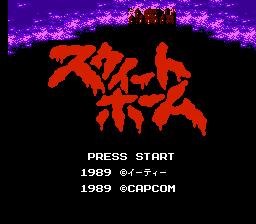
Considered by some to be the original version of Resident Evil, Sweet Home is actually a licensed game based on a movie of the same name. It was developed by Capcom and produced by RE producer Shinji Mikami, who later admitted that Resident Evil began as a remake of Sweet Home. For many modern gamers, RE is a tough sell with its fixed camera angles, blurry graphics and tank² controls. If this describes you, then Sweet Home may be the outdated choice for you. Although developed on the Famicom there is a surprising number of similarities with RE on the Playstation.
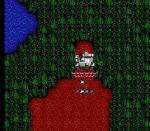
Even in 8-bit, the mansion holds that eerie feel
When you change rooms the all-too-familiar door opening animation will escort you through. The inventory system and puzzles will ring extremely familiar for those that explored the mansion as Chris or Jill. In fact, the big spooky mansion is probably the most distinguishing similarity, although instead of a biological outbreak it’s merely haunted by the ghost of Lady Mamiya. And even though it’s technically a survival horror title, the game plays much more like a classic Japanese role playing game (JRPG) with random Final Fantasy-like battles. If you’ve always wanted to explore a haunted house JRPG style, check this one out, especially considering the decent english translation making the rounds.
 Gaming History 101