Posts Tagged ‘shmup’
Axelay (Konami)
You’ve heard this very web site make consistent statements about the unfortunate slowdown that plagues almost all SNES shmups. Some say it was the limited amount of processing power (literally half that of the Genesis), while others claim that the increase in graphics meant that developers wanted to push the visuals at the expense of the framerate. Whatever the reason, Axelay, developed by Konami, the very company responsible for the SNES port of Gradius III that slows to a crawl around every corner, has absolutely no slowdown. It’s like a miracle of programming – the game does not slow or stutter and is a strong and competent shmup with horizontal and vertical (behind the ship) levels, much like Life Force. As far as I know, it’s the sole reason we have to say “most” SNES shmups slow down, because one alpha title soars above the rest: Axelay.
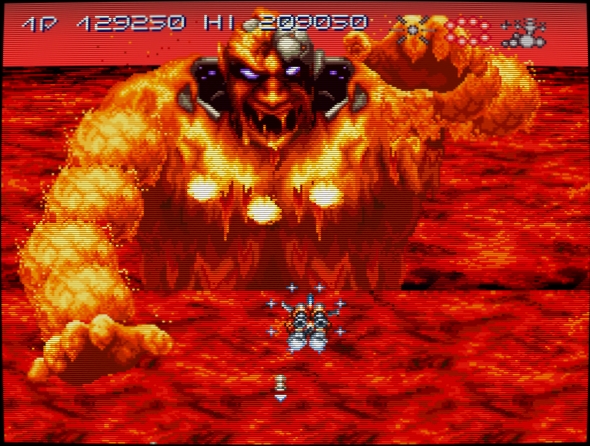
Vertical/behind the ship level
It’s pretty much your typical shmup story, and given the fact that this is no series nor does it have ports, there’s really nothing to note other than aliens attack humans and we send a space ship in to kill them. What is notable is that the Konami team that programmed Axelay was none other than “support program”, better known as Hideo Ueda and Kazuhiko Ishida, but many companies wouldn’t allow programmers to be revealed for fear they would get recruited to competitors. In this case, Ueda and Ishida instead went on to help create their own competitor: Treasure – best known for Gunstar Heroes, touted by some as the best game on the Genesis, and more prominent contemporary shmups such as Bangai-O, Radiant Silvergun, Ikaruga, Gradius V and Sin & Punishment. Turns out those two programmers that made a fast and smooth shmup on the SNES were actually on to something.
Raiden Series (Seibu Kaihatsu/Moss)
Raiden (pronounced “rhy-den”, not “ray-den” like in Mortal Kombat) doesn’t really need an introduction, as an arcade game that came out worldwide in 1990 many people are probably familiar with it, but for what it is it’s perhaps best to take a second look. You see, it’s probably the first game in the famed “bullet hell” genre (or danmaku), although since you’re more dodging bullets rather than weaving in and out of them it may be an archaic example. This doesn’t make the game any less fun, though, it basically takes the conventions of the vertical shmup that started with titles like 1942 and integrates much more bullets. This title also supports co-operative play and respawns instead of checkpoints.
The reason I like this particular series is that it rides the “just good enough” wave on so many levels. It’s not particularly hard, although the gameplay footage below makes it seem far too easy compared to when I play it. It doesn’t have much of a power-up system, so the concept of a single life playthrough is not necessary. It also has a ton of non-shooting enemies, big blinky ships and massive bosses that don’t do much to feel like a true powerhouse, especially when compared to the short lifespan of most bullet hell titles.
R-Type (Irem)
Irem is a developer that was quintessential in the 80s for many of the classic games we know and love, especially on the NES. It is no shock to me that I just recently found out that among classics like Kung-Fu, Kid Nikki: Radical Ninja and the only playable version of a Ghostbusters video game (Ghostbusters II), that they are also responsible for the impressive shmup R-Type. For many gamers, you’ve probably seen footage of R-Type or played a game based on it at one point or another in your life. Furthermore, it has spanned the test of time and continues to see releases even nowadays. In the late 1980s, with its impressive graphics and a first boss that looked rather close to the xenomorph in the movie Aliens, it was all about making the newest port and getting that screenshot into gaming magazines. R-Type was ported to so many consoles that the number of ports is longer than the coverage on the versions themselves.
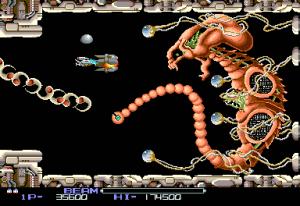
The infamous screenshot that every port wanted to look like.
Salamander (Konami)
I can’t stress this enough, Salamander is my favorite shmup of all time. It’s not that the game is unique, it’s clearly a spin-off of Gradius and in the United States Konami pretends that this game, renamed Life Force here, is the second game in the Gradius series. It’s not the challenge or anything like that, honestly the game is one of the easiest shmups. Nope, it’s just so much fun to play and the little tweaks over the Gradius formula just keep it on the top of my list.
Salamander adjusts the power-up bar that Gradius established, which appeared to be popular enough to include it as an option in all future Gradius titles moving forward. It also adds co-op gameplay, the second ship being the “Lord British” although in this title there is no difference to the power-ups or gameplay. Instead of your deaths returning you to a checkpoint, your ship automatically respawns when a life is lost. In addition all the cold mechanical machine settings of the Gradius series are instead replaced by organic styled levels and bosses. In Japan and Europe, the game released as Salamander and both versions are essentially identical. In the United States, we received a version called Life Force that added a plot about being inside an alien complete with cut scenes, more organic themes to the bosses and level names that sound like body parts. Japan later released their own version of Life Force that included most of these elements and changed the soundtrack. Unlike Gradius, Salamander switches between horizontal shooting levels and vertical shooting levels, even in its ports.
Anatomy of a Cute ‘Em Up
By now you hopefully have the overall concept of a shmup down, if not then you probably missed our article on that very subject, so now it’s time to talk about the different facets (or genres, if you will) that shmups can take. Enter probably the most popular contemporary concept: the cute ’em up. No, they don’t have any clever nicknames like the shmup, but that’s mostly because shmup is a perfect definition of these games. Cute ’em ups are for gamers that like a little aesthetic to accompany their hardcore shooter, even perhaps a little sexuality or titillation. Bright colors, anthropomorphic animals and big bouncy breasts are just par for the course in a cute ’em up. Don’t stray from these titles simply because you feel their gameplay or difficulty will adjust according to their look, this couldn’t be farther from the truth. In fact, for the most part, cute ’em ups are some of the most challenging shmups one can find.

Magical Chase (Palsoft/Quest)
To keep the theme of this weekend alive, I decided to go with yet another light and fluffy shmup on this Sunday afternoon. I’ve chosen to go with one of the most expensive games in my collection, Magical Chase, one of the few Japanese-heavy shmups to find a release on the Turbografx-16 system in the US. I always thought this game was kind of a throw away title as a child, it didn’t do anything quite as well as Fantasy Zone, Gradius or even R-Type, but of course I had to dig it out when I found out how rare and expensive it was. I am pleased to say that when I gaze upon this title with learned eyes I am much more aware of some of the great things it does and now that I finally got my hands on an owner’s manual I can play the game the way it’s supposed to be played. See, back then if we couldn’t understand a game we just assumed that it was too complicated or we were too stupid and just ignored it. I had no idea how to control the stars before getting my hands on that text document. Don’t believe I actually have the game? Well here’s your proof below (yes, this is a cheesy excuse to show it off):
Fantasy Zone (Sega)
So many shmups have heavy music, vast spacescapes and horrid alien bosses, but not Fantasy Zone. One of Sega’s first shooters to grace arcades in 1986 it’s also one of the best titles that explains exactly what you’re going to get. Fantasy Zone breaks the mold for such a popular title – it was ported to almost everything imaginable in the late 80s – and still manages to be a fun and addicting shmup. Forget the brutal challenge and seriousness of other shmups (like Gradius, which has been owning my soul all morning) and instead wander over to a colorful bubbly world with protagonist Opa-Opa.

Looking like a hybrid between a space ship and a small winged creature with legs, Opa-Opa has been somewhat of a sidekick for Sega, even getting an appearance in Sonic and Sega All-Stars Racing. In Fantasy Zone you will control this little ship in a scrolling world (think Defender) while defeating bad guys to collect money and upgrade your ship. As you move along certain boss battles will unlock that move you on to the next world, each new one as unique as the one before it. Fantasy Zone is littered with bright colors and funny looking enemies that get it categorized as more of a “cute ’em up”. To this day I still don’t know exactly where to unlock each boss, but I do know that they appear before you have spent too much time thinking about it. That’s the thing, unlike many other shmups you’re not trying to reach a goal per se, but rather exploring a world and letting it take you on a ride. I know plenty of people who didn’t think there even was a world beyond the first and still pumped quarters into the machine to play it anyway.
Gradius Series (Konami)
Responsible for plenty of attributes to the shmup genre, notably the space aesthetic, but the most significant thing I remember about the title “Gradius” is how often people mispronounced it. Okay people, I’ve confirmed this with Konami, the pronunciation is “grah-dee-us”, not “gray-dee-us”, “grah/grey-die-oos” or any other awkward pronunciation. It’s pronounced simply how it is spelled.

The Gradius series has withstood the test of time with the first technical iteration in 1981 and the most recent actual game released in 2008 (Gradius ReBirth on Wii). In that time the series has graced almost every console and portable that has come out, although recent iterations have been predominantly collections. Not only that, the series is responsible for a few offshoots including my favorite shmup of all time, Salamander (Life Force in US), and the Parodius series. Despite critics rightfully complaining that each new title in the series seems to harken back to the original, I feel it is the series staples that keep dedicated fans and strong sales. I grew up knowing this series on the NES, although I am told that in Japan and Europe it has a more significant presence on the MSX. Like all shmups, it does bury its roots in the early days of the arcade and to me is still on that short list of video games you must play before you die. Nowadays the list of titles is quite long, but after recently playing the series over last week, I still find the original title (not necessarily first in the series) to be the most significant.
19XX Series (Capcom)
I figured we would start of this Shmuppreciation month right with one of the first examples of a true shoot ’em up: Capcom’s 19xx series. It’s a bit funny that I even reference it as such, because to the best most gamers are only aware of the first two titles and they are quite similar: 1942 and 1943: Battle of Midway. The lesser known three titles are 1941: Counter Attack, 1944, and 19xx. There are, however, many different iterations of each so we will discuss the premise, differences in versions and significance to the series. Over the years I have come to realize that shmups make for pretty poor screen shots; it can be nearly impossible to discern what’s going on in most stills so this year I will be providing gameplay video. While it’s ideal for all video to be shot by me from my own consoles/arcades, it’s a lot of work so I will try to capture my own video when I can.
Capcom is definitely no stranger to the arcade scene, but before they generated monster hits with Final Fight and Street Fighter II, they managed some strong success with 1942 in 1984. Set in the Pacific front of World War II, it was pretty interesting to see that this title had you flying a “Super Ace” to destroy the Japanese air force and attack Tokyo. You would think that a World War II title out of Japan wouldn’t focus so much on some of the rougher international relations with the United States, but regardless of that fact 1942 not only came out but was a runaway hit in both regions. Known best for the distinctive twin booms of the plane, which closely resemble the Lockheed P-38 Lightning fighter plane the Super Ace was clearly designed after, and the ability to perform a loop-the-loop that made you temporarily invisible. 1942 introduced the vertically scrolling shooter, gun power-ups and small assisting planes, all significant staples to shmups moving forward. While it wasn’t the first Capcom arcade to get a sequel, it was definitely the most popular. As such, this title has been ported to several systems including the NES/Famicom, MSX, PC-8801, Amstrad CPC, ZX Spectrum, C64, Gameboy Color, Playstation 2/Xbox/PSP (in a Capcom collection), and even a recent revival on PC/PSN/XBLA as 1942: Joint Strike.
What is a Shmup?

For some reason, this screen from R-Type is always what I think about when I hear the word “shmup”.
It’s leap day, a day that on most years doesn’t even exist, and had it not been for today it would officially be March. For those of us in the retro gaming world, shooter fans or basically anyone who listens to Drunken Gamers Radio it also means Shmuppreciation month. For 31 long days we show our appreciation for intergalactic starships, Moai heads, tiered power-ups, sexy young girls with large breasts that aren’t involved in a hentai game, dodging thousands of bullets and actually seeing a vertical raster effect in a high-definition game. It is all for the love of the shoot ’em up, these days called “shmups” for short. What’s distinct about the shmup is that aside from most other genres, it has been around as long as video games themselves – yes, the first video game was a shmup – and has remained relatively unchanged for more than 30 years. As an avid fan with probably more than $1,000 in shmups alone among almost every system – did I mention the shmup has some of the most expensive games in existence? – I wanted to reflect on the history of the shmup.
 Gaming History 101