Posts Tagged ‘atari’
Review: Life of Pixel
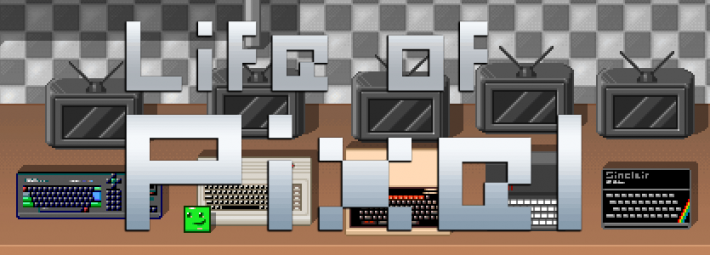 Retro “style” has become exponentially popular these days. What started as an amusing aesthetic for Mega Man 9 or upgraded project like Retro City Rampage has spawned a rush of pixelated, sprite-based games that may look like they came from yesteryear but play like anything but. To the untrained eye (or non-technical gamer) these are nothing more than cash-in titles hoping to embrace the nostalgia of gamers like myself and strategically place a casual game in a 1985 wrapping. My only exception to this style probably lies in titles like Retro Game Challenge on the DS, which fully recreated new games that actually play like old games, or titles like Pier Solar on the Genesis, which is an actual title that plays on the console. Life of Pixel rests just in the middle because it plays completely like a game from the past, but also looks like a game of the past as well. The twist: it does this with eight different known consoles/microcomputers.

One of the first systems is the Atari 2600
Released on the Playstation Mobile platform, an odd choice at first but completely appropriate in hindsight, you follow a single pixel lost to the annals of history that rediscovers its value visiting a retro game museum. In this museum he discovers that he was quite useful on international consoles Atari 2600, Gameboy, and NES, along with five microcomputers that dominated 80s gaming in the UK. These work as “worlds” for the game, each containing eight levels of pure retro platforming bliss. In truth the levels are nothing special if not for the fact that each level and console looks and acts just like it did in the past, flaws and all. An easy example is that of the Atari 2600, which cannot scroll its screen in any way and thus the levels are contained in what you see. Additionally microcomputers could not scroll at will like the NES could so you have to move screen to screen. These are just a couple of examples of how the particular console you are on relates to the type of tactics you use in each level. This isn’t the only hook, as game design “grows up” as you progress in the consoles, so do the mechanics and gameplay styles. In the end you’re basically playing the same series and concept of game across 8 consoles and more than a decade of hardware and game design. If that doesn’t speak to the retro style I don’t know what does. Life of Pixel is a full retro experience, complete with visual styles that faithfully resemble the aesthetic of that console – you know how each console seemed to have a “look” – and properly credited music that holds as true as the graphics.
Podcast: Do The Math

Fred is joined by Derrick of All Games and Rob “Trees” from EZ Mode Unlocked to talk about Atari, Inc.’s illustrious past in light of the information it is entering Chapter 11 bankruptcy (don’t worry, the company will survive no problem, they’re just restructuring). We discuss the history and origins of Atari and what the company did after splitting off from the games division.
Podcast: Tis the Season

For our holiday show, Fred is joined by Shawn Freeman of Knuckleballer Radio and Rob “Trees” O’Connor from EZ Mode Unlocked to discuss the holiday releases of days passed. With a plan to cover 20 years of releases we only get through five (1985-1989), but plenty of fond memories are shared.
Buying Guide: Jaguar

We all love our retro consoles, but in many cases the consoles we are buying are because they are cheap enough or we have enough money to purchase what we never were able to in our youth. Unfortunately the business of making used retro items available to the masses can at times be a money grubbing market where consumers are deceived by people they will never meet in real life. As an individual who has spent the last decade scouring the local area, conventions, eBay, and the internet as a whole I have learned many valuable lessons. For that reason I present my buying guide series, which is a handy quick guide to knowing what to purchase and what will cost an arm and a leg to replace.
The Atari Jaguar just can’t get a break. Touted as a technological breakthrough of its time, this holiday 1993 console may have been a commercial failure but it was clearly a hardware powerhouse. Sure, it may not have been a true 64-bit console just because the twin Tom and Jerry chips were 32-bit co-processors (more on that in our podcast), but for $250 you were getting a lot for your money (estimates claim the Jaguar cost up to $400 to manufacture). As far as exclusives go there’s not really much to tell. You’ve basically got Aliens vs. Predator, Tempest 2000, Breakout 2000, and Kasumi Ninja – half of which are considered to be crap by most gamers – so finding the games on the Jaguar elsewhere will be easy to do. Couple that with the god awful controllers and the need (at least for me) to purchase all of the console games complete in box with the inserts for the controller (and essentially increasing the price anywhere from three to ten fold) and most people are probably going to walk away. In the event that you aren’t one of those people, just prepare for the fact that you will be spending on the upwards of $100-$200 just on a working console with a couple of controllers and then probably $30-$60 on each game if you want all the inserts and whatnot. What you will receive in return is an impressive experience for not only the exclusives, but also the definitive version of a lot of games that were ported all over the place. Doom, NBA Jam: Tournament Edition, Wolfenstein 3D, Raiden, Flashback, Primal Rage, and Rayman all look as good or better than their original arcade/PC versions and often have enhancements or extra content to justify the re-release on this console. Not only that but titles like Cannon Fodder, Syndicate, and Theme Park are identical to the 3DO versions of those games – which in and of itself was a much more expensive ($700) and disc-based console – so if you want to re-live those halcyon Windows 95 days you either have endless headaches with DOSbox or grabbing these decent controller-ready console ports. At this price point, you want to make sure you know what to get so here’s what you can expect when trying to grab a Jaguar:
River Raid (Activision)
Shortly before the video game crash of 1983, a little company by the name of Activision, formed to give programmers credit for their properties and hard work, released a game called River Raid on the Atari VCS/2600. Released in 1982, this game was a basic scrolling vertical shmup where you control a little plane and blast enemies that appear. Your plane remains at the bottom of the screen, but you can increase the scrolling (plane) speed and move left and right. I know that seems like a basic version of most shmups we’ve seen this month, but when you consider it was an early 80s home video game – on Atari’s limited space, no less – River Raid is an achievement.
Star Wars Arcade (Atari)
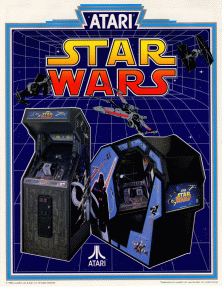
There is a surprising similarity between Star Wars Arcade, released in 1983, and Star Fox, released in 1993. For starters they are both 3D graphical on-rails shooters that involve space battle and a predominance toward the cockpit view. In addition they’re all about blowing up things in space while people scream at you with words and phrases that offer no assistance in the gameplay. Okay, so they’re not actually all that similar when it comes down to gameplay (honestly I find Star Wars Arcade to be the better game), but it does demonstrate that the style of gameplay does withstand the test of time.
Even though it coincided more with the movie release of Return of the Jedi, Star Wars Arcade was a vector graphics 3D shooter where you controlled Luke Skywalker as he attacked the Death Star in Red 5 at the end of the Star Wars: A New Hope. The game involved three stages of battle, called “waves” in the game, that they had to overcome in order to complete it. In the first wave you would destroy TIE fighters as you approach the Death Star, in the second wave you would destroy turrets on the surface and in the final wave you would fight in the trench against both types of enemies and take a crack at shooting the exhaust port and destroying the space station. If you did so, you would loop into the game again and receive an extra shield that allowed you to play for longer periods of time. Doing so without firing a single bullet in the trench until the perfect shot on the exhaust port would be considered as a “using the force” run and net you a huge point bonus in addition to your additional shield. Because of these bonuses it was possible to play for a long time on one quarter, which was like finding gold in old school arcades, and one guy even played for more than 50 hours on a single credit.
Asteroids (Atari)
Back in the 70s, before the VCS/2600 dominated the home market, Atari founder Nolan Bushnell created the first arcade game, Computer Space. Intended to be a single player version of what is considered by some to be the first video game, Spacewar! by MIT students on a PDP-1 valued at $100,000, it was a marvel of ingenuity that was met with commercial failure outside of the scope of nerdy college kids. Shortly after, Bushnell created the much more user-friendly Pong and raked in over $1 million annually for Atari. Unfortunately back then it was much easier to copy a game and get away with it (home versions of Pong that didn’t come from Atari/Sears were actually referred to as “Pong clones”) so the way Atari stayed on top was to make the newest and best games. The apex of the concept begun in Spacewar! came with the Atari coin-op Asteroids in 1979.

Although the connection with Spacewar! and Computer Space hasn’t been universally made, I always view the games as being generational improvements on the formula. If you ask Atari exec Lyle Rains, which is credited with conceptualizing the game, he would probably tell you it came from his famous discussion with Ed Logg, a then Atari programmer, when he asked, “what about a game where you smash asteroids – big rocks into small rocks?” After that Logg and designed and programmed the game with fellow co-worker Dominic Walsh. One of the basic concepts to be born out of the early days of arcades, Asteroids is not only one of the highest regarded titles of all time but it holds the top slot in terms of sales at Atari. Selling more than 70,000 units domestically, many of them needing to be modified with larger coin boxes to keep from shorting out, this game was so popular that when the next big game, Lunar Lander, came out some were custom installed with Asteroids instead because the customer was only interested in that specific game.
Ikaruga (Treasure)
Ikaruga is shrouded in praise and wonder from those in the critical and shmup communities, but if you were to just pick it up and play you wouldn’t really see what all the fuss is about. First off, it’s pretty freaking hard and absolutely impossible if you don’t understand the special gameplay mechanics. Second of all, like so many other shmups, it started life in Japanese arcades so unless you’re lucky enough to get the US Gamecube version you will need to figure out how the game is played before you embark. I don’t know about you, but most of the gamers I know tend to not do critical things like read instruction manuals before playing. This is a big mistake with Ikaruga.
This game is the spiritual successor to Treasure’s Radiant Silvergun in that it borrows the ideas of color connection and polar opposites as its main gameplay style choice. The plot is basically irrelevant, but you are fighting forces in a specialized jet fighter known as the Ikaruga. Polarity, or opposites if you will, are the main objective in the game – you need to figure out how best to handle the light (white) and dark (black) polarities in enemies to plan your strategy. Your ship is capable of swapping polarities at any time under your control with the same polarity granting you invulnerability and the opposite polarity dealing dual damage. It’s a balance between a heavy offense or an unbreakable defense and trying to decide which is most important. Mind you, even though you are invulnerable to bullets of the same polarity, you are not invulnerable to the collision of ships so destroying them should be a high priority. Unlike other danmaku (bullet hell) shmups, you will be weaving in and out of enemy fighters just as much as bullets. In addition, the invincibility option also puts you in situations where it’s not possible to dodge all the bullets. In other danmaku shmups it will always be possible, no matter how tight or specific, to dodge the bullets if you know the pattern.
Day 4
On the fourth day of Christmas my memories gave to me…
Four AA Batteries!

I know they don’t look like much, but these little capsules of power are responsible for oh so many smiles and tears to gaming children. In the early 90s, everyone wanted a portable gaming system of some kind – Gameboy, Tiger handheld, maybe even an Atari Lynx – and they all had one thing in common: they needed batteries. Stories of whether or not any of these devices came with batteries are often passed around anecdotes of suburban myth, but regardless of that fact no child could survive Christmas weekend on one set of batteries alone. I know for a fact that the Gameboy did come with batteries, but any of the others is anyone’s guess. Either way, it was the beginning of a time where frantic holiday shopping parents coming to terms with $100 price tags were greeted with reminders to purchase bundles of batteries and most passed. Then on Christmas morning these parents realized how poor a choice that was.
 Nothing ruins a parents day like getting children a new toy, an electronic toy no less, that cannot run. In many cases the portable console would be the only thing they received for Christmas, and if not then various games may be the only other gift(s). As expected, there was almost nothing open on Christmas day – in 1990 in the suburb of Chicago I grew up in there weren’t even 24 hour Walgreens or gas stations nearby that opened on Christmas. If you didn’t have batteries and needed them, you were essentially screwed. Thankfully most remote controls used AA back then rather than the AAA they use now so it was a scavenger hunt for anything with a remote. If you were lucky enough to snag all 4 AAs, however, the batteries in those remotes were probably on the verge of death because the same type of parent that didn’t buy batteries at Christmas were also the kind that didn’t replace them until the remote was near death for at least a month. If you were lucky you got an hour out of the device before it died again. In the end it was a lesson that parents quickly learned, but the child gamer paid the price.
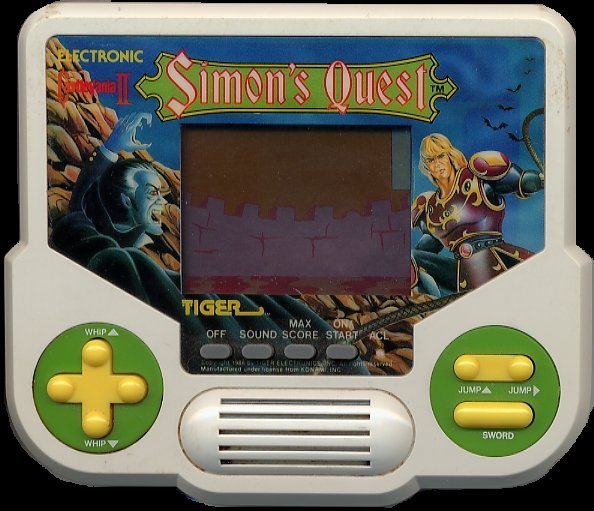
Thankfully by 1995 most stores and parents knew the best option was a rechargeable battery pack, AC adaptor, DC adaptor, or even a kit with everything for a low price. In fact, by 2000 many of the available versions in stores were bundles that included said kit as a way for the store to generate a profit on the console sale (if you’re unaware, most retailers make no profit on the sale of a console itself). Thankfully my parents also learned this lesson, but I still remember getting handhelds I couldn’t play right out of the box.
Day 1
On the first day of Christmas my memories gave to me…
A Wish List Catalog from JC Penny!

Catalogs are definitely not the rage today. Most likely those still utilizing them are the technologically inept or those that just cannot release their grasp on the past. In the 80s and 90s, however, these little guides were responsible for hours of enjoyment to me and my fellow gamers. If you were a good enough customer of certain departments stores – namely JC Penny, Sears and Montgomery Ward, although I’m certain there were others – a massive 500+ page catalog would adorn your mailbox around the end of November. Within it was a virtual form of pretty much everything available in that specific department store, including video games. I used to love going to department stores and bask in the glory of the video game section. There would always be a line of youngsters like myself, all bundled up and overheating in winter coats, affixed to whatever the demo game was. Unfortunately, being only like eight years old, going to the department store or toy store to peruse the video game aisle was not something my mother would do at my beckoned call. On the other hand, the various department store catalogs were always available and waiting on my family’s desk.
 If I haven’t made this clear enough, these catalogs were humongous, heavy books that rivaled War & Peace in size and featured glossy full color pages. Most of them would have a high price tag printed on, like $15 or $20, although I’m certain my family got all of them free because even in the 80s we were no stranger to ordering items remotely. Thanks to their massive size, these catalogs held nothing back even in the video game section, so most games on the market would appear in the catalog. If you were lucky there would be a screenshot and a little paragraph that was nothing but marketing drivel, which I always cherished as gospel, otherwise it was just box art and a price. Before Nintendo Power premiered in 1988 (and even then I didn’t have a subscription until late 1990), these catalogs were the only way to find out what great games were releasing for the holidays. I would come home from school and scour those pages, initially trying to figure out what games I wanted to ask for.
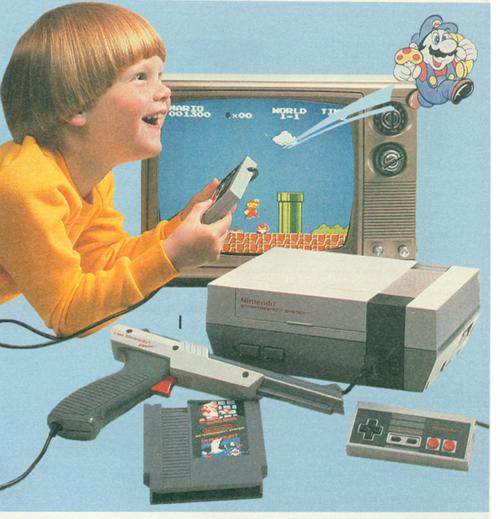 After the first week of browsing had passed and my want list written, the second function of the catalog was to create a list of all the items I would get if I were rich. Since anything and everything was in there I could sit back and imagine I had money for the SNES (about $200 at launch, out of my budget), Turbo Express (around $300) and even distant dreams of a Neo Geo (a whopping $650). Hell, even the games for the Neo Geo sold at ridiculous prices like $120, so there were times that I would list one or two of those titles and imagined I already had the system. There was often a “coming soon” section that featured upcoming titles, some of which would never see the light of day, that allowed me to assess what games were worth saving gift money for. After demand started skyrocketing for video games in the 90s, these catalogs would be excellent places to pre-order consoles and popular games as well as a last effort to grab items sold out in stores.
Catalogs from department stores were my first exposure to video game coverage, albeit a one-sided consumer driven version, but game coverage nonetheless. With parents who were against giving out personal information, even back then, I never got into the Nintendo Club by filling out a registration card. Thanks to an active imagination and a lot of free time, Christmas was celebrated over and over throughout the month of December before the actual gifts arrived.
Go on to the second day of Christmas ->
 Gaming History 101