Posts Tagged ‘konami’
Review: Castlevania II: Simon’s Quest (NES)
 Console: Nintendo Entertainment System (NES)
Released: 1988
Developer: Konami
Publisher: Konami
Famicom? Yes (as Dorakyura Tsu: Noroi no Fuin – English Translation: Dracula 2: The Seal of the Curse )
Instruction Manual: Not necessary – Link
Difficulty: Moderate
Played it as a child? Yes
Value: $4.80 (used) $195.00 (new) (pricecharting.com)
Price: $15-$20 (used) $400.00-$1,000 (new) on eBay
Digital Release? Yes – Virtual Console (NES version) – $5.00
What are you supposed to do?
Control Simon Belmont through an open world and collect the five scattered body parts of Dracula and a magical cross. Once all of these items have been discovered, Simon returns to Dracula’s castle and assembles the parts to fight and kill Dracula, who has put a curse on Belmont. Depending on how fast you can complete the game, you will be given one of three endings.
Review
 In Konami’s follow-up to Castlevania, the developer attempts to refine the game mechanics and make the sequel quite different from the original, as many NES games at the time were doing, with RPG elements. Simon Belmont can level up, purchase upgrades and weapons from townspeople, and freely explore an open world. The gameplay of fighting enemies remains mostly the same, however with the new open world format there is little direction as to where to go but blocked paths and out of reach ledges due to not having the right item streamlines it into a somewhat linear experience. In addition, day and night cycles keep the player on their toes as night time removes the safety of villages and doubles the strength of enemies. At face value the concept of this game was great, but there are some big issues that prevented us from enjoying it then and now.
Review: Castlevania (NES)
 Console: Nintendo Entertainment System (NES)
Released: 1987
Developer: Konami
Publisher: Konami
Famicom? Yes (as Akumajo Dorakyura)
Instruction Manual: Not necessary – Link
Difficulty: Hard
Played it as a child? Yes
Value: $12.87 (used) $55,000.00 (new) (pricecharting.com)
Price (eBay): $15-$20 (used) $1125.00 (new) NOTE: This copy is revision A and thus has a lower value.
Digital Release? Yes – Virtual Console (NES version) – $5.00
What Are You Supposed To Do?
This is a linear action platformer. Many attribute the Castlevania series as an RPG or action RPG, whereas aside from the second title in the series, it has never really been. With no real inventory to maintain and no story elements to speak of, this original title is all about jumping and killing enemies.
Review
Castlevania released early in the NES life cycle and for that time seemed to be the culmination of everything you would want in a video game. Hitting store shelves early summer of 1987, most NES gamers had either just gotten or were hoping to get the console in the near future and word was getting around that this was one of the pivotal titles to play. You control a hero, Simon Belmont, who has vowed to hunt Dracula in his own castle. In the game you encounter all types of horror staples such as bats, zombies, and Medusa heads all while tackling large scale boss battles with famous monsters like Frankenstein, the Mummy, and even Death himself (aka: the Grim Reaper). As a young boy, this sounded like the most amazing game in the world and I was even happier to find out it delivered on all fronts. Castlevania is a difficult and wild ride through a haunted castle of horrors that holds up even today, albeit at the cost of your sanity with the Dracula battle.

Feature: Castlevania Retrospective

Few titles that started life on the NES still exist today. Of those titles there are even fewer that weren’t developed by Nintendo. Konami is one of the few companies that has a list of titles like this, although many of them suffer from very few updates and recent iterations such as the Metal Gear (Solid) series and Gradius. Castlevania does not have this problem. In fact, it still seems to withstand the test of time and despite trying to reinvent itself so many times, celebrates at least mild success with each new iteration. As a gamer who got his first console, an NES, in 1988, I have literally grown up alongside the series and played most titles it has to offer. If you don’t know Castlevania or have never played a single game, this will hopefully explain why you need to.
Parodius Series (Konami)
There’s been a lot of build-up for the Parodius series, especially because I mentioned it was my favorite series and not one iteration (except maybe technically Otomedius, but I consider it a different series) came out in the United States. Unfortunately there really isn’t much to say because the game completely parodies the Gradius series and thus it follows the exact same formula. There is also the fact that I cover the series quite well in the Cute ‘Em Up article on this very web site. Furthermore, since it has been such a scattered series there are only a handful of titles but they span almost every console in both Europe and Japan. Why the series never released in the United States is really anyone’s guess. Some say it’s because so many of the bosses are either mildly sexual or blatantly mock American culture. Others say that the regionalization team for Konami wasn’t that great and didn’t want to worry about what to trim and what not to trim to get through our audience. Whatever the reason, and mind you the Japanese don’t have the best track record with US localization, we haven’t ever received a single one.
Parodius
As most would guess, the first title in the series is called Parodius, but it began life on the MSX microcomputer system only in Japan. At this point it was more cartoon-like and lacked any of the risqué sexual innuendo that the series has always been known for. Mind you, this sexual undertone is rather innocent and in other countries doesn’t even make a gamer blush. In the innocent United States, our parents would have probably gone nuts. Regardless of the content or the controversy, one thing remains constant: Parodius titles are fun and challenging versions of Gradius. Contrary to popular belief, this game was released solely on the MSX with no ports save for the various collections that had it as an option on Playstation, Saturn and PSP.
Axelay (Konami)
You’ve heard this very web site make consistent statements about the unfortunate slowdown that plagues almost all SNES shmups. Some say it was the limited amount of processing power (literally half that of the Genesis), while others claim that the increase in graphics meant that developers wanted to push the visuals at the expense of the framerate. Whatever the reason, Axelay, developed by Konami, the very company responsible for the SNES port of Gradius III that slows to a crawl around every corner, has absolutely no slowdown. It’s like a miracle of programming – the game does not slow or stutter and is a strong and competent shmup with horizontal and vertical (behind the ship) levels, much like Life Force. As far as I know, it’s the sole reason we have to say “most” SNES shmups slow down, because one alpha title soars above the rest: Axelay.
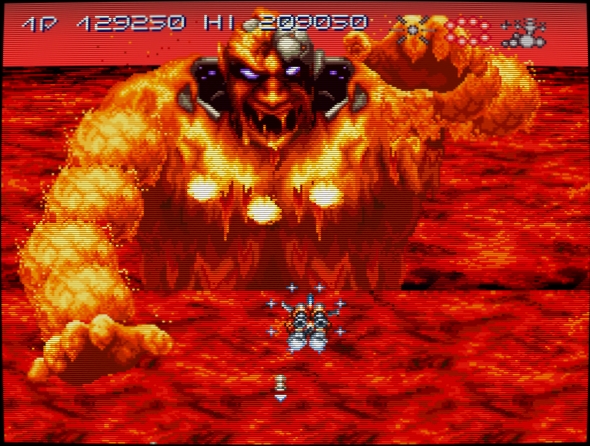
Vertical/behind the ship level
It’s pretty much your typical shmup story, and given the fact that this is no series nor does it have ports, there’s really nothing to note other than aliens attack humans and we send a space ship in to kill them. What is notable is that the Konami team that programmed Axelay was none other than “support program”, better known as Hideo Ueda and Kazuhiko Ishida, but many companies wouldn’t allow programmers to be revealed for fear they would get recruited to competitors. In this case, Ueda and Ishida instead went on to help create their own competitor: Treasure – best known for Gunstar Heroes, touted by some as the best game on the Genesis, and more prominent contemporary shmups such as Bangai-O, Radiant Silvergun, Ikaruga, Gradius V and Sin & Punishment. Turns out those two programmers that made a fast and smooth shmup on the SNES were actually on to something.
Salamander (Konami)
I can’t stress this enough, Salamander is my favorite shmup of all time. It’s not that the game is unique, it’s clearly a spin-off of Gradius and in the United States Konami pretends that this game, renamed Life Force here, is the second game in the Gradius series. It’s not the challenge or anything like that, honestly the game is one of the easiest shmups. Nope, it’s just so much fun to play and the little tweaks over the Gradius formula just keep it on the top of my list.
Salamander adjusts the power-up bar that Gradius established, which appeared to be popular enough to include it as an option in all future Gradius titles moving forward. It also adds co-op gameplay, the second ship being the “Lord British” although in this title there is no difference to the power-ups or gameplay. Instead of your deaths returning you to a checkpoint, your ship automatically respawns when a life is lost. In addition all the cold mechanical machine settings of the Gradius series are instead replaced by organic styled levels and bosses. In Japan and Europe, the game released as Salamander and both versions are essentially identical. In the United States, we received a version called Life Force that added a plot about being inside an alien complete with cut scenes, more organic themes to the bosses and level names that sound like body parts. Japan later released their own version of Life Force that included most of these elements and changed the soundtrack. Unlike Gradius, Salamander switches between horizontal shooting levels and vertical shooting levels, even in its ports.
What is a Shmup?

For some reason, this screen from R-Type is always what I think about when I hear the word “shmup”.
It’s leap day, a day that on most years doesn’t even exist, and had it not been for today it would officially be March. For those of us in the retro gaming world, shooter fans or basically anyone who listens to Drunken Gamers Radio it also means Shmuppreciation month. For 31 long days we show our appreciation for intergalactic starships, Moai heads, tiered power-ups, sexy young girls with large breasts that aren’t involved in a hentai game, dodging thousands of bullets and actually seeing a vertical raster effect in a high-definition game. It is all for the love of the shoot ’em up, these days called “shmups” for short. What’s distinct about the shmup is that aside from most other genres, it has been around as long as video games themselves – yes, the first video game was a shmup – and has remained relatively unchanged for more than 30 years. As an avid fan with probably more than $1,000 in shmups alone among almost every system – did I mention the shmup has some of the most expensive games in existence? – I wanted to reflect on the history of the shmup.
Now & Then: The Simpsons Arcade Game
Now & Then is different from both a retrospective and a review. It tackles games you probably already know and is a place for gamers to discuss these games. Below is an overview of a game’s presence in the market then and now. Authors of these articles share their personal experience, so we encourage all of you to do the same in the comments.
Last week The Simpsons Arcade Gamereleased on the PSN, the XBLA version coming out a few days earlier, and completed Konami’s classic beat-em-up licensed arcade series. For some reason media outlets decided to review this game – this makes little sense to me given that by definition the game will be outdated and any potential customer has already played it – but I know plenty of freelance reviewers that have amassed a decent collection of free retro games by trading a review for a download code. Although this is not the best arcade brawler on the market, even among licensed peers X-Men and Teenage Mutant Ninja Turtles, it’s probably the most popular. There’s a good reason for this, as Simpsons mania took America by storm at the beginning of the 90s, it was impossible to avoid the disfunctional family from Springfield, USA.

 Gaming History 101