Archive for the ‘Lessons’ Category
Genre Study: Japanese RPGs (JRPGs)

Nowadays when people refer to a “JRPG” it’s either associated with a flood of nostalgic love for a handful of long-running series or a groan as modern Japanese companies try to capture the form of evolution that many game players strive for. This is because modern day JRPGs aren’t a whole lot different from the ones that started life and popularity back in the 16-bit era in Japan and the 32-bit era in America. If you’re not too familiar with or have never played any of these games, modern or classic, you may wonder why games that follow a well-known and successful formula may fail. Sure, gamers’ tastes have changed to a certain extent, but there’s still plenty of us that love to play these classic titles and have no problem sinking tens of hundreds of hours into beating them all over again. Unfortunately for modern titles of this ilk, they suffer from a lack of resources and that personal touch that made the older games so charming. Even when they do, like the recent Wii release The Last Story, these titles still can’t hold a candle to the heavy hitters of history. As a result fans of the genre have pretty much independently decided to freeze this genre, and its subsequent games, in time and appreciate that era as exactly that: a specific time of genre-specific gaming bliss. This makes it difficult for modern gamers trying to break into the genre because the amount of time to complete most games is much lower these days, lack of explanation and exploration are things of the past, and the price tags on the “classics” are either sky high or dirt cheap for the “poor ports.” For that reason, we’ve compiled a basic overview of the genre as a whole, it’s roots, and the factors that make a title considered JRPG. At the end we also suggest a handful of very accessible titles that are good for those starting out, especially with many of the classics porting to handhelds with varying results, and will continue coverage throughout this site.
Know this Publisher: Sunsoft
Normally we focus on developers, the true makers of video games, but it’s also important to focus on the publishers responsible for making sure we ever see the game in stores. In many cases these notable publishers are the ones that grab a bunch of smaller developed or imported games and grants them release in another region.

Sunsoft was such a great publisher back in the days of the NES. Back in those days the few of us who read the labels of game boxes didn’t normally notice a developer, but rather a the publisher logo (although to be fair the two were often the same). Whenever the Sunsoft logo crossed your boxed copy you could almost guarantee two things about it that normally don’t go together: 1.) your game would be a license game 2.) it would be good. Yes, you read that correctly, Sunsoft made good licensed games on the NES. As time continued, Sunsoft got more linked in with lackluster mascot games of the 16-bit era, but that doesn’t stop them from still being a publisher worth noting. In fact, had it not been for Sunsoft porting many a game that wasn’t slated for release outside of Japan, we may never have seen these classics. Oh yeah and Blaster Master, they made that too.
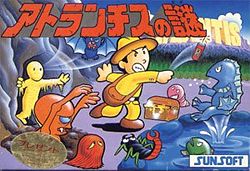
Atlantis No Nazo box art
Sunsoft is not in any way related to the short-lived SunSoft that was part of Sun Microsystems in America, but rather a subsidiary of Sun Denshi (or Sun Electronics) that entered the video game realm in the late 1970s. When the publisher/developer opened a branch in the United States it went under the title Sunsoft of America but the logo still remained simply “Sunsoft”. They developed mostly unknown games on arcades at that time: Arabian, Ikki, and Kangaroo – a weird hybrid of Donkey Kong and Popeye – but it wasn’t until the company moved to the NES that it really started making waves. Sunsoft developed arcade ports and original Famicom games in Japan, mostly odd titles that would never come out over here like Tokaido Gojusan-tsugi (English: Stations of the Tokaido), which is a side scrolling action platformer where you play Kintaro, a fireworks salesman and use fireworks as a weapon. Of the most famous is a kusoge (Japanese slang for cult video games that literally translates to “sh*tty game”) known as Atlantis No Nazo (English: Mystery of Atlantis), which has the player navigating an explorer through 100 levels of platforming. What most don’t know is that the hit detection is horrendous and the platforming physics are a crash course in masochism, not to mention the game doesn’t move linearly (ie: you don’t necessarily go onto level 4 when you beat level 3). Like most other games of the 8-bit era, a game over results in you completely starting over and the real aggravating part is that the game is completed by doing a sequence of about seven brutal stages in a certain order (including hidden warp zones). Without having the information from the onset, I’d safely declare this title impossible.
Know This Developer: Radical Entertainment

It was announced on June 28, 2012, that after careful consideration Activision decided to disband most of Radical Entertainment (on a recent episode of Giant Bombcast it was discussed that the rumored remaining staff was 12) and basically close the studio. Granted, although the logo may appear on future games and thus be an argument to the fact that the studio is still open, Activision states that Radical remains a support studio with no ability to develop its own games. Cynics want to blame Activision for setting inappropriate goals for the Prototype developer and we all tend to believe that the remaining Radical staff will be assigned to a Call of Duty in the future, but that’s a different discussion for a different forum. Instead, I want to touch on how Radical Entertainment came to be and the games it has contributed to the industry.
What is a Shmup?

For some reason, this screen from R-Type is always what I think about when I hear the word “shmup”.
It’s leap day, a day that on most years doesn’t even exist, and had it not been for today it would officially be March. For those of us in the retro gaming world, shooter fans or basically anyone who listens to Drunken Gamers Radio it also means Shmuppreciation month. For 31 long days we show our appreciation for intergalactic starships, Moai heads, tiered power-ups, sexy young girls with large breasts that aren’t involved in a hentai game, dodging thousands of bullets and actually seeing a vertical raster effect in a high-definition game. It is all for the love of the shoot ’em up, these days called “shmups” for short. What’s distinct about the shmup is that aside from most other genres, it has been around as long as video games themselves – yes, the first video game was a shmup – and has remained relatively unchanged for more than 30 years. As an avid fan with probably more than $1,000 in shmups alone among almost every system – did I mention the shmup has some of the most expensive games in existence? – I wanted to reflect on the history of the shmup.
Homebrew
It started predominantly with the Dreamcast, but for as long as consoles have been around “homebrew” make an appearance in one form or another. Nowadays it’s not uncommon to find a myriad of independently developed applications and games for consoles. Mind you, it does require you to hack your console – and these days that’s no simple feat and usually carries with it the risk of bricking¹. Once complete, a modded console with working homebrew can greatly improve the capabilities of your device – certain Wiis, for example, can play DVDs and MP3s as a virtual media machine that even accepts external hard drives via USB. There are plenty of dark sides to homebrew as well, including the inevitable piracy debate, and in some consoles the homebrew scene is almost laughable. This article will discuss what homebrew is, why it has been beneficial and the legalese dance any homebrew user must take.
Basement Beer
 I couldn’t find any direct correlation between the two, but most likely the name “homebrew” comes from the culture of brewing alcohol in one’s home that began wide popularity after it was made legal in most countries in the 1970s. Independent “brewers” would create wine, beer or grain alcohols in their homes using various materials and methods. It was said by these homebrewers that unique flavors were created via methods not possible in major distillers and breweries. Much like these basement libations, the homebrew scene on video game consoles stems from a similar background.
Homebrew is defined as a program or game created for specific hardware (the specifications of the home console they are developed for) by the community. In many cases these games are not authorized or licensed by the manufacturer of the console and at times aren’t even legal due to the use of protected materials and copyrights. It is possible to have legal software created on a development kit and authorized by manufacturers, but this is rare and has only seen mainstream success via Microsoft’s XNA program. From my experience homebrew either helps the pirating community open up the capabilities for a console to emulate games that never came to them, college students to get the most out of their device (the aforementioned turning a Wii into a DVD player) and hardcore fans of a dead console creating new and sometimes impressive games.
Bang For Your Buck
Video games are similar to several other hobbies, like comic books, that have two different worlds: collectors and players. Players, like comic book readers, are more concerned with the content rather than the value or potential value as items become old and/or rare. Collectors, in any form, are always concerned with several aspects like condition, completeness and rarity. In the case of retro gaming, the two worlds collide quite often, especially because plenty of rare games are also known for their amazing content. Fortunately digital downloads and re-releases have assisted in making former high-cost classics like Final Fantasy VII and Phantasy Star IV cheap and easy to get your hands on.
 Personally I am not much of a collector, despite the fact that I do have a decent collection, because I’m more interested in the game itself. My copy of Snatcher is not worth what others fetch on eBay – it has a large rental sticker all over it that someone attempted to remove (and failed) not to mention it had several surface scratches before I resurfaced it – but the game plays in my Sega CD nonetheless and I enjoyed it as much as any other gamer. Other than the games I bought new, many of the expensive games I have acquired don’t have cases, instructions or even labels. Although rare, there are even a few games that were so badly beaten they wouldn’t play but I was able to resurface or create backups because there was no copy protection on the console (I do not perform permanent hardware mods or install mod chips). I am a player and I’m not shelling out $150 for Snatcher. I want the largest amount of quality games I can get and my budget is limited, therefore I get what I can.
No matter how rough a game is (assuming it’s playable) or what format you get it in, there are always going to be minimum and maximum points at which to purchase games. It’s just not reasonable that you will ever find a copy of Snatcher for $20. When you’re out and about, it’s important not to get taken advantage of because like all collectible items, video games can suffer heavy mark-ups from those cashing in on the misinformed. Your best bet is to get a price guide, especially when you want to check if that copy of Final Fight Guy on SNES really is appropriately priced at $30. It’s also fun to look back at the classics and discover what games from the past became gems of the present. In addition you may discover that you own some of the top dollar products out there and cash in if times are tough. These higher value titles are also good trade value – I recently traded my second 32x console, which I thought was broken but just had the wrong AC adaptor, for most of the cost of a Turbografx-16 at a brick & mortar shop near me. It’s like the stock market, you want to consistently keep up with the trends so as to make the most out of your dollar.
Supplemental: Remembering the Sega 32X

In 1994, the 16-bit generation in America was dwindling and gamers were ready for the 32-bit generation to emerge. With discussions of interactive CD-ROM consoles, the emergence of early 32-bit CD consoles like CD-i and 3DO and everyone wanted to know what Sega and Sony had in store for the future. Super Nintendo was only three years into its life and riding strong while the Genesis was having a tougher time competing. Not only did its age (it’s two years older than the SNES) hinder it, but with the introduction of the failing Sega CD, the Genesis still didn’t have the kick it wanted. In early January 1994, Sega CEO Hayao Nakayama wanted a 32-bit cartridge console to be released that Christmas, codenamed “Project Jupiter” (Sega used planets for its projects). Sega shortly decided that CD-based technology would be better suited for this project and it was renamed to “Project Saturn” – it would later go on to be the Sega Saturn console that released in 1995.
Emulation: The Secret Multiconsole
On our most recent episode of The B-Team Podcast a listener wrote in to ask about whether or not we consider it right to emulate a game that was more than eighteen years old. While my rant was less than ideal, I felt it was time to discuss the often unwritten world of emulation. We will discuss what emulation is, reasons why it exists and what ethical and legal choices you may need to make prior to diving in.
What is emulation?
The word itself says it all: emulation. Emulation is defined as “the act of imitating” and that is precisely what emulation means in terms of video games: different hardware attempting to imitate other hardware. In the beginning this was limited to computers because they were the only format capable of re-creating consoles effectively, but lately this has been expanded to portable and home consoles. Thanks to most consoles having limited hardware due to cost issues, early consoles were capable of being emulated on computers of the day. This all changed starting with the 3D generation, consoles like the Playstation and Saturn and technical specs. Recent consoles like the Playstation 3 and Xbox 360 strip away the processing power core and have high-end graphical processors, which makes emulation on computers difficult. It is true that Crysis looks better on PC, but to have a PC try to re-create a Playstation 3 and then try to run the PS3 version of Crysis is just an overuse of resources and requires too much power to be worth it.

ePSXe enhances Playstation graphics
Dropping the Ban Hammer
Have you ever eagerly anticipated the release of a game only to find out it isn’t coming to the United States? Imagine if the reasoning wasn’t due to licensing issues or internal policies by the ESRB and console developers. Aside from Rapelay, a game I can barely give credit as a video game and was never intended to see a release anyway, I’ve never heard of a game that isn’t welcome in the US. It’s one of those great freedoms that we take completely for granted in this country – we don’t have our media banned or censored federally. This isn’t to say content isn’t stripped down, many of us remember Manhunt 2 getting an AO rating that rendered it unable to release on its intended platforms (PS2 and Wii). As a result, developer Rockstar released a “toned down” version that was approved with an M rating and saw retail release. The difference between this situation and the situation in other countries is that the industry self polices and decides what is allowed and what is not. Currently the major console manufacturers refuse to release AO titles, but that doesn’t restrict a developer from releasing on PC or an available platform. In some other countries, you’re given a stringent refusal to release your product after you’ve created it.
Converts
So now you want to import consoles and games, do you? Well you’ll be happy to know that it is entirely possible on most consoles, however there are some things you’ll have to be aware of before you do it. This article discusses the different things you have to do to both the electric and video signal of various imported consoles. It will also briefly discuss how to get foreign games to play on US consoles, if possible.
Electricity Differences
No matter what console you are using, it’s important to know the differences between electricity in the US, Europe and Japan.
Japanese Consoles in the US
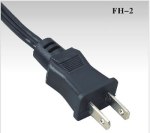 As you’ll see plenty of times in this article, Japan is quite similar to the United States in many ways, including power. We use 120 volts as our standard for power. Japan doesn’t appear to use a ground (or at least none of the Japanese consoles I’ve ever gotten do, never been to Japan itself), so all plugs from Japanese consoles will be two-pronged and fit in an US outlet. Also fortunate is the fact that most consoles, especially retro ones, will use AC adaptors that work in the US. Never interchange US power supplies into Japanese consoles, you could fry the console or worse. For example, if you import a Famicom, use that console’s AC adaptor and not an US NES one. For newer consoles like Japanese PS2s and PS3s, you may want to check the back of the console, but I think those are good for AC 100-240 volts for worldwide distribution, but I could be wrong. Basically if it generates heat, be very careful and do a search for advice from a reputable source (no, Yahoo! Answers is not a reputable source). Also if you want to be completely safe, there are Japanese voltage converters that allow use of Japanese products here.
 Gaming History 101