Archive for the ‘PS3’ Category
Quick Look: Bioshock
This month’s game club is none other than the 2K Boston (Irrational Games) 2007 release Bioshock. Unlike many of the games in our game club, it’s not the first time we’ve touched this game so instead of the usual banter we focus on gameplay elements, historical development context, and of course the slew of minutia that makes this nearly 7 year old game seem timeless. Due to a microphone balancing issue, my commentary is sometimes drowned out by the game’s audio
Review: Velocity (Ultra)
 Velocity is one of those games that I remember first trying on my PSP on long commutes between London to Cambridge and had I not played this game I probably would have gone insane with boredom. It released for the Playstation Network as a mini back in 2012 and then later given the HD make over and released for the PS Vita as Velocity Ultra.
Velocity is a space ship game that impressively mixes shooting, puzzles and speed all into one. Set in the year 2212 (which is rather clever as this game was released in 2012) the star Vilio has exploded causing a massive electromagnetic pulse (EMP) field, cutting the power in nearby colonies. You pilot the Quarp Jet, a teleporting spacecraft, and your job is to rescue survivors while also shooting down the invading aliens. The story is presented in nice little graphic novel style panels which are short and to the point. Velocity has fifty missions which are all pretty short – around five minutes, sometimes less – making this a perfect game for short bursts, but with its incredibly addictive nature it is very likely you will play much longer.

Podcast: Shmup Game Club

This week we are joined by listener Jason (@albirhiza) to discuss our Shmup Game Club: Giga Wing 2, Velocity (Ultra), Radiant Silvergun, Power-Up, and Sine Mora. Campaigns, tactics, high scores, and more are covered as we dissect some of the more contemporary additions to the genre.
Retro Review: Dead Space
 When you first read or hear about Dead Space, it may not seem to peak your interest as much as it should. In truth, Dead Space is an experience from start to finish. This game is going to suck you into a world that will literally take over your living room if you let it. Aside from that, the universe is big as well. You can currently pick up the graphic novel, telling the early story, and as of yesterday the animated movie also released, which tells of the events leading directly into the game. Couple that with the announcement that Dead Space 2 is officially in development and there’s no reason to skip this game.
In order to appreciate Dead Space, you want to play it at night, with surround sound (as sound seems like a bigger factor than visuals), and pair these factors with being alone. A high-def screen helps, but is in no way as necessary as surround sound for this game. From the very beginning to the tense ending, you will treat this game much like being the leader in a haunted house: at the edge of your seat.

Retro Review: DeathSpank
 Deathspank has been described as being like a myriad of popular games such as Diablo and Monkey Island, but while it does share similarities to these titles, Deathspank is its own game. What’s most impressive about it is the multitude of things to do in a download title. DeathSpank not only has a brilliant and hilarious script but the gameplay aspects offer enough variance that most gamers will be pleasantly pleased.
DeathSpank’s mission is simple: recover an ancient artifact that is appropriately named “The Artifact”. Along his quest DeathSpank will meet with plenty of other adventurers, townsfolk, and enemies. Like most action RPGs, the main quest is only a small part of the game that opens up the large world map, but there are plenty of side quests (115 quests in total) to explore. While they vary from the mundane – you’ll create the ultimate psychedelic lair for a talking tree in a series of fetch quests – to the unique – beating the crap (literally) out of demons – the one constant is that the game always remains funny. Designer Ron Gilbert is best known for his work with the Secret of Monkey Island and the recent Penny Arcade Adventures games and it definitely shows.
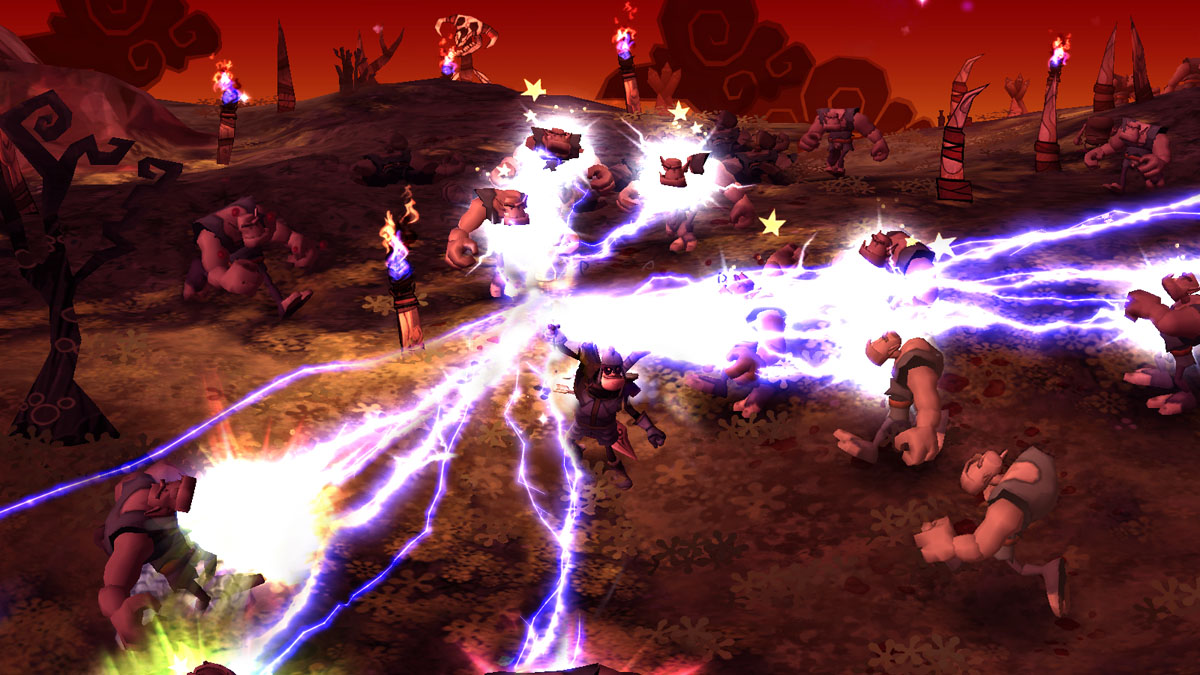 DeathSpank plays like a basic hack-and-slash title, the closest comparison I found was last generation’s Balder’s Gate series, complete with dungeon crawling (or rather cave crawling) and loot drops. This is where I feel the Diablo comparisons are inappropriate given the fact that DeathSpank lacks the variance and multitude of loot that made Diablo so addictive. While there’s plenty of goodies to be had, many of them are upgraded versions of weapons you found early on the game and by the end you can basically purchase an epic armor set from a street vendor. Still, it is great when you come across a cool new weapon or piece of armor that is much stronger than what you’re wearing and as expected, many make your character look ridiculous. I also like the fact that aside from questing or locked treasure chests, many of these items will be acquired from simply killing a random foe – don’t expect heavy loot drops from big enemies or bosses because you usually get nothing at all. The basic leveling system serves only to limit what weapons and armor you can wear at the time and I had to do some grinding on top of all the quests to reach the max level 20. You don’t need to be that high to beat any of the bosses, however, as none of them posed much of a challenge.
Retro Review: Call of Duty 4: Modern Warfare
 Call of Duty is going someplace that no other World War II shooter franchise has gone before: modern day in a fictional Middle East country. The follow up to last year’s lackluster Call of Duty 3 (created by sibling developer Treyarch), Infinity Ward is back with its iteration to the franchise and suffice to say this game is impressive. Modern Warfare comes with a slew of tactical contemporary guns, a gripping new plotline, and easily the most gorgeous graphics I’ve ever seen. Look out Halo, you very well may have competition.
From the first mission where you are literally dropped into, boarding and clearing a large freight liner in the middle of the ocean during a rainstorm, this game is faster and more covert. Previous titles in the series focused around being the hero in a clutter of large scale battles, whereas much of Modern Warfare deals with a covert black ops feel. The change comes with additional tools like night vision, a melee knife attack and a short-burst run that are all, quite frankly, badass. In addition the campaign feels more like a team effort, with each member chipping in to do their part. Mind you, the AI won’t beat the game for you, but I had several instances where a random enemy that jumped in front of me was popped off by a teammate.

Modern Warfare also integrates interactive scripted moments that make you feel even more like a black ops team behind enemy lines. Along with the impressive new graphics comes events that not only outline the horrors of war but really immerse you into a realistic experience. Without spoiling anything, lets just say you’ll never guess what happens half way through the campaign. The difficulty has also been tweaked a bit, dividing each difficulty with a much larger gap; you will immediately notice that normal difficulty doesn’t feel as tough as it did in COD 2 or 3, but the jump to veteran (hardest) seems wider. Regardless of what difficulty you play it on, it does seem that this game is on par with previous titles in terms of difficulty.
Know This Developer: Ubisoft Montreal

As I was looking into doing a history on this fantastic studio I came upon an excellent reference that was so good there’s no point in me doing one. While it’s easy to rag on big media conglomerates, IGN’s Mitch Dyer did a fantastic story of the origins of Ubisoft Montreal that includes stories of Splinter Cell‘s origin, the reinvention of Prince of Persia, and the visual treat that is Far Cry. It’s a fascinating story that documents the major franchises you can thank that studio for and a must read for gaming history buffs like ourselves. Head on over and check out House of Dreams: The Ubisoft Montreal Story when you can.
Retro Review: Afro Samurai
 Afro Samurai has identity issues. It’s not that the character does, anyone who has watched the cartoon series knows that Afro is quite aware of his personality to a fault. While the game works very closely with the cartoon series, despite the game’s claim in various moments to convince you it’s deterring from the original plot (a few major points are changed, but you have to know the series to catch them), the game itself doesn’t know what it wants to be. On the positive side, it does manage to sprinkle these various types of games in a relatively strong light.
Any fan of the series will feel right at home as Namco Bandai have captured the aesthetic feel perfectly. The original gritty feel of the anime allowed for a cell shaded game that literally brings the series to life, complete with the player controlling a living, breathing (and smoking) Afro Samurai. Couple this with a great mix of sound design and everyone’s favorite Samuel L. Jackson (voicing Afro’s loudmouth sidekick) making a mockery of both Afro and the player at the same time and the immersion is complete. That is, until you begin getting later in the game.
For starters, Afro Samurai is a short game; it took me probably five and a half hours to complete and there is no initial choice in difficulty. It starts off with a few levels of good old fashioned hack-and-slash gameplay, teaching you some moves here and there, and occassionally having you fighting a boss. I have to admit that while many people may find this repetitive, I felt right at home with the button mashing bloody mess that begins the game.

Shortly after that, in the quarry level to be specific, the game begins to deter from its original pattern and takes on several new qualities. Timing becomes very important as you enemies begin to learn how to consistently block, parry, and even throw you. Additionally you are forced to do things like split bullets in mid air and cut thick ropes that require a timed slash, which took me a while to figure out was connected to the controller vibrating. That is the one thing you’ll slowly learn about Afro Samurai, it consistently assumes you know things you’ve never been taught. More than a few times I’d confront a situation or a boss battle and wonder how the hell I was supposed to do it, and while it took everything in me not to consult a walkthrough, I found no sense of accomplishment when finally figuring things out. It usually ended with me loudly exclaiming, “Really? Really!” and then moving on.
Review: Strider (2014)
 Yet another in a long line of modern re-hashes on cult favorites, I went into Strider with a bit more optimism than than other titles to date. Aside from spruced up graphics the game appeared to be faithful to the arcade original, which my retrospective and the podcast last week contested is the best iteration of the series. Couple that with the development being handled by Double Helix – a very popular developer with success not only in Killer Instinct 3, but also was purchased by Amazon for an unannounced project – and the open map MetroidVania game design, things were shaping up to success. Having completed the game, I must admit that just like the anomaly of the original, Strider is a melting pot of prior series staples that gets it right from start to finish.

The scale of the overall world is massive and can be stunning.
If you sit still too long in the original arcade game, you will die. Best laid plans are to push forward (ie: to the right) and just attack anything in your path while trying not to fall off a ledge. In the new game that theme is aggressively applied with herds of enemies so thick they will literally be a blocking point for you at times in the game. As a member of the Strider clan, Hiryu is able to cut down most adversaries with the greatest of ease and the balance between enemy hit points and his acrobatic abilities result in a fast paced romp. I never had down time in Strider and felt like a masterful ninja with frantic but controlled moves as I navigated the game’s massive map. While I can concede to the basic MetroidVania label, I would say the game more closely resembles Rondo of Blood rather than the hybrid genre. Even when you have a full moves list at your disposal these hiding places are more off the beaten path rather than the wide open areas you uncover in other titles of the genre. What results is a game that is more linear than anything else, and despite it being a huge map the development team broke it up into different areas complete with a boss battle and new weapon at the core, so basically it’s just like having levels that you can return to. Strider is no stranger to this method of map design, the original NES title was quite similar and a small following prefer it to the traditional “run to the right” design of the arcade title. In the end I grew tired of looking too hard for too much because I was having such a blast following the marker to the next step of the main mission that I played it exactly like a linear game.

Two bosses on opposing sides are no problem for Hiryu.
 Gaming History 101