Retro Game Night: Night Slashers X
This week, and for the first time ever, we are using emulation to capture a Beats of Rage engine remake, Night Slashers X. This was originally a 1994 Data East arcade beat-em-up that got ported over with extra violence on the open source brawler engine, Beats of Rage. This also marks the first video in full 1080p HD! Watch for more HD videos, most of which should be in 720p or 1080p in the future.
Review: Bayonetta
 Platform: Xbox 360, Playstation 3, Wii U
Released: 2010 (360/PS3), 2014 (Wii U)
Developer: Plantinum Games (360), Nex Entertainment (PS3 port), Bee Tribe (Wii U port)
Publisher: Sega (360/PS3), Nintendo (Wii U)
Digital Release? Yes, this game is available on all released platforms digitally
Price: $7.59 (disc only), $11.24 (complete), $14.99 (sealed) per Price Charting
Bayonetta is an anomaly. It succeeds where many before it have failed. Merging a Japanese style video game in every sense of the word, whimsical plot, a female sexually independent dominatrix lead, and incredible gameplay that attracts both Eastern and Western fans alike. It is a true testament to the fact that if you bring a bunch of ideas together, no matter how outlandish, and they all remain consistent with an overall theme then more can definitely be better. The first major release from Platinum Games knocks it out of the park, provided you don’t play the PS3 version.
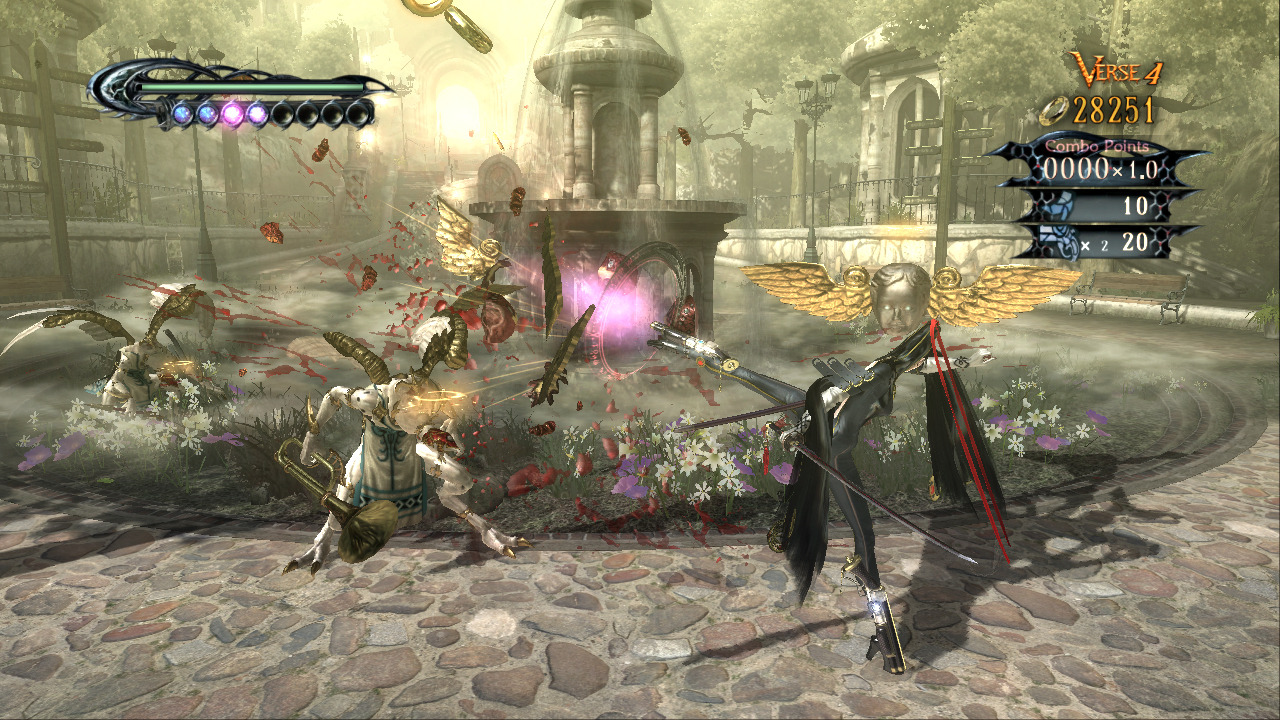 Bayonetta opens in the fictional town of Vigrid where an endless battle is being fought between light and dark wages on. Representing the light are the Lumen Sages and representing the dark are the Umbra Witches, and right off the bat this game turns the tables on you by revealing that your lead character, Bayonetta, is an Umbra Witch. Not that the light is portrayed in a particularly positive way – all of these “angelic” creatures don halos as well as aggressive weapons, massive sizes, horrific appearances, and an affinity for causing death. As Bayonetta you will trek across areas that vary from natural modern cities to metaphysical interpretations of heaven, purgatory, and hell, all with help from the game’s handful of unique characters that add some spark to Bayonetta’s lone wolf demeanor. That’s not to say you’ll be swapping who you play as or that there’s a multiplayer component – because you won’t and there isn’t – nope, all of these cast members merely break up the monotony of the typical “hero on a quest” formula. It’s all a good fit for an entertaining story, but that’s only the half of it because from both a plot and gameplay perspective Bayonetta herself has plenty of depth.
Podcast: Ah Ah Ahhhhh
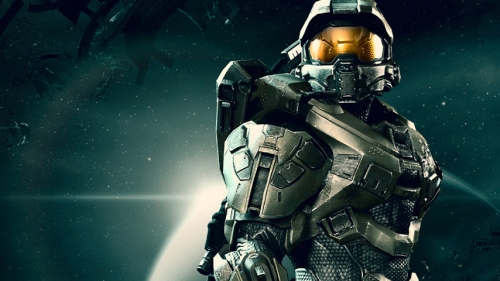
This week Fred and Jam are discussing the misadventures of Master Chief, at least in terms of the Bungie developed ones. What started out as a Real Time Strategy (RTS) title for the Mac ended up ironically being the launch title for the Microsoft Xbox that has withstood the test of time and is to this day one of the strongest properties in gaming.
Neo Retro: Chief’s Big Day
 This morning I got up and instead of immediately heading to work I dropped by the old big box retailer to pick up a title I had been highly anticipating: Halo: The Master Chief Collection. Here on the left you can see a photo of me with the item, big dumb smile in tow. It’s kinda surreal picking up a collection of games that you have already played. None of that wonder of what the mechanics, game design, or story remain because you’ve experienced it all before, and yet I find myself just as excited as I was the day I first picked up a copy of Halo or the three sequels that share space on the disc. If you’re not a Halo fan then you probably won’t pick this up, and I expect that there will be either a slew of negative talk or more likely no talk at all regarding this package, but mark my words this is going to be a popular release. Whether you first started playing Halo at college LAN parties, shared one of the earliest experiences on Xbox Live, or just took Master Chief for a spin or two during the Halo 3 Beta zeitgeist that existed early in the 360’s life cycle (and you can hear about many more on tonight’s podcast), there’s no denying that those who have owned Microsoft consoles can’t help but notice Halo. That’s when it got me thinking about the state of re-releases these days – especially on this generation of consoles – and how as hard as I try to avoid them, I just can’t help buying into them (literally).
The Master Chief Collection isn’t the only game to make an updated appearance this year. Tomb Raider received its re-release early into the year, followed by Fable Anniversary giving that game an update no one asked for, Resident Evil 4 got a third revision on the PC bringing it to 1080p, Final Fantasy X/X-2 received face lifts, Metro 2033 and Last Light received semi-controversial reduxes, The Last of Us came to PS4 after only having been on retail for just over a year, Sleeping Dogs got the Square “definitive” treatment in October, and we can expect GTA V next week. This doesn’t even touch the slew of portable and downloadable games that were “HD-ified” and who knows how many ports I’m not considering to be actual re-releases to the PC, Xbox One, and PS4. Hell, I even dropped a dozen hours re-playing Bayonetta on Wii U (review Thursday) because the sequel came with it. It’s kinda hard to argue that this whole retro thing may have been the correct route to go because it seems clear that whether audiences want it or not, what’s on store shelves is at least partially games you already know. The big question is whether or not this is a good thing.
Figuring Out How Retro Game Videos Can Look So Good
So recently I’ve been looking at the current YouTube videos we create for the site as well as some of the photos I capture from those videos. You see due to authenticity of how it feels to play the game – not to mention my personal affinity towards doing too much within a computer for console gaming – it’s not very viable for me to emulate. In truth there’s little concern for the legal aspect or even the technological aspect, it’s just that playing an emulated game on an HDTV comes with it compatibility issues, screen tearing, and lets not forget the overwhelming feeling that no matter what controller you use it doesn’t feel the same as plugging that actual controller into that actual console. As a result, most of the gameplay videos I see out there focus on either how good it looks or how good it plays, but rarely does it look at both. There’s quite a few reasons for that, I discovered, and for my weekend project I set out to figure out how one gets these razor sharp awesome videos when compared to my relatively blurry ones.
 The reason for this is a few things, but they all have to deal with the fact that Standard Definition TVs (SDTV) are very different than High Definition TVs (HDTV) and none of that matters until you try to adapt retro consoles (SDTV) to YouTube (HDTV). It may look fine on my screen but it looks like crap when you pull that video up on your TV. How do you fix that? Well it depends on the console and your ultimate goal. Video game systems had an output in either 240p (320×240 progressive), 480i (640×480 interlaced), 480p (640×480 progressive), 720p (1320×1080 progressive), 1080i (1920×1080 interlaced), and 1080p (1920×1080 progressive). For the most part, anything before the PS2/Xbox/Gamecube was in 240p/480i (more on that in a sec), PS2/Xbox/Gamecube was mostly 480p (with some potential 720p for the Xbox and lack of 480p for Gamecube), and then the Wii was 480p with the 360/PS3 being either 720p/1080i/1080p. In terms of a YouTube video or contemporary HDTVs, you want to immediately omit the interlaced resolutions because those only illuminate half of the image at once and blink back and forth, so they create scanlines (which HDTV signals and Youtube do not like or display) and make a choppy effect when things move. While that’s no problem for the modern consoles because you can just omit 1080i and only use 720p or 1080p, you may notice that’s a big problem for retro consoles. 240p is available, but often not right out of the gate (you ever see a 240p/RGB output on a retro console?) and most of us (in the US) hooked our old school consoles up to our televisions with the lovely composite cable (yellow/red/white). This made a 480i image out of a 240p image, which means it not only made the image look poor and blurry because it increased the resolution without increasing the pixel count, but it also removed the progressive scan and thus made scanlines and choppiness. This is the key problem to 99 percent of the game capturing I do.
Podcast: Ripto – Trilogy of the Dragon
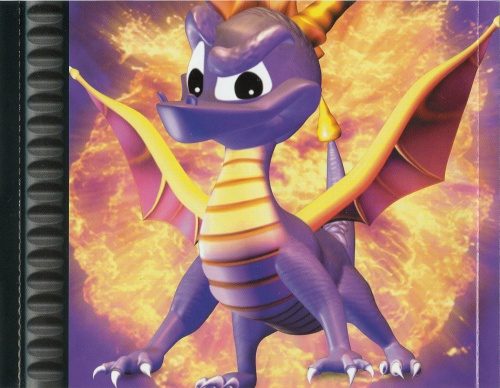
In a widely requested topic, this week Jam and Fred discuss the Spyro the Dragon trilogy on PS1. After briefly telling the story of the origins of developer Insomniac, the guys delve deep into the young dragon that played one of the only open world 3D competitors to Nintendo’s Super Mario 64.
Review: Phantasmagoria: A Puzzle of Flesh
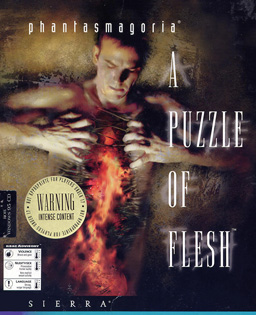 Also Known As: Phantasmagoria 2, Phantasmagoria II: Fatal Obsessions (European title)
Platform: DOS/Windows PC
Released: 1996
Developer: Sierra
Publisher: Activision
Digital Release? Yes, on Good Old Games (gog.com) for $5.99 (compatible with Windows XP, Vista, 7, and 8 only)
Price: $4.44 (5 discs only), $32.99 (complete), $69.00 (sealed) per Price Charting
Phantasmagoria, besides being a franchise with one of the most awesome names ever, is a psychological horror full motion video (FMV) game – a genre that was a hugely common in the 90’s thanks to the use of CD-ROMs as media. A Puzzle of Flesh is the sequel to the controversial original. Why was it controversial? Well, the original featured a crazy amount of graphic content including horrific death scenes for characters and adult scenes which caused quite the stir back in the day when it was released. This included sexual content and a rape scene, which is possibly not as controversial as the media makes it out to be. The sequel follows this trend, but on its own controversial level entirely. Being released just a year after the first game it was surprising to see this game did not receive the same attention as the original.
 You play Curtis Craig, a man who loves his pet rat ‘blob,’ his girlfriend Jocilyn, and his taste in grey pocket t-shirts because he never seems to change his grey pocket T throughout the entire game. He’s living the American dream. Curtis has also been out of a mental hospital for a year and creepy things start to go down at his home and work at the suspicious WynTech Industries Corporation. Curtis very quickly starts to question his sanity, so it’s up to him to find out what’s going on or face another trip to the loony bin. It’s certainly a story I’ve not seen in a game before and contains a surprising amount of twists that most won’t see coming.
Review: Phantasmagoria
 Platform: DOS/Windows PC, Sega Saturn (only in Japan as Phantasm with Japanese text/subtitles)
Released: 1995
Developer: Sierra
Publisher: Sierra
Digital Release? Yes, on Good Old Games (gog.com) for $9.99 (compatible with Windows XP, Vista, 7, and 8 only)
Price: $7.50 (7 discs only), Complete not available, $20.49 (sealed) per Price Charting
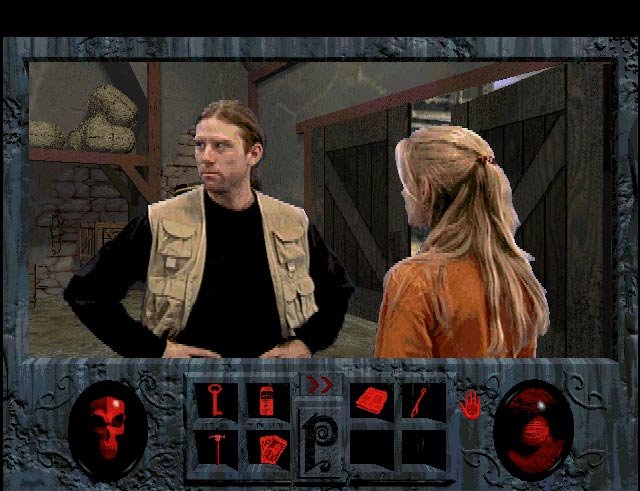 In the mid 90s a change was afoot, especially on PCs: the compact disc (CD). Once CD-ROM drives were introduced to gaming technology and the 1.44 MB floppy disk was replaced by the 650 MB CD, you could create massive experiences without so much as a care as to how big your code was. In fact, developers cared so little that blatant wastes of space were created in the form of both full motion video (FMV) titles and multi-disc experiences that had voice integration and usually the first few hundred MB of each disc contained the same coding. I can’t think of any bigger example of this than the point-and-click FMV title from Roberta Williams (she made King’s Quest), Phantasmagoria. Weighing in at 7 full CDs (8 on the Japan-only Saturn version), you basically change discs at the end of each day in the game and the whole week tells a chilling tale not unlike Stephen King’s The Shining. With full video laughably integrated into computer generated images, lackluster gameplay, and a the goriest scenes ever portrayed in a game at the time, Phantasmagoria is a sight to behold.
Podcast: Silent Hill 3 Revisited
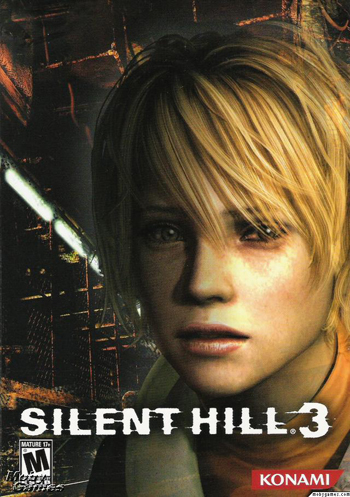
Ever since the 10/01 episode “Silent 3vil” released, we felt one thing was severely missing: everyone’s impressions on Silent Hill 3. In honor of Halloween Fred, Jam, and Vos all got together 30 days later and had a little round table discussion about what we appreciate about the third and final Team Silent installment in the series.
Please Note: This episode is a follow-up to an earlier episode this month (Silent 3vil).
Retro Game Night: New Ghostbusters II, DecapAttack, and Kid Dracula
This week’s late Retro Game Night features the Famicom title New Ghostbusters II by HAL Laboratories (they made Kirby and Lolo), DecapAttack for the Genesis, and finally the Famicom version of Kid Dracula.
 Gaming History 101