Posts Tagged ‘nintendo’
Review: Adventure Island (NES)
 Console: Nintendo Entertainment System (NES)
Released: 1988
Developer: Hudson Soft
Publisher: Hudson Soft
Famicom? Yes (as Takahashi Meijin no Bouken Shima)
Instruction Manual: Not necessary – Link
Difficulty: Easy
Played it as a child? Yes
Value: $4.75 (used) $100.00 (new) (pricecharting.com)
Price (eBay): $8-$15 (used) $600 (new)
Digital Release? Yes – Virtual Console (NES version) – $5.00
What Are You Supposed To Do?
Much in the same vein of Super Mario Bros., your goal is to navigate caveman Master Higgins through various levels and avoid enemies along the way. You can collect weapons that are used to kill enemies, lots of platforming sections, and a boss battle completes the third or fourth level of each “world”.
Review
I know I’m going to get some criticism saying that Adventure Island is easy, but it very much is. Even as a child it didn’t take long to see the ending and the lass boss had a very simplified pattern that I could quickly learn. That doesn’t prevent this title from being one of the best games and series to grace the NES and anyone who hasn’t played Hudson’s classic platformer should make this a must play. After having its name proudly on most top 100 and even a few top 10 lists for the NES, not to mention the millions in sales it achieved when it came out, this game is what you look for in an NES title.
Review: 1942 (NES)
What Are You Supposed To Do?
As far as shooters go, this is as simple as it gets. You need to navigate your plane and shoot down all other planes. You are given 3 lives and can collect power-ups for your guns as well as assistant planes. In a pinch, the A button can be pressed to make you temporarily invulnerable. You have 32 missions, each one the goal is to go from beginning to end without dying.
Review

Review: Abadox (NES)
 Console: Nintendo Entertainment System (NES)
Released: 1990
Developer: Natsume
Publisher: Milton Bradley
Famicom? Yes (as Abadox)
Instruction Manual: Not Necessary – Link
Difficulty: Insane
Played it as a child? No
Value: $0.87 used $34.99 new (pricecharting.com)
Price (eBay): Couldn’t find a listing
Digital Release? No
What are you supposed to do?
You control Second Lieutenant Nazal through various levels in a side-scrolling and top down vertical view shooter. Various aliens and creatures will enter the screen in an attempt to shoot you down with bullets or by colliding with you. In addition the level itself will feature obstacles that jut out of the walls, block your path with destructable walls that regenerate and create small pathways you must navigate. Throughout levels you can collect weapons and power-ups that assist you in overcoming enemies and obstacles.
Review

Review: 1943: Battle of Midway (NES)
What Are You Supposed To Do?
This is one of the earliest versions of the vertical shoot-em-up where enemies approach from the top and sides of the screen and attack the player, who is usually located at the bottom. Your goal is to shoot the planes out of the sky, avoid being shot yourself and prevent your energy from depleting completely.
Review
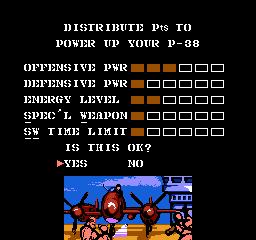 As a follow-up to 1942, 1943: Battle of Midway places you in the pacific theatre of World War II during the battles at Midway Atoll. I always felt that this was the more popular of the two titles, but in most cases the arcade version was ported and re-released whereas the NES version is a bit different. For starters you get to tweak and improve your stats, allowing you to improve your plane and abilities in future levels. There are also more diverse enemies and bosses that weren’t present in the arcade and I personally feel the levels are longer, although I can’t confirm that. At first it may be difficult to figure out why you fail a mission in 1943 and you will fail missions time and time again because the game is of the hardest shooters on the platform. You not only need to keep up with the planes and bullets, but also your energy meter in the lower right corner – if it depletes, you crash. All kinds of things deplete your energy from what I can tell: it naturally drops with time, every time you get shot and every time you use a charged attack. Like all titles of this genre, power-ups will drop from certain enemies that can restore your energy, give you a new weapon or increase your number of special attacks.
10-Yard Fight Review
What Are You Supposed To Do?
Much easier to understand than most games of the era, 10-Yard Fight is a simple football simulation. Your goal on the offense is to run the punt return as far as possible without getting bogged down by the defense attacking you. During a punt return your players will surround you phalanx-style and allow you to get as much yardage as possible before getting tackled. When on the offense you can run or pass the ball and attempt to score a touchdown. On defense, you select one of two defenders with either A or B and attempt to sack the quarterback or person in control of the ball.
Review
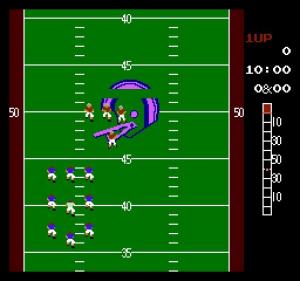
They’re moving at a snail’s pace, but go on, scream “Go! Go! Go!” anyway. You know you want to.
Full disclosure, I suck at football games. Having said that, I understand even the more complex rules and plays in the game so I haven’t had much issue with football titles like Madden, but I’m never any good at them. Thanks to varied difficulties, a surprise for me, I was able to play against a “high school team” instead of the “professional team” or “Superbowl team”. Not only were these descriptors amusing ways to select how hard the computer-controlled opponent would be, but it allowed me to actually win at a football game. Being a very early football sim, the simplicity of 10-Yard Fight is also the key to its addictive gameplay.
Review: Friday the 13th
 Console: Nintendo Entertainment System (NES)
Released: 1988
Developer: Pack-In-Video
Publisher: LJN (Acclaim)
Famicom? No
Instruction Manual: Helpful – Link
Difficulty: Hard
Played it as a child? Yes
Value: $2.57 (pricecharting.com)
Price (eBay): $5-$10 (used) $100.00 (new/sealed)
Digital Release? No
What are you supposed to do?
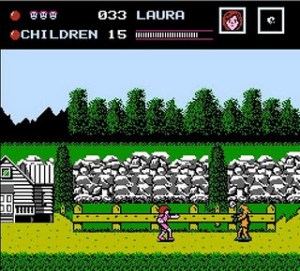
Survive three day/night cycles while attempting to kill Jason. You are given six camp counselors, three boys and three girls, each with one of three template play styles. At random moments throughout the game Jason will attack another counselor, a group of the 15 children you are watching, or the counselor you’re currently playing as. If he attacks another counselor or children, you have to find the cabin they are in and fight Jason. If he attacks you, fight him and stay alive. In order to eliminate Jason each day his life must be depleted, which requires the use of either the machete, torch or axe (technically you could probably do it with the rock or the knife, but it would take so long I wouldn’t recommend it). To assist you on all three days you can find Jason’s hidden lair in the cave, fight his mother and receive a crucial item for the day. On the first day you get a machete, on day 2 you get the sweater (which reduces damage from Jason by half) and on day 3 you get the pitchfork, which permanently kills him. You will need to light fireplaces in big cabins with the lighter to move events forward.
Super Mario Land 3D: Not Your Father’s Mario
While I’m perfectly capable of giving a review of this title, its merits and setbacks hold more value to me in a comparison to the series as a whole instead of a single title of the generation. This is not a retrospective either, I’m more than happy to compare the timeline of the series if my content slims to that point.

We’re Sorry, but Your Princess is in Another Castle
As a gamer who has been conquering Bowser Koopa – back then we called him “King Koopa” – in 1987 when I unboxed my first NES, the Super Mario franchise is as dear to me as gaming. Needless to say that for better or worse, I have at one time or another owned every Nintendo console and thoroughly completed any part of the Super Mario platforming series. As the years carried on I grew older and more mature, as did the Super Mario series. One thing always remained consistent: each new release on a Nintendo platform played to the strengths of the hardware. Super Mario Land 3D is no exception; it thwarts bold statements that the 3D hardware doesn’t enhance a game just like Super Mario Galaxy did for motion controls on the Wii. It is not, however, Super Mario Bros. 3 meets Super Mario Galaxy, not in the least.
Generation Gap: Import Edition
So you’ve decided you may be interested in this import scene, huh? You may want to see what the other regions have to offer? Perhaps you just don’t know what’s out there and you’re just curious. Well here you go – a wrap-up of some of the most popular consoles overseas that didn’t quite it over here.

Sega SG-1000 – Released in: Japan, Europe – Launch: 1983
Sega and Nintendo have been up against each other since day one, literally. While we didn’t see the NES over here until at least 1985, Sega’s first console, the SG-1000, released day in date alongside the Famicom (NES) in Japan. A cartridge based system that had nearly identical hardware to the ColecoVision, Sega’s first outing is most notable for having a solid Donkey Kong clone (Congo Bongo) and some of Sega’s top arcade titles. I’m fairly certain that Flicky made its first home appearance thanks to the SG-1000 as did Monaco GP.
Day 11
On the eleventh day of Christmas my memories gave to me…
11 Different Gameboy Advance Colors!

Gameboy Advance (GBA) was not the first console to offer multiple colors. In fact, it wasn’t even the first Nintendo or even Gameboy console to do so, but it definitely was the first to push variety. Releasing with seven initial colors, the GBA created the first Christmas where it wasn’t just about getting the right portable for your child, but also the right color. Of course the really popular ones, fuchsia and arctic come to mind, were the first to sell out and the most common, indigo, was the only color left in every retail outlet. Not only did they feature various normal colors, but limited edition colors were offered worldwide, creating a high demand to grab all the various rare (and expensive) GBAs for collectors.

I’d love to say that I’m not guilty of this, but back in 2001 when I went out to purchase a GBA with my Christmas money I hunted at a bunch of stores and didn’t buy the portable for 2 weeks because I didn’t like any of the colors I found. My heart was set on the midnight blue color, which I later discovered was only available at Toys R Us and had its horrendous logo above the screen. I quickly settled for one in glacier, but not before finally finding a midnight blue – in hindsight I probably could have made some money re-selling that thing.
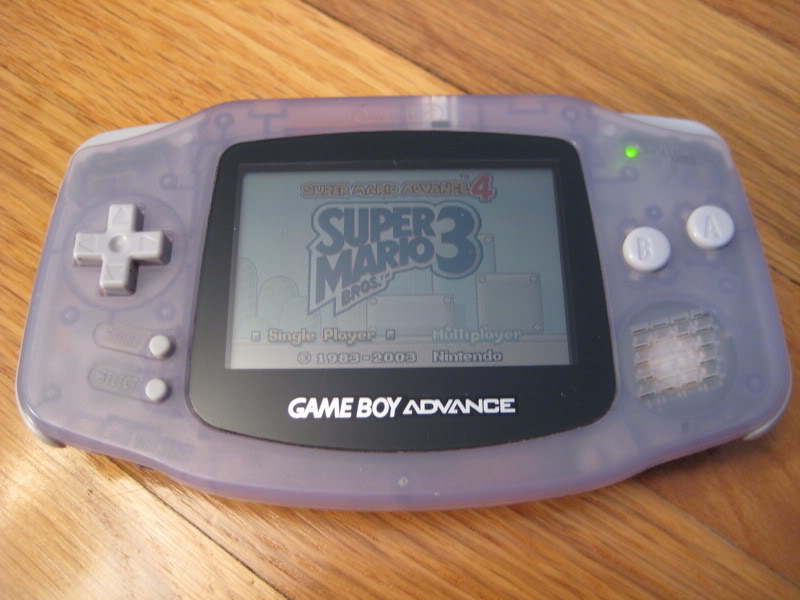
I still think fondly on those times, despite the fact that the GBA would start the trend of console iterations – the GBA SP being such an improvement over the original I couldn’t help but pick it up as well. Anytime I go to a used game store I always browse the GBA consoles for that random shot I could get my hands on the limited Japanese clear orange or spice colors. I think it was the only console cycle where I never had to hunt for a specific game but I always had to hunt for a specific colored console.
Day 4
On the fourth day of Christmas my memories gave to me…
Four AA Batteries!

I know they don’t look like much, but these little capsules of power are responsible for oh so many smiles and tears to gaming children. In the early 90s, everyone wanted a portable gaming system of some kind – Gameboy, Tiger handheld, maybe even an Atari Lynx – and they all had one thing in common: they needed batteries. Stories of whether or not any of these devices came with batteries are often passed around anecdotes of suburban myth, but regardless of that fact no child could survive Christmas weekend on one set of batteries alone. I know for a fact that the Gameboy did come with batteries, but any of the others is anyone’s guess. Either way, it was the beginning of a time where frantic holiday shopping parents coming to terms with $100 price tags were greeted with reminders to purchase bundles of batteries and most passed. Then on Christmas morning these parents realized how poor a choice that was.
 Nothing ruins a parents day like getting children a new toy, an electronic toy no less, that cannot run. In many cases the portable console would be the only thing they received for Christmas, and if not then various games may be the only other gift(s). As expected, there was almost nothing open on Christmas day – in 1990 in the suburb of Chicago I grew up in there weren’t even 24 hour Walgreens or gas stations nearby that opened on Christmas. If you didn’t have batteries and needed them, you were essentially screwed. Thankfully most remote controls used AA back then rather than the AAA they use now so it was a scavenger hunt for anything with a remote. If you were lucky enough to snag all 4 AAs, however, the batteries in those remotes were probably on the verge of death because the same type of parent that didn’t buy batteries at Christmas were also the kind that didn’t replace them until the remote was near death for at least a month. If you were lucky you got an hour out of the device before it died again. In the end it was a lesson that parents quickly learned, but the child gamer paid the price.
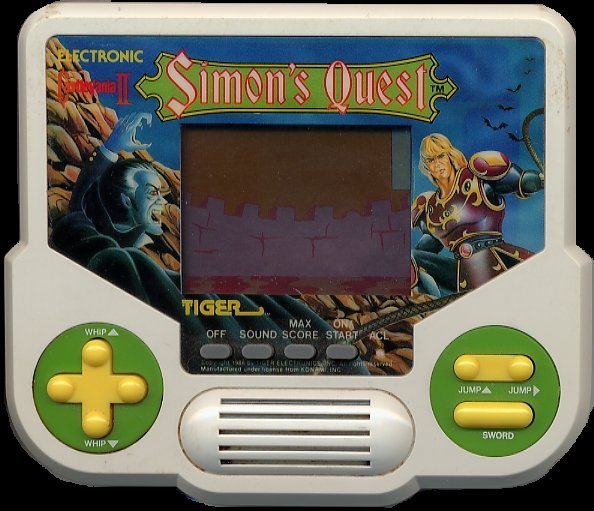
Thankfully by 1995 most stores and parents knew the best option was a rechargeable battery pack, AC adaptor, DC adaptor, or even a kit with everything for a low price. In fact, by 2000 many of the available versions in stores were bundles that included said kit as a way for the store to generate a profit on the console sale (if you’re unaware, most retailers make no profit on the sale of a console itself). Thankfully my parents also learned this lesson, but I still remember getting handhelds I couldn’t play right out of the box.
 Gaming History 101