Posts Tagged ‘nes’
Review: Abadox (NES)
 Console: Nintendo Entertainment System (NES)
Released: 1990
Developer: Natsume
Publisher: Milton Bradley
Famicom? Yes (as Abadox)
Instruction Manual: Not Necessary – Link
Difficulty: Insane
Played it as a child? No
Value: $0.87 used $34.99 new (pricecharting.com)
Price (eBay): Couldn’t find a listing
Digital Release? No
What are you supposed to do?
You control Second Lieutenant Nazal through various levels in a side-scrolling and top down vertical view shooter. Various aliens and creatures will enter the screen in an attempt to shoot you down with bullets or by colliding with you. In addition the level itself will feature obstacles that jut out of the walls, block your path with destructable walls that regenerate and create small pathways you must navigate. Throughout levels you can collect weapons and power-ups that assist you in overcoming enemies and obstacles.
Review

Review: 1943: Battle of Midway (NES)
What Are You Supposed To Do?
This is one of the earliest versions of the vertical shoot-em-up where enemies approach from the top and sides of the screen and attack the player, who is usually located at the bottom. Your goal is to shoot the planes out of the sky, avoid being shot yourself and prevent your energy from depleting completely.
Review
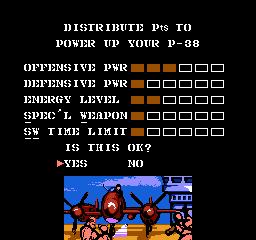 As a follow-up to 1942, 1943: Battle of Midway places you in the pacific theatre of World War II during the battles at Midway Atoll. I always felt that this was the more popular of the two titles, but in most cases the arcade version was ported and re-released whereas the NES version is a bit different. For starters you get to tweak and improve your stats, allowing you to improve your plane and abilities in future levels. There are also more diverse enemies and bosses that weren’t present in the arcade and I personally feel the levels are longer, although I can’t confirm that. At first it may be difficult to figure out why you fail a mission in 1943 and you will fail missions time and time again because the game is of the hardest shooters on the platform. You not only need to keep up with the planes and bullets, but also your energy meter in the lower right corner – if it depletes, you crash. All kinds of things deplete your energy from what I can tell: it naturally drops with time, every time you get shot and every time you use a charged attack. Like all titles of this genre, power-ups will drop from certain enemies that can restore your energy, give you a new weapon or increase your number of special attacks.
10-Yard Fight Review
What Are You Supposed To Do?
Much easier to understand than most games of the era, 10-Yard Fight is a simple football simulation. Your goal on the offense is to run the punt return as far as possible without getting bogged down by the defense attacking you. During a punt return your players will surround you phalanx-style and allow you to get as much yardage as possible before getting tackled. When on the offense you can run or pass the ball and attempt to score a touchdown. On defense, you select one of two defenders with either A or B and attempt to sack the quarterback or person in control of the ball.
Review
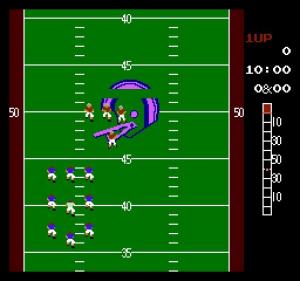
They’re moving at a snail’s pace, but go on, scream “Go! Go! Go!” anyway. You know you want to.
Full disclosure, I suck at football games. Having said that, I understand even the more complex rules and plays in the game so I haven’t had much issue with football titles like Madden, but I’m never any good at them. Thanks to varied difficulties, a surprise for me, I was able to play against a “high school team” instead of the “professional team” or “Superbowl team”. Not only were these descriptors amusing ways to select how hard the computer-controlled opponent would be, but it allowed me to actually win at a football game. Being a very early football sim, the simplicity of 10-Yard Fight is also the key to its addictive gameplay.
Review: Friday the 13th
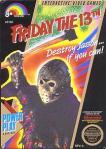 Console: Nintendo Entertainment System (NES)
Released: 1988
Developer: Pack-In-Video
Publisher: LJN (Acclaim)
Famicom? No
Instruction Manual: Helpful – Link
Difficulty: Hard
Played it as a child? Yes
Value: $2.57 (pricecharting.com)
Price (eBay): $5-$10 (used) $100.00 (new/sealed)
Digital Release? No
What are you supposed to do?
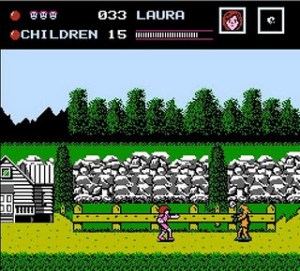
Survive three day/night cycles while attempting to kill Jason. You are given six camp counselors, three boys and three girls, each with one of three template play styles. At random moments throughout the game Jason will attack another counselor, a group of the 15 children you are watching, or the counselor you’re currently playing as. If he attacks another counselor or children, you have to find the cabin they are in and fight Jason. If he attacks you, fight him and stay alive. In order to eliminate Jason each day his life must be depleted, which requires the use of either the machete, torch or axe (technically you could probably do it with the rock or the knife, but it would take so long I wouldn’t recommend it). To assist you on all three days you can find Jason’s hidden lair in the cave, fight his mother and receive a crucial item for the day. On the first day you get a machete, on day 2 you get the sweater (which reduces damage from Jason by half) and on day 3 you get the pitchfork, which permanently kills him. You will need to light fireplaces in big cabins with the lighter to move events forward.
Converts
So now you want to import consoles and games, do you? Well you’ll be happy to know that it is entirely possible on most consoles, however there are some things you’ll have to be aware of before you do it. This article discusses the different things you have to do to both the electric and video signal of various imported consoles. It will also briefly discuss how to get foreign games to play on US consoles, if possible.
Electricity Differences
No matter what console you are using, it’s important to know the differences between electricity in the US, Europe and Japan.
Japanese Consoles in the US
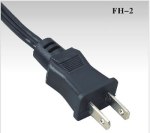 As you’ll see plenty of times in this article, Japan is quite similar to the United States in many ways, including power. We use 120 volts as our standard for power. Japan doesn’t appear to use a ground (or at least none of the Japanese consoles I’ve ever gotten do, never been to Japan itself), so all plugs from Japanese consoles will be two-pronged and fit in an US outlet. Also fortunate is the fact that most consoles, especially retro ones, will use AC adaptors that work in the US. Never interchange US power supplies into Japanese consoles, you could fry the console or worse. For example, if you import a Famicom, use that console’s AC adaptor and not an US NES one. For newer consoles like Japanese PS2s and PS3s, you may want to check the back of the console, but I think those are good for AC 100-240 volts for worldwide distribution, but I could be wrong. Basically if it generates heat, be very careful and do a search for advice from a reputable source (no, Yahoo! Answers is not a reputable source). Also if you want to be completely safe, there are Japanese voltage converters that allow use of Japanese products here.
Day 9
On the ninth day of Christmas my memories gave to me…
A 9-in-1 Game Cart!

My father was born and raised in Costa Rica (hence why I’m half Costa Rican), but I was pretty young for the first family vacations back “home”. Near the end of the NES era, a bunch of family members on my mother’s side as well as my immediate family celebrated Christmas in Costa Rica. There were lots of subtle differences to American culture there, but none more interesting to me than imported knock-offs. If you were to enter little toy shops in and around central hub city San Jose, you could expect to see items cheaply made and imported from Asia. I still remember the Teenage Mutant Ninja Turtles figures I picked up (all 4 for about $15) that had Chinese all over the box and looked a bit off-center with its paint job. They all broke by the end of the trip. There were also video games, of course, and I couldn’t help but check them all out.
For like $50 there was an NES that was painted all silver, more boxy (I later discovered it was the Famicom design) and had controllers and a zapper permanently wired into them. Not only that, when you turned it on it had 101 games built-in, which I didn’t pick up because I had an NES already and this console wouldn’t work with cartridges. What I also saw was a slew of “x-in-1” cartridges that contained some of the console’s best games all together. It was old school pirating at its best – take a bunch of smaller older games and thanks to new technology put them all into a single cartridge and sell them in foreign countries. I remember buying one for my NES, probably a 76-in-1, that I could have sworn had 76 individual titles but I later discovered there were only like seven games repeating on a list with different names. I also bought a Game Gear 9-in-1 (pictured above) for my buddy, which was amazing because it contained Sonic the Hedgehog and a handful of arcade ports. I wasn’t really trying to be kind, but it was like $20 and I used to love borrowing his Game Gear, now I gave him a reason to be forthcoming with it.
This trend would continue in gaming moving forward to as recently as this generation with Sonic’s Ultimate Genesis Collection and several others. In addition, I still see 30-in-1 Genesis systems and 50-in-1 Atari systems for roughly $30 at Walgreens, which are now legal items that these respective companies have approved. As is the case with most collections, they were as much a double-edged sword then as they are now. You have so much selection that you barely spend any time with a single game and never accomplish much other than beating the first level of each title before the system eventually dies. Costa Rica gave me lots of great memories and views, but it was also my first glimpse at how bad small countries got it in the video game market. No wonder the Master System and Genesis were so big in Brazil. Any one out there have some crazy unlicensed all-in-one pirate games?
Day 1
On the first day of Christmas my memories gave to me…
A Wish List Catalog from JC Penny!

Catalogs are definitely not the rage today. Most likely those still utilizing them are the technologically inept or those that just cannot release their grasp on the past. In the 80s and 90s, however, these little guides were responsible for hours of enjoyment to me and my fellow gamers. If you were a good enough customer of certain departments stores – namely JC Penny, Sears and Montgomery Ward, although I’m certain there were others – a massive 500+ page catalog would adorn your mailbox around the end of November. Within it was a virtual form of pretty much everything available in that specific department store, including video games. I used to love going to department stores and bask in the glory of the video game section. There would always be a line of youngsters like myself, all bundled up and overheating in winter coats, affixed to whatever the demo game was. Unfortunately, being only like eight years old, going to the department store or toy store to peruse the video game aisle was not something my mother would do at my beckoned call. On the other hand, the various department store catalogs were always available and waiting on my family’s desk.
 If I haven’t made this clear enough, these catalogs were humongous, heavy books that rivaled War & Peace in size and featured glossy full color pages. Most of them would have a high price tag printed on, like $15 or $20, although I’m certain my family got all of them free because even in the 80s we were no stranger to ordering items remotely. Thanks to their massive size, these catalogs held nothing back even in the video game section, so most games on the market would appear in the catalog. If you were lucky there would be a screenshot and a little paragraph that was nothing but marketing drivel, which I always cherished as gospel, otherwise it was just box art and a price. Before Nintendo Power premiered in 1988 (and even then I didn’t have a subscription until late 1990), these catalogs were the only way to find out what great games were releasing for the holidays. I would come home from school and scour those pages, initially trying to figure out what games I wanted to ask for.
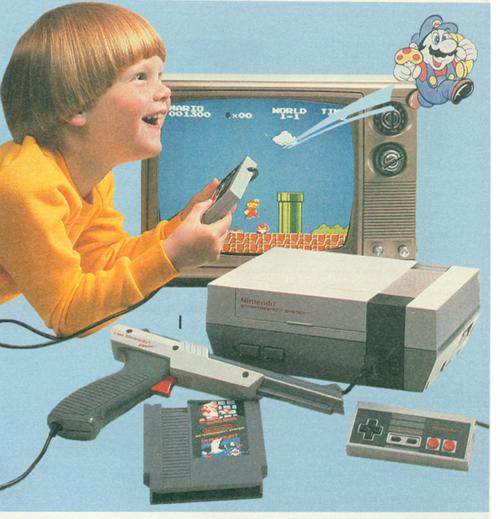 After the first week of browsing had passed and my want list written, the second function of the catalog was to create a list of all the items I would get if I were rich. Since anything and everything was in there I could sit back and imagine I had money for the SNES (about $200 at launch, out of my budget), Turbo Express (around $300) and even distant dreams of a Neo Geo (a whopping $650). Hell, even the games for the Neo Geo sold at ridiculous prices like $120, so there were times that I would list one or two of those titles and imagined I already had the system. There was often a “coming soon” section that featured upcoming titles, some of which would never see the light of day, that allowed me to assess what games were worth saving gift money for. After demand started skyrocketing for video games in the 90s, these catalogs would be excellent places to pre-order consoles and popular games as well as a last effort to grab items sold out in stores.
Catalogs from department stores were my first exposure to video game coverage, albeit a one-sided consumer driven version, but game coverage nonetheless. With parents who were against giving out personal information, even back then, I never got into the Nintendo Club by filling out a registration card. Thanks to an active imagination and a lot of free time, Christmas was celebrated over and over throughout the month of December before the actual gifts arrived.
Go on to the second day of Christmas ->
Halloween Rarities
I’m really into lucrative titles, especially when they are about Halloween or horror. For the most part these games are classic titles from the past that you have either never played or never had a chance to play. On the plus side, thanks to rom¹ hacks and translations, you can easily find any of these games to play on an emulator. While I don’t condone piracy, nothing in this list was released in the US save for one title so for a single play to see what you’re missing I feel there’s no harm, especially since you have no other option. I cannot link any of these roms directly, but feel free to search for “(title of game) rom” on Google and you shouldn’t have any problems. Without further ado, here’s the list of great Halloween games you’ve probably never played.
Sweet Home (Suīto Hōmu) – Famicom – 1989
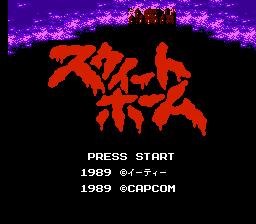
Considered by some to be the original version of Resident Evil, Sweet Home is actually a licensed game based on a movie of the same name. It was developed by Capcom and produced by RE producer Shinji Mikami, who later admitted that Resident Evil began as a remake of Sweet Home. For many modern gamers, RE is a tough sell with its fixed camera angles, blurry graphics and tank² controls. If this describes you, then Sweet Home may be the outdated choice for you. Although developed on the Famicom there is a surprising number of similarities with RE on the Playstation.

Even in 8-bit, the mansion holds that eerie feel
When you change rooms the all-too-familiar door opening animation will escort you through. The inventory system and puzzles will ring extremely familiar for those that explored the mansion as Chris or Jill. In fact, the big spooky mansion is probably the most distinguishing similarity, although instead of a biological outbreak it’s merely haunted by the ghost of Lady Mamiya. And even though it’s technically a survival horror title, the game plays much more like a classic Japanese role playing game (JRPG) with random Final Fantasy-like battles. If you’ve always wanted to explore a haunted house JRPG style, check this one out, especially considering the decent english translation making the rounds.
Generation Gap Pt. 2: 8-Bit
Amidst the video game crash of 1983, it seemed pretty unlikely that home consoles would have a future. Fortunately a Japanese toy maker had figured out how to re-sell video games to the masses despite the world economy turning its back. That company was Nintendo.
8-bit Generation (1985 – 1995)
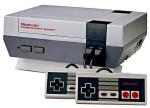
Nintendo Entertainment System – Launch Price: $200 – Released: 1985
Depending on your age, the Nintendo Entertainment System (NES) probably needs the least introduction or background, but there were many things going on behind the scenes that assisted this console in becoming the giant it was. Initially Nintendo had to figure out how to overcome the world economy’s opinion on video game consoles, which the Famicom/NES clearly was. In Japan, where personal home computers were all the rage, it was marketed as a computer for your family, hence the name Famicom (for “family computer”). In America the better way to sell it was as a toy, which everything from the console’s marketing to the simple boxy aesthetic suggests. It worked and in both regions this little 8-bit system assisted Nintendo in virtually running the 8-bit era.
Strength in Numbers
Anniversaries. As time progresses everything ages at the same pace and with each passing year a ton of video games hit new milestones. Popular titles from the past can be revisited in short periods of time for the sake of nostalgia or the chance to finally complete a difficult game for the first time¹. Since no one day can go by without something in the video game industry reaching a notable age, it’s no surprise that retro articles are riddled with regular anniversary celebrations. This site will be no exception.
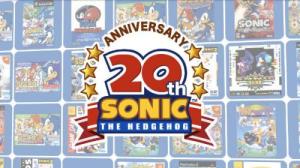 Gaming companies have now begun to celebrate series anniversaries themselves on a more consistent basis. In some cases I feel these creations are warranted, but I find myself frowning a bit when it’s a last-ditch effort to revitalize an intellectual property that should have died off long ago. I think the better anniversary is the for titles that stand on their own and you rarely think about until they are brought up. A perfect example of this is Chrono Trigger. Despite a few remakes and Square’s occasional interest in bringing attention to the title, it’s mostly one for the nostalgia vault. Thankfully, unlike so many other titles, Chrono Trigger holds up today and stands as an individual game even though it technically has two other entries in the series². Oddly enough, even though the game celebrated 15 years in 2010, it received a GBA port on its 13th birthday and didn’t come to virtual console and PSN until this year (its 16th anniversary). This only further proves that incremental numbers aren’t always on a publisher’s top priority list.
 Gaming History 101