Archive for the ‘Arcade’ Category
Podcast: Luck O’ the Irish – Special Edition
Rob “Trees” O’Connor joins us on the most Irish of days, St. Patrick’s Day. To celebrate, we are discussing Irish video games of the past and because that only takes 5 minutes we’re also talking special edition consoles. Yes, those $500 editions typically exclusive to Japan that make our inner fanboy reach for the wallet every time we see a new ridiculous logo on something we already own.
Opening song: The Blood of Cuchulainn by Michael Danna (popularized in the opening credits of the movie The Boondock Saints)
Closing song: Irish Drinking Song by Dropkick Murphys
Top 5 Shmups Worth Importing

Ah March, shmuppreciation is back and in full effect on Gaming History 101. If this is your first time hearing the phrase, shmuppreciation is for the love of the shoot-em-up genre (shmup for short) and is celebrated all March on the site. If you missed Shmuppreciation 2012 I highly recommend you check it out as we provided more than 30 articles dedicated to introducing you to genre specifics and the myriad of popular series in the most triumphant genre of all time.
This year we’re going past introductions and into the intermediate world of shmups, which requires more skill, dedication, and money than the games covered last year. While I would hardly call the games we will be covering obscure by any stretch, these titles are much less known outside of enthusiastic shmup fans. To kick it off we’re featuring the top 5 games worth importing. Shmups are of the most expensive games out there so you can expect a bit of sticker shock even with the games mentioned here. Just keep in mind that you’re currently dropping $60 for day one releases and sometimes even more if you’re into that special edition stuff. The titles in this list are unique because they have not seen a release, even digital, within the United States and thus require some sort of special circumstances to play today. There’s a great list of import games that have released digitally on PSN, XBLA, and Wii Virtual Console as well so be sure to check out our article on those titles as well. In order to play these games you have to either import them or get access to a digital service outside of your region. The links in each title will take you to the games’ review or video on our site.
Review: Capcom Arcade Cabinet (XBLA/PSN)
 Whenever I hear about another announcement for another arcade collection to be released individually I always think back to Game Room. Here we go again. Not only that but you would be hard pressed to not point out that Capcom has released these arcade gems before, most if not all of them (there are some games I don’t yet know about) appearing on the Capcom Classics Collection that appeared on Xbox, PS2, and PSP. Despite all of that against it – your interest and want in the specific games notwithstanding – Capcom Arcade Cabinet offers exactly what retro gamers purchasing arcade games on today’s consoles look for and all at an easy impulse buy price.
At its core it’s a lot like Game Room in that you navigate a main screen that displays the available games you have to play. Games that you have not purchased or that aren’t available yet are blacked out. Of the titles you do have, you can read a quick background paragraph on the game or enter its specific menu. As of now the selection is an interesting mixed bag of highly popular and relatively unknown titles from 1984-1987 – currently the three titles from 1987 have been released: Black Tiger, 1943, and Avengers – and the overall package looks to be consistent with that structure moving forward. Whether or not you want these games is entirely up to you and probably responsible for whether or not you’ll pick up anything, but this review isn’t about each individual game but rather the options and package you get with Capcom Arcade Cabinet.

The Japanese Always Get The Better Version: Contra (Famicom)
 Console: NES/Famicom
Released: 1988
Developer: Konami
Publisher: Konami
Instruction Manual: Not Necessary – Link
Difficulty: Moderate
Played it as a child? Yes
Value: $26.01 (used), $399.95 (new) (pricecharting.com)
Other Releases: Yes – Arcade, Microcomputers, PS2, DS (all are the Arcade version)
Digital Release? Yes – Virtual Console (NES version), XBLA/PSN (Arcade ver) ($5 on all platforms)
With box art that is clearly Arnold Schwarzenegger and Sylvester Stallone combining forces to be in a franchise that belongs to neither, Alien, this game has it all. For the most part you and potential partner rush through eight levels, including a jungle that is ripped straight out of Predator, to attack bad guys and eventually aliens. It’s a confusing game in America because nothing is spelled out for you, the game just drops you in the jungle without any plot, scene, or explanation. Now that I’ve played the Famicom version (and the video below will show the complete game to you as well), it looks like there’s a decent plot that unfolds. Since I don’t know Japanese nor can I read Kanji, what is actually conveyed is a mystery to me, but I’m sure the translated explanation is only a Google search away. Contra not only introduced us to a frustrating and fun franchise, but it’s also where most of us learned the Konami code (up, up, down, down, left, right, left, right, B, A, Start). If you put this into the title screen you would begin the game with 30 lives (if you instead end the code with Select before Start you can start a two player game with both players having 30 lives), which was the only way most of us could beat the game when we were younger. After years of practice I can now complete the game with the given 3 lives, although not flawlessly, and I prove it in the video below.

The Famicom version I’ve always heard is “enhanced” over the NES version and the two are worth roughly the same amount, so when I was picking up the title at a retro show I opted for the Japanese version. It’s not really that different, but the changes of note are the aforementioned cutscenes, moving backgrounds, and slightly easier difficulty. Either way it just goes to show that the Japanese version of most games will always be the better version. Then again when this title released in Europe it was renamed to Probotector and features robots instead of humans (although in either version the enemies pop and explode). Without further ado, I give you the completion video of Contra on the Famicom.
Review: Final Fight CD (Sega CD)
 Console: Sega-CD/Mega-CD
Released: 1993
Developer: Capcom
Publisher: Sega (Sega/Mega-CD, 32X CD)
Instruction Manual: Not necessary
Difficulty: Hard
Played it as a child? Yes
Value: $21.50 (used) $76.00 (new) (pricecharting.com) – Price for Sega CD version only
Price: $23-$60 (used) N/A on US Version (new) on eBay
Other Releases: Arcade, SNES, Gameboy Advance
Digital Release? Yes – SNES version on Virtual Console ($8), Arcade version on XBLA/PSN as Double Impact ($10)
Final Fight is a pivotal late 80s arcade release for Capcom for two reasons: it established the norms that would make up the concept of the “beat-em-up” genre for its short-lived life (although it oddly enough didn’t introduce any of them) and it created the aesthetic and building blocks of Street Fighter II. Anyone who has played this game or SFII will immediately be familiar with that semi-realistic semi-animated graphical style of Final Fight that remained exclusive to these two titles moving forward for a few sequels (I’m considering the numerous re-hashes of SFII to be sequels). In full disclosure this is my favorite brawler of all time and definitely ranks highly in my overall top games I’ve ever played despite the fact that Final Fight doesn’t translate well to home consoles because it’s intended to take your money and prompt more quarters rather than be completed in a finite number of lives/credits. In order to complete the game in the allotted five credits requires you to memorize the cheaper boss battles and exploit the collision detection. For me it was just repetitive stupid fun.
Head to Head: Double Dragon
In many cases, games with the same name – and even the same game ported to various consoles – can be drastically different. This was especially true in the 8-bit era where plenty of popular arcade games were deemed too limited for a boxed release on consoles like the NES. Head to Head takes two particular games and explains the drastic difference between the two that often keep fans of each camp drastically divided. Aside from ports, you can also expect several other types of comparisons such as localization.

Double Dragon Arcade
VS
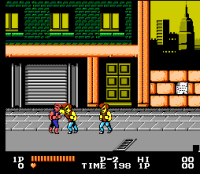
In 1987 Technos released a spiritual successor to its popular brawler Renegade (Nekketsu Kōha Kunio-kun) known as Double Dragon. It told the story of two brothers, Billy Lee and Jimmy Lee (Hammer and Spike in US arcades), who are fighting the mean streets of the Black Warriors turf to get back Billy’s girlfriend. It released first to arcades and eventually saw a port over to the NES, which drastically changed the game. Chances are if you are an American that played the game in your past, then you remember the NES version. Now that arcade ports of many games we loved on the NES are releasing on services like Xbox Live and Playstation Network, it’s important to know the drastic differences between the two because they are different games. Love ’em or hate ’em, here’s the Head to Head on Double Dragon.
Now & Then: Mortal Kombat II (Midway)

Midway must have known it had a hit on its hands with the original Mortal Kombat because no time was wasted creating the sequel. While most of us anticipated the home release of the first title, Mortal Kombat II (MKII) snuck into arcades and blew our minds. This game literally had it all – more characters, more fatalities/finishing moves, and more violence. For most MK series fans, myself included, this is considered to be the best and it’s one of the highest grossing video games of all time.
MK Meets its Match
The original Mortal Kombat was an impressive fighter, especially for one that was developed with digitized actors in only 10 months, but creator Ed Boon wanted to do more. “[MKII] had everything we wanted to put in the original MK but didn’t have time for,” he said in an interview with EGM2 (issue 5, Nov. 1994). It does seem like there’s some truth to his claim, especially with the introduction of more stage fatalities, a second fatality for each character, and even joke finishers “friendships” and “babalities”. I’m not so sure the roster was an initial idea, nor was the background concepts of Outworld, but I can definitely see the Midway team wanting to break away from the perceived reality of the original. Not only was MKII the definitive version of the original concept, but it continues to be the template for which all other titles in the series are based on.
Now & Then: Mortal Kombat (Midway)
Last week Mortal Kombat released for the Playstation Vita and while I was playing it for review I couldn’t help but notice that the series has not changed much since it first released. Normally this is a bad thing, but in the case of this series its strength relies on its simplicity. Mortal Kombat is a game all about beating the crap out of your opponent and then topping it all off with a finishing move that is extremely violent in nature.

First Impressions
I still remember the day that I saw the first Mortal Kombat arcade out in the wild. It was 1992, I was 10 and frequented the local roller rink where I could meet up with friends and play arcade games. Yeah, even in 1992 the roller rink was still alive and well in Chicago’s northern suburbs. At that time the arcade was dominated by Street Fighter II, a cartoon-like fighter from the geniuses at Capcom, but I wasn’t all that good at it and truthfully had little interest in fighters. That is, until I walked in and saw a new game that prominantly displayed the title “Mortal Kombat” in bright yellow letters. My first thought was how stupid it was that the word “combat” was misspelled, but then I noticed that the game used digitized realistic looking actors. Even more impressive was when the first uppercut made contact and a shower of blood erupted from the opponent’s face. I was intrigued.
 Gaming History 101