Archive for the ‘NES’ Category
Retro Game Challenge: Super Mario Bros.
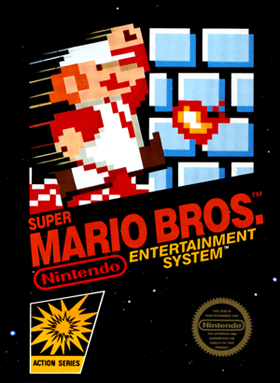 Console: NES
Released: September 1985
Developer: Nintendo Creative Department
Publisher: Nintendo
Instruction Manual: Not necessary – Link
Difficulty: Easy
Played it as a child? Yes
Value: $5.79 (used), $1,000.00 (new) (pricecharting.com)
Other Releases: Yes – SNES (Super Mario All-Stars), Gameboy Color (as Super Mario Bros. Deluxe), Gameboy Advance (Nintendo Classics), Wii (Super Mario All-Stars Wii)
Digital Release? Yes – Virtual Console for both Wii and 3DS
Review: Mother aka Earthbound Zero (Famicom)
 Console: Famicom
Released: 1989
Developer: Ape
Publisher: Nintendo
Instruction Manual: None released outside of Japan
Difficulty: Difficult
Played it as a child? No
Value: N/A – No official US release, most versions are fan translations and prototype carts have no official price
Other Releases: Yes – This game was updated and re-released in Japan on GBA as Mother 1 + 2
Digital Release? Yes – Although technically not true. Digital fan translations to English are available but not really legal.
Thanks to a strong and devoted fan community and some odd ambiguity with Nintendo’s releases of this series, Mother (known as Earthbound Zero with most circles that play english translations) has got to be one of the hardest series to cover. Having never played Earthbound (Mother 2 in Japan) I did the traditional completionist thing and started with the original game, which is extremely dated by almost all RPG standards. Mother suffers from everything I dread about going into retro role-playing games: a ton of grinding (or “meat walls”), constant random encounters, no true direction as to where to go next, casual dungeons with incredibly hard boss battles, slow pacing, and a limited inventory system. Not only that, anytime you try to look up help on this game, everyone who’s written about it has played the game a million times and speaks so condescending of people who get stuck that you feel like an idiot. That’s because Mother has a small but incredibly devoted community that feels this game and its sequels are the apex of game design. Despite all these faults, the charm of the writing and what it was doing at the time was enough to keep me invested until the grueling end.
Buying Guide: The Nintendo Entertainment System

We all love our retro consoles, but in many cases the consoles we are buying are because they are cheap enough or we have enough money to purchase what we never were able to in our youth. Unfortunately the business of making used retro items available to the masses can at times be a money grubbing market where consumers are deceived by people they will never meet in real life. As an individual who has spent the last decade scouring the local area, conventions, eBay, and the internet as a whole I have learned many valuable lessons. For that reason I present my buying guide series, which is a handy quick guide to knowing what to purchase and what will cost an arm and a leg to replace.
Most of us that are over 30 and grew up gaming had a Nintendo Entertainment System (NES) at one point or another in our collection, so it’s not that common to have a reseller screw you over with a used console. Still, I think it’s best to know exactly what you need to look for in your NES so here’s the official list of items that should be included in a used console:
The Japanese Always Get The Better Version: Contra (Famicom)
 Console: NES/Famicom
Released: 1988
Developer: Konami
Publisher: Konami
Instruction Manual: Not Necessary – Link
Difficulty: Moderate
Played it as a child? Yes
Value: $26.01 (used), $399.95 (new) (pricecharting.com)
Other Releases: Yes – Arcade, Microcomputers, PS2, DS (all are the Arcade version)
Digital Release? Yes – Virtual Console (NES version), XBLA/PSN (Arcade ver) ($5 on all platforms)
With box art that is clearly Arnold Schwarzenegger and Sylvester Stallone combining forces to be in a franchise that belongs to neither, Alien, this game has it all. For the most part you and potential partner rush through eight levels, including a jungle that is ripped straight out of Predator, to attack bad guys and eventually aliens. It’s a confusing game in America because nothing is spelled out for you, the game just drops you in the jungle without any plot, scene, or explanation. Now that I’ve played the Famicom version (and the video below will show the complete game to you as well), it looks like there’s a decent plot that unfolds. Since I don’t know Japanese nor can I read Kanji, what is actually conveyed is a mystery to me, but I’m sure the translated explanation is only a Google search away. Contra not only introduced us to a frustrating and fun franchise, but it’s also where most of us learned the Konami code (up, up, down, down, left, right, left, right, B, A, Start). If you put this into the title screen you would begin the game with 30 lives (if you instead end the code with Select before Start you can start a two player game with both players having 30 lives), which was the only way most of us could beat the game when we were younger. After years of practice I can now complete the game with the given 3 lives, although not flawlessly, and I prove it in the video below.

The Famicom version I’ve always heard is “enhanced” over the NES version and the two are worth roughly the same amount, so when I was picking up the title at a retro show I opted for the Japanese version. It’s not really that different, but the changes of note are the aforementioned cutscenes, moving backgrounds, and slightly easier difficulty. Either way it just goes to show that the Japanese version of most games will always be the better version. Then again when this title released in Europe it was renamed to Probotector and features robots instead of humans (although in either version the enemies pop and explode). Without further ado, I give you the completion video of Contra on the Famicom.
Review: Castlevania III: Dracula’s Curse (NES)
 Console: Nintendo Entertainment System (NES)
Released: 1990
Developer: Konami
Publisher: Konami
Famicom? Yes (as Akumajo Densetsu – English Translation: Devil’s Castle Legend )
Instruction Manual: Not necessary – Link
Difficulty: Moderate
Played it as a child? Yes
Value: $12.25 (used) $172.82 (new) (pricecharting.com)
Price: $15-$20 (used) $289.00-$500.00 (new) on eBay
Digital Release? Yes – Virtual Console (NES version) – $5.00
What are you supposed to do?
Castlevania III returns to its roots and is an action platformer. Unlike the original, the game isn’t entirely linear, giving you branching paths along your way. Of the game’s 15 levels, you will play 9-10 of them depending on your decisions, eventually making your way to Dracula.
Review
As one of the later games on the NES, Castlevania III: Dracula’s Curse is surrounded by technical mastery. In fact, it utilizes such an expansive amount of supplemental hardware (ie: chips) that the Japanese version isn’t even capable of working with the NES (unless you modify it, of course) and the US version is incompatible with “famiclone” systems. For all that work, however, Castlevania III is a great title that impresses on all fronts. Back to the extra hardware – the memory management controller chip, version 5 (MMC5) allowed the game to be playable on the NES albeit at the cost of some of the impressive sounds and graphics in the Japanese version. This doesn’t mean it’s bad by any means, the game still looks and sounds better than a majority of games ever released on the console, it’s just that the Japanese version is a bit better thanks to the VRC6 microprocessor. Normally I don’t gush on video game soundtracks, because save for a select few I don’t really consider it a notable factor. This is one of those rare cases that I must say the game sounds amazing, in any form. 1up’s own Jeremy Parish captured the difference in a YouTube video that I have provided below so you can hear the difference for yourself.
Review: Castlevania II: Simon’s Quest (NES)
 Console: Nintendo Entertainment System (NES)
Released: 1988
Developer: Konami
Publisher: Konami
Famicom? Yes (as Dorakyura Tsu: Noroi no Fuin – English Translation: Dracula 2: The Seal of the Curse )
Instruction Manual: Not necessary – Link
Difficulty: Moderate
Played it as a child? Yes
Value: $4.80 (used) $195.00 (new) (pricecharting.com)
Price: $15-$20 (used) $400.00-$1,000 (new) on eBay
Digital Release? Yes – Virtual Console (NES version) – $5.00
What are you supposed to do?
Control Simon Belmont through an open world and collect the five scattered body parts of Dracula and a magical cross. Once all of these items have been discovered, Simon returns to Dracula’s castle and assembles the parts to fight and kill Dracula, who has put a curse on Belmont. Depending on how fast you can complete the game, you will be given one of three endings.
Review
 In Konami’s follow-up to Castlevania, the developer attempts to refine the game mechanics and make the sequel quite different from the original, as many NES games at the time were doing, with RPG elements. Simon Belmont can level up, purchase upgrades and weapons from townspeople, and freely explore an open world. The gameplay of fighting enemies remains mostly the same, however with the new open world format there is little direction as to where to go but blocked paths and out of reach ledges due to not having the right item streamlines it into a somewhat linear experience. In addition, day and night cycles keep the player on their toes as night time removes the safety of villages and doubles the strength of enemies. At face value the concept of this game was great, but there are some big issues that prevented us from enjoying it then and now.
Review: Castlevania (NES)
 Console: Nintendo Entertainment System (NES)
Released: 1987
Developer: Konami
Publisher: Konami
Famicom? Yes (as Akumajo Dorakyura)
Instruction Manual: Not necessary – Link
Difficulty: Hard
Played it as a child? Yes
Value: $12.87 (used) $55,000.00 (new) (pricecharting.com)
Price (eBay): $15-$20 (used) $1125.00 (new) NOTE: This copy is revision A and thus has a lower value.
Digital Release? Yes – Virtual Console (NES version) – $5.00
What Are You Supposed To Do?
This is a linear action platformer. Many attribute the Castlevania series as an RPG or action RPG, whereas aside from the second title in the series, it has never really been. With no real inventory to maintain and no story elements to speak of, this original title is all about jumping and killing enemies.
Review
Castlevania released early in the NES life cycle and for that time seemed to be the culmination of everything you would want in a video game. Hitting store shelves early summer of 1987, most NES gamers had either just gotten or were hoping to get the console in the near future and word was getting around that this was one of the pivotal titles to play. You control a hero, Simon Belmont, who has vowed to hunt Dracula in his own castle. In the game you encounter all types of horror staples such as bats, zombies, and Medusa heads all while tackling large scale boss battles with famous monsters like Frankenstein, the Mummy, and even Death himself (aka: the Grim Reaper). As a young boy, this sounded like the most amazing game in the world and I was even happier to find out it delivered on all fronts. Castlevania is a difficult and wild ride through a haunted castle of horrors that holds up even today, albeit at the cost of your sanity with the Dracula battle.

Head to Head: Double Dragon
In many cases, games with the same name – and even the same game ported to various consoles – can be drastically different. This was especially true in the 8-bit era where plenty of popular arcade games were deemed too limited for a boxed release on consoles like the NES. Head to Head takes two particular games and explains the drastic difference between the two that often keep fans of each camp drastically divided. Aside from ports, you can also expect several other types of comparisons such as localization.

Double Dragon Arcade
VS
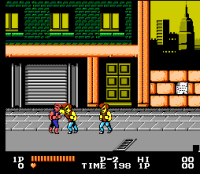
In 1987 Technos released a spiritual successor to its popular brawler Renegade (Nekketsu Kōha Kunio-kun) known as Double Dragon. It told the story of two brothers, Billy Lee and Jimmy Lee (Hammer and Spike in US arcades), who are fighting the mean streets of the Black Warriors turf to get back Billy’s girlfriend. It released first to arcades and eventually saw a port over to the NES, which drastically changed the game. Chances are if you are an American that played the game in your past, then you remember the NES version. Now that arcade ports of many games we loved on the NES are releasing on services like Xbox Live and Playstation Network, it’s important to know the drastic differences between the two because they are different games. Love ’em or hate ’em, here’s the Head to Head on Double Dragon.
Review: Adventure Island (NES)
 Console: Nintendo Entertainment System (NES)
Released: 1988
Developer: Hudson Soft
Publisher: Hudson Soft
Famicom? Yes (as Takahashi Meijin no Bouken Shima)
Instruction Manual: Not necessary – Link
Difficulty: Easy
Played it as a child? Yes
Value: $4.75 (used) $100.00 (new) (pricecharting.com)
Price (eBay): $8-$15 (used) $600 (new)
Digital Release? Yes – Virtual Console (NES version) – $5.00
What Are You Supposed To Do?
Much in the same vein of Super Mario Bros., your goal is to navigate caveman Master Higgins through various levels and avoid enemies along the way. You can collect weapons that are used to kill enemies, lots of platforming sections, and a boss battle completes the third or fourth level of each “world”.
Review
I know I’m going to get some criticism saying that Adventure Island is easy, but it very much is. Even as a child it didn’t take long to see the ending and the lass boss had a very simplified pattern that I could quickly learn. That doesn’t prevent this title from being one of the best games and series to grace the NES and anyone who hasn’t played Hudson’s classic platformer should make this a must play. After having its name proudly on most top 100 and even a few top 10 lists for the NES, not to mention the millions in sales it achieved when it came out, this game is what you look for in an NES title.
Review: 1942 (NES)
What Are You Supposed To Do?
As far as shooters go, this is as simple as it gets. You need to navigate your plane and shoot down all other planes. You are given 3 lives and can collect power-ups for your guns as well as assistant planes. In a pinch, the A button can be pressed to make you temporarily invulnerable. You have 32 missions, each one the goal is to go from beginning to end without dying.
Review

 Gaming History 101