Archive for the ‘PS4’ Category
Resident Evil HD Remaster Under 3 Hour Speedrun

Completing a longer game in a speedrun can be not only an accomplishment but also quite rewarding. In the case of Resident Evil, completing the game in a speedrun is literally built into the programming with the expectation that after you’ve explored the game a couple of times you will jump right into it. The recent Resident Evil HD Remaster came out and while I found the game quite difficult in my recent playthrough and it took me over 11 hours to complete, I dared leap into an under 3 hour speedrun (albeit with the gracious help of a guide from GameFAQs). I also decided to capture it and offer voiceover so that you can not only enjoy watching a speedrun, but see what is done and why to somewhat bend the timeline of the game to be as short as it is. I’ve embedded the first video below and you can see the entire playlist here.
Resident Evil HD Remaster Review
Fred’s Take
After long last it appears that Resident Evil, specifically the Gamecube remake from 2002, is making a widespread appearance on modern consoles complete with increased resolution, performance, and controls. This is significant because the number of people who owned a Gamecube was relatively small and the Wii port had such a limited print run it was a bit difficult to find. Not only that, but at 12 years old, the game itself has plenty of dated setbacks that most gamers I talk to refuse to put up with. Thankfully this new version is digital only (no need to hunt down copies), adapted for today, and relatively inexpensive ($19.99 on all platforms). With all the tweaks made to this game it is so close to being worth the money I can’t see any fan of horror games or the original series not wanting to pick up this new version. Besides, it’s January, what else is coming out?
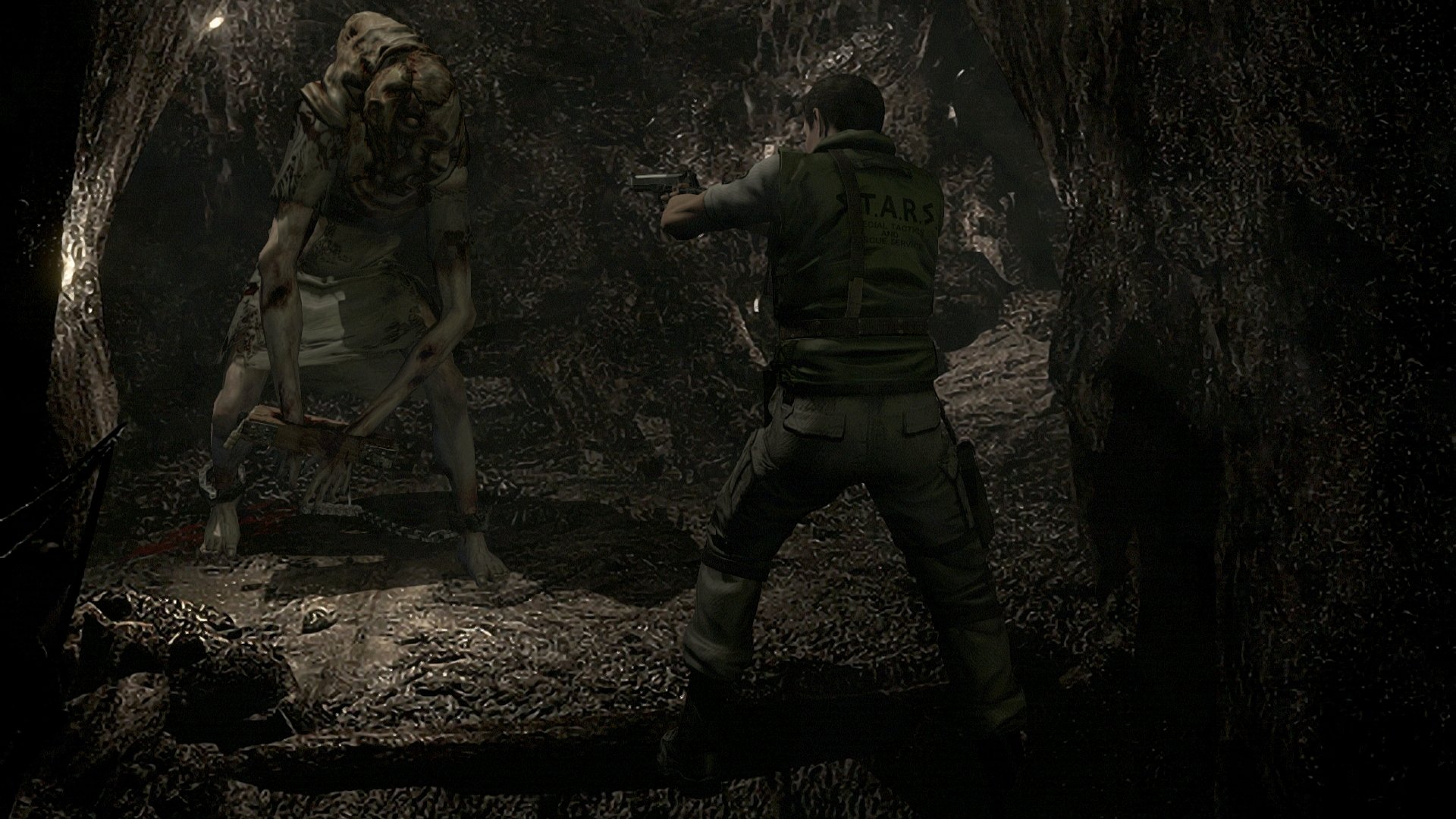 If you played the original to death – and pretty much anyone who owned the game back in 1996 did as we waited two whole years for the sequel – it’s a pretty rudimentary journey at this point. You know where everything is, you probably know most of the tricks, you don’t need to save often, and your completion time will be somewhere in the 3-6 hour mark. On the other hand, the limited release of this game and the cumbersome systems it can be found on means that you probably aren’t that familiar with it. This is no graphical coat of paint over the original design, it’s a brand new experience. The mansion’s layout has been changed, most of the puzzles are different, there are new enemies, and everything is scattered in completely different places. That doesn’t mean that experts of the original can’t jump in and easily conquer this title from start to finish, but it’s going to take you some time. Even more impressive is the fact that despite me completing the original at least once a year since it released, this version was able to get some tense and great jump scare moments out of me along the way. It’s a new Resident Evil and it’s worth replaying.
Rock Boshers DX Director’s Cut Review
Jam’s Take
 With the ever increasing improvements to video games – top of the range PCs with graphics cards that are able to show realism that get closer and closer to the real thing – as a gamer you really start to question how games could get any better. Then comes along a game called Rock Boshers that shows us that the evolution in gaming of not necessarily going forward, but backwards.
Rock Boshers is very much a love letter to the ZX Spectrum gaming days. The game happily advertises that it pulls from a palette of just 15 colours and even mimics the music the old micro computers from the eighties was capable of. Rock Boshers is not the first game to give love to the old microcomputer, the ZX Spectrum still gets a lot of love to this day with homebrew games being regularly released (Retro Gamer magazine which is a popular read in the UK, discusses popular homebrew released every month). Rock Boshers is one of the few ZX Spectrum inspired games as far as I am aware that has made it to Steam and even the PS4 and PSVita (the latter being the version I’ve reviewed).
Resident Evil HD Remaster First Look
Sorry this is going up on Sunday night. Normally Retro Game Night is recorded on Friday and goes up Saturday morning, but we had to delay recording a day and these HD videos take a lot longer to render and post to YouTube. Either way, the video speaks for itself, but Fred got a retail copy of Resident Evil HD Remaster on PS3 that will be coming to the US in “early” 2015 (according to Capcom). Well since there was another option, we grabbed it early. Enjoy!
Podcast: Gaming History X: This is Next Gen?

This week we celebrate Jam (@Jamalais) coming on board as a permanent co-host, a slew of retro news, and onto the more modern topic of contemporary consoles. Now that the gang’s all here, we dissect the current state, conditions, and factors of the previously called “next gen” and loosely discuss the upcoming future.
Know This Developer: Ubisoft Montreal

As I was looking into doing a history on this fantastic studio I came upon an excellent reference that was so good there’s no point in me doing one. While it’s easy to rag on big media conglomerates, IGN’s Mitch Dyer did a fantastic story of the origins of Ubisoft Montreal that includes stories of Splinter Cell‘s origin, the reinvention of Prince of Persia, and the visual treat that is Far Cry. It’s a fascinating story that documents the major franchises you can thank that studio for and a must read for gaming history buffs like ourselves. Head on over and check out House of Dreams: The Ubisoft Montreal Story when you can.
Review: Strider (2014)
 Yet another in a long line of modern re-hashes on cult favorites, I went into Strider with a bit more optimism than than other titles to date. Aside from spruced up graphics the game appeared to be faithful to the arcade original, which my retrospective and the podcast last week contested is the best iteration of the series. Couple that with the development being handled by Double Helix – a very popular developer with success not only in Killer Instinct 3, but also was purchased by Amazon for an unannounced project – and the open map MetroidVania game design, things were shaping up to success. Having completed the game, I must admit that just like the anomaly of the original, Strider is a melting pot of prior series staples that gets it right from start to finish.

The scale of the overall world is massive and can be stunning.
If you sit still too long in the original arcade game, you will die. Best laid plans are to push forward (ie: to the right) and just attack anything in your path while trying not to fall off a ledge. In the new game that theme is aggressively applied with herds of enemies so thick they will literally be a blocking point for you at times in the game. As a member of the Strider clan, Hiryu is able to cut down most adversaries with the greatest of ease and the balance between enemy hit points and his acrobatic abilities result in a fast paced romp. I never had down time in Strider and felt like a masterful ninja with frantic but controlled moves as I navigated the game’s massive map. While I can concede to the basic MetroidVania label, I would say the game more closely resembles Rondo of Blood rather than the hybrid genre. Even when you have a full moves list at your disposal these hiding places are more off the beaten path rather than the wide open areas you uncover in other titles of the genre. What results is a game that is more linear than anything else, and despite it being a huge map the development team broke it up into different areas complete with a boss battle and new weapon at the core, so basically it’s just like having levels that you can return to. Strider is no stranger to this method of map design, the original NES title was quite similar and a small following prefer it to the traditional “run to the right” design of the arcade title. In the end I grew tired of looking too hard for too much because I was having such a blast following the marker to the next step of the main mission that I played it exactly like a linear game.

Two bosses on opposing sides are no problem for Hiryu.
 Gaming History 101