Posts Tagged ‘konami’
Top 5 Shmups on Portable Consoles
Given the frantic and brief nature of most shmups, the genre is perfect for the portable platform, much like it was perfect for the arcade. For one reason or another, these titles can be rare to find on traditional handhelds and even harder to find actually good ones. On the other hand some of my favorite shmups are exclusive to portables (at least in the United States) so we’ve compiled a list of the portable shmups actually worth playing.
5. Space Invaders Extreme (Nintendo DS)
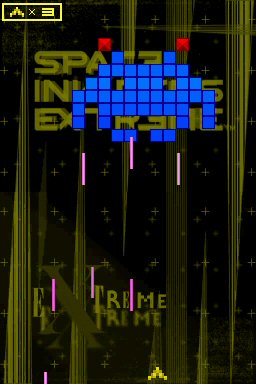 When Taito decided it would re-invent the Space Invaders formula I was skeptical. We were told in previews that the game would feature an upbeat techno soundtrack, plenty of screen tricks and explosions, dual screen integration on DS, and a hybrid between modern game mechanics and the original title. Just in case that sounds tempting to you, it’s almost verbatim what no gamer wants to hear when a beloved franchise is rebooting. Somehow Taito pulled it off and with no updates save for that fearful list Space Invaders Extreme was an addicting masterpiece. It released in a few forms on a few consoles but bar none the Nintendo DS version is the one to get. With non-linear level progression and utilization of dual screen to make the DS function more like a vertical arcade monitor, it’s like having Space Invaders on speed. Bonus rounds, boss battles, and power-ups were simple tweaks to the original formula that switched up gameplay without being a specific reason to play the game. Needless to say if you haven’t played Space Invaders Extreme, regardless of whether or not you’re a fan of the original, you should give this handheld game that’s easy to learn and brutal to master a try. It will keep you occupied for many a train, plane, or bus ride to come.
Top 5 Shmups Worth Importing

Ah March, shmuppreciation is back and in full effect on Gaming History 101. If this is your first time hearing the phrase, shmuppreciation is for the love of the shoot-em-up genre (shmup for short) and is celebrated all March on the site. If you missed Shmuppreciation 2012 I highly recommend you check it out as we provided more than 30 articles dedicated to introducing you to genre specifics and the myriad of popular series in the most triumphant genre of all time.
This year we’re going past introductions and into the intermediate world of shmups, which requires more skill, dedication, and money than the games covered last year. While I would hardly call the games we will be covering obscure by any stretch, these titles are much less known outside of enthusiastic shmup fans. To kick it off we’re featuring the top 5 games worth importing. Shmups are of the most expensive games out there so you can expect a bit of sticker shock even with the games mentioned here. Just keep in mind that you’re currently dropping $60 for day one releases and sometimes even more if you’re into that special edition stuff. The titles in this list are unique because they have not seen a release, even digital, within the United States and thus require some sort of special circumstances to play today. There’s a great list of import games that have released digitally on PSN, XBLA, and Wii Virtual Console as well so be sure to check out our article on those titles as well. In order to play these games you have to either import them or get access to a digital service outside of your region. The links in each title will take you to the games’ review or video on our site.
Podcast: Snake? Snake! Snaaake!

This week Fred and Trees celebrate the release of Metal Gear Rising Revengeance with a podcast about words that don’t exist… Er, scratch that. Instead, we discuss Hideo Kojima’s classic stealth franchise Metal Gear.
Retro Game Challenge: Super C (NES)
 Console: NES
Released: April 1990
Developer: Konami
Publisher: Konami
Instruction Manual: Not necessary – Link
Difficulty: Moderate
Played it as a child? Yes
Value: $9.03 (used), $179.95 (new) (pricecharting.com)
Other Releases: Yes – as Super Contra on arcade, PCs (microcomputer and IBM compatibles)
Digital Release? Yes – Virtual Console for Wii (NES version) and XBLA (arcade version)
Per a request from reader Quark, our follow up from the Contra retro review. Now we complete the sequel.
The Japanese Always Get The Better Version: Contra (Famicom)
 Console: NES/Famicom
Released: 1988
Developer: Konami
Publisher: Konami
Instruction Manual: Not Necessary – Link
Difficulty: Moderate
Played it as a child? Yes
Value: $26.01 (used), $399.95 (new) (pricecharting.com)
Other Releases: Yes – Arcade, Microcomputers, PS2, DS (all are the Arcade version)
Digital Release? Yes – Virtual Console (NES version), XBLA/PSN (Arcade ver) ($5 on all platforms)
With box art that is clearly Arnold Schwarzenegger and Sylvester Stallone combining forces to be in a franchise that belongs to neither, Alien, this game has it all. For the most part you and potential partner rush through eight levels, including a jungle that is ripped straight out of Predator, to attack bad guys and eventually aliens. It’s a confusing game in America because nothing is spelled out for you, the game just drops you in the jungle without any plot, scene, or explanation. Now that I’ve played the Famicom version (and the video below will show the complete game to you as well), it looks like there’s a decent plot that unfolds. Since I don’t know Japanese nor can I read Kanji, what is actually conveyed is a mystery to me, but I’m sure the translated explanation is only a Google search away. Contra not only introduced us to a frustrating and fun franchise, but it’s also where most of us learned the Konami code (up, up, down, down, left, right, left, right, B, A, Start). If you put this into the title screen you would begin the game with 30 lives (if you instead end the code with Select before Start you can start a two player game with both players having 30 lives), which was the only way most of us could beat the game when we were younger. After years of practice I can now complete the game with the given 3 lives, although not flawlessly, and I prove it in the video below.

The Famicom version I’ve always heard is “enhanced” over the NES version and the two are worth roughly the same amount, so when I was picking up the title at a retro show I opted for the Japanese version. It’s not really that different, but the changes of note are the aforementioned cutscenes, moving backgrounds, and slightly easier difficulty. Either way it just goes to show that the Japanese version of most games will always be the better version. Then again when this title released in Europe it was renamed to Probotector and features robots instead of humans (although in either version the enemies pop and explode). Without further ado, I give you the completion video of Contra on the Famicom.
Review: Castlevania: Symphony of the Night (PS1)
 Console: Sony Playstation (also released on Sega Saturn in Japan only)
Released: 1997
Developer: Konami
Publisher: Konami
Japan? Yes (as Akumajo Dracula X: Gekka no Yasokyoku Translation: Devil’s Castle Dracula X: Nocturne in the Moonlight)
Instruction Manual: Not necessary – Link
Difficulty: Moderate
Played it as a child? No
Value: $22.87 (used) $64.45 (new) (pricecharting.com) – NOTE: There are two versions: original and greatest hits. Original is much more rare and expensive, so adjust your buying habits appropriately.
Price: $15-25 (used GH) $35-$60 (used original) $90-$130 (new GH) $400 (new original) on eBay
Digital Release? Yes – released as PSOne title on PS3/PSP and on XBLA – $10.00 for all versions. Also available with Rondo of Blood in the Dracula X Collection for PSP – $15 digital, varies on UMD.
***We also did a podcast on this and other Castlevania titles like it here.***
While Rondo of Blood may be the hidden gem of the Castlevania series, Symphony of the Night is anything but. There wasn’t a Playstation gamer around that didn’t see this release back in 1997, bringing a much-needed change to the traditional formula. Every Castlevania game that released on consoles seemed to push the hardware to do things it was never intended to do and usually had amazing results, so it was interesting that in a world consumed by 3D polygonal graphics Symphony of the Night was a 2D side scroller. In Japan, the series has a much easier way to identify the games that go together – main campaign titles often wore Akumajo in the title and in this case Dracula X – but in America we had not received (and most of us had not played) Rondo of Blood. The game starts out with you climbing the stairs to Dracula’s chamber at the end of Rondo and you re-create the final fight with Dracula (of which you cannot die). Then a long bit of lore scrolls the screen and next thing you know you’re playing as Alucard, Dracula’s son, and you’re rushing to Castlevania to rescue Richter from its curse. It was like being dropped into the middle of an epic you had not previously learned the story of. Frankly, it didn’t matter, and even today playing Rondo of Blood only assists in giving you background detail because like all other Castlevania games it’s the gameplay and level design that keeps you hooked.
Review: Castlevania: Bloodlines (Genesis)
 Console: Sega Genesis
Released: 1994
Developer: Konami
Publisher: Konami
Mega Drive? Yes (as Banpaia Kira Translation: Vampire Killer, Castlevania: The New Generation in Europe)
Instruction Manual: Not necessary – Link
Difficulty: Hard
Played it as a child? No
Value: $23.07 (used) $59.99 (new) (pricecharting.com)
Price: $25-$50 (used) $60-$350 (new) on eBay
Digital Release? No
Just like today there was fierce competition between the two main 16-bit consoles, SNES and Sega Genesis, that necessitated exclusive games. Aside from the first party developed titles, third-party developers could opt to either create the same game for both consoles or create completely new ones. In the case of many Disney games, like Aladdin or The Lion King, different companies developed the game on each console but the basic concepts and level design would remain consistent regardless of which version you purchased. Konami, on the other hand, would usually make completely different exclusive titles that played to the strength of the specific console it was designed on. There was no way this developer, who was free to release games on any (and every) console not to create games for both. Castlevania: Bloodlines is a side story game, much like Rondo of Blood, that played to the audiences that came running to Sega’s edgy console.
Review: Dracula X: Rondo of Blood (PC-E CD)
 Console: PC-Engine CD (Japan)
Released: 1993
Developer: Konami
Publisher: Konami
Japanese Title: Akumajo Dracula X: Chi No Rondo – English Translation: Devil’s Castle Dracula X: Rondo of Blood
Instruction Manual: Not necessary – Link
Difficulty: Hard
Played it as a child? No
Value: $83.00(used) Unknown – this usually indicates none have ever been sold (new) (pricecharting.com)
Price: $90-$120 (used) N/A (new) on eBay
Digital Release? Yes – Virtual Console and remake on Dracula X Chronicles (PSP) – $9.00 (VC), $15.00 (PSP) digitally
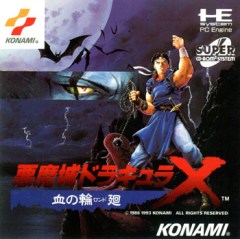
Akumajo Dracula X: Chi No Rondo is one of those games that you either know about or you don’t. As a side story to the series, appearing on the PC-Engine CD no less, I don’t think Konami ever intended the game to be popular but what it does for the Castlevania formula is worth noting. Rondo of Blood (as it is known in English) follows Richter Belmont, a descendent of Simon and Trevor, in a side story where he seeks out Dracula to recover his girlfriend Annette. It takes place in Germany, I think (I’ve never played the game in English), and the cutscenes even contain German dialogue with Japanese subtitles. Thanks to the RAM and CD format of this title, it also features amazing sound design and an anime-like style. Oh yeah, and until recently it was never released outside of Japan.
Review: Super Castlevania IV (SNES)
 Console: Super Nintendo Entertainment System (SNES)
Released: 1991
Developer: Konami
Publisher: Konami
Super Famicom? Yes (as Akumajo Dracula – English Translation: Dracula’s Castle)
Instruction Manual: Not necessary – Link
Difficulty: Mild
Played it as a child? No
Value: $22.79 (used) $189.95 (new) (pricecharting.com)
Price: $20-$30 (used) $150.00 (new) and $500 for first edition (v-seam) on eBay
Digital Release? Yes – Virtual Console – $8.00
 It’s pretty much understood that Super Castlevania IV is merely a remake of the original Castlevania, however for many reasons it is a significant game in its own right. In Japan the game held almost the same name as the original (Akumajo Dracula) and in the lore and instruction manual in Japan it literally has the same plot. For the US release, Konami attached the “IV” as well as giving a slightly different story that suggests the events of this game take place immediately following the second game, Simon’s Quest. Even though both the developers and the fans agree it’s not a sequel, the two games have little in common with one another. While it’s a cool experiment with many gameplay characteristics, some that would never return and others became series staples, Super Castlevania IV was also a flagship title for the SNES to show off all the things the various modes (including the overhyped Mode 7) could do to a game. Think of it as a fleshed out action platformer tech demo that was far more interesting in retrospect than Pilotwings.
Review: Castlevania III: Dracula’s Curse (NES)
 Console: Nintendo Entertainment System (NES)
Released: 1990
Developer: Konami
Publisher: Konami
Famicom? Yes (as Akumajo Densetsu – English Translation: Devil’s Castle Legend )
Instruction Manual: Not necessary – Link
Difficulty: Moderate
Played it as a child? Yes
Value: $12.25 (used) $172.82 (new) (pricecharting.com)
Price: $15-$20 (used) $289.00-$500.00 (new) on eBay
Digital Release? Yes – Virtual Console (NES version) – $5.00
What are you supposed to do?
Castlevania III returns to its roots and is an action platformer. Unlike the original, the game isn’t entirely linear, giving you branching paths along your way. Of the game’s 15 levels, you will play 9-10 of them depending on your decisions, eventually making your way to Dracula.
Review
As one of the later games on the NES, Castlevania III: Dracula’s Curse is surrounded by technical mastery. In fact, it utilizes such an expansive amount of supplemental hardware (ie: chips) that the Japanese version isn’t even capable of working with the NES (unless you modify it, of course) and the US version is incompatible with “famiclone” systems. For all that work, however, Castlevania III is a great title that impresses on all fronts. Back to the extra hardware – the memory management controller chip, version 5 (MMC5) allowed the game to be playable on the NES albeit at the cost of some of the impressive sounds and graphics in the Japanese version. This doesn’t mean it’s bad by any means, the game still looks and sounds better than a majority of games ever released on the console, it’s just that the Japanese version is a bit better thanks to the VRC6 microprocessor. Normally I don’t gush on video game soundtracks, because save for a select few I don’t really consider it a notable factor. This is one of those rare cases that I must say the game sounds amazing, in any form. 1up’s own Jeremy Parish captured the difference in a YouTube video that I have provided below so you can hear the difference for yourself.
 Gaming History 101