Archive for the ‘Lessons’ Category
Generation Gap: Import Edition
So you’ve decided you may be interested in this import scene, huh? You may want to see what the other regions have to offer? Perhaps you just don’t know what’s out there and you’re just curious. Well here you go – a wrap-up of some of the most popular consoles overseas that didn’t quite it over here.

Sega SG-1000 – Released in: Japan, Europe – Launch: 1983
Sega and Nintendo have been up against each other since day one, literally. While we didn’t see the NES over here until at least 1985, Sega’s first console, the SG-1000, released day in date alongside the Famicom (NES) in Japan. A cartridge based system that had nearly identical hardware to the ColecoVision, Sega’s first outing is most notable for having a solid Donkey Kong clone (Congo Bongo) and some of Sega’s top arcade titles. I’m fairly certain that Flicky made its first home appearance thanks to the SG-1000 as did Monaco GP.
Localization


Ghostbusters released on almost every platform in the 80s, but if you picked up the NES version you would be greeted with an all-too-common error: the completion screen proudly exclaims “Conglaturation!!!” Back in the late 80s I was a mere seven when playing NES games and improper spelling or verbage was something I shrugged off as not understanding. I never assumed the game was wrong, I just assumed that I didn’t get it. See, back in the 80s most games were lucky to get a decent translation, let alone a full localization, and it made playing many of the Japanese games difficult. Nowadays it’s a completely different world – pioneers like Atlas and Square Enix have full-blown localization departments that are hellbent on creating the best possible experience for a specific regional audience. It’s more than just a translation, it’s a retooling for another culture.
Gaming To-Go Part 3: Self-Reliance
Given the low price point for both games and hardware, massive amount of ports, and obvious room in the market for clones, portables were not hard to find. It wasn’t until the late 90s that they actually found their voice, though, starting with weak license translations and resulting in full-blown solid titles developed solely for portable platforms. At the same time, many developers would revert back to ports now that they could make long RPGs of yesteryear and games from last gen run in your hand.
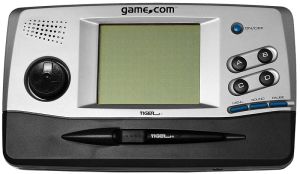
Game.com – Released: 1997
Pronounced “game com” and not “game dot com”, this newest handheld from Tiger Electronics was a clear attempt to make a cartridge-based handheld version of the games they popularized in the late 80s. Much like those old school handhelds, the games shared popular licenses of the time and similarities in gameplay, but for the most part were unique creations. Think of a company that only does book adaptations to film – the concept remains the same and the characters are familiar, but it’s essentially something new. This sounds like a good idea, but for some reason Tiger always seemed to miss the point of portable games and Game.com is no exception.
Gaming To-Go Part 2: Gameboy and beyond
For more than 10 years various portable games came and went, mostly focusing on a single title in custom hardware, then in 1989 it all hit at once. With such a small gap between releases it was clear that multiple companies were developing cartridge-based portable consoles. Most portable systems in history moving forward had one simple goal: to port home console games to handhelds as faithfully as possible. While some gems of creativity did spawn from portables that were clearly not ports, the main goal of many developers was always about getting those console ports in the palm of your hand.

Gameboy – Launch Price: $89.99 – Released: 1989
In every way shape and form, the Nintendo Gameboy was designed to be a portable NES. The brainchild of Gunpei Yokoi (Game & Watch series) and Nintendo Research & Development 1 (R&D1), known best for the creation of Metroid, the Gameboy was defined by one game: Tetris. Not only was the portable 8-bit console looking as promising as the NES – complete with launch titles Super Mario Land and a handful of all-too-familiar titles that launched the NES like Baseball and Tennis – but Nintendo picked the ultimate pack-in. With the Gameboy, Nintendo linked to a more casual market as well as the NES and gamer faithful, which was no more clear than the inclusion of Tetris, not Super Mario Land, in the box. Tetris fever was rampant in the United States at the time, some six or more versions were floating around on various platforms by 1989, and the Gameboy was a convenient and relatively inexpensive (Tetris was around $40 in most software versions) way to get a versatile version of the game. Starting in 1990, after many children and adults alike received a Gameboy for Christmas, it was not uncommon to see people in public grinding away the hours on a Gameboy. What was unique is that they almost always were playing Tetris and nothing else.
Gaming To-Go Part 1: Single Game Devices
Portable gaming is almost as old as console gaming, developers attempting to harness the technology of video games in any shape or form they could. This tangential development is most likely the result of experimentation in the early days of figuring out just what and how video games would work. With the first handheld video game premiering in 1977, the same year as the VCS (Atari 2600) and about 5 years following the premiere of the Pong consoles (and clones), gaming has always had a portable option. The biggest difference between console gaming and portable gaming is that consoles require additional devices for video, audio, and often for controls, whereas a portable contains all three of those attached. Early portables, much like early consoles, were mostly restricted to a single title on very basic displays.

Mattel’s Auto Race – Released: 1977
It’s difficult to pinpoint the actual release of Auto Race, especially considering it was far less popular than Mattel’s immediate second portable, Football. According to Gamasutra, it was on store shelves in 1977 (others claim 1978) and although Football released the next year, it is often miscredited as the first handheld. The design was simple: you were given 99 seconds to get your car from the bottom of the screen to the top in a 3-lane road. Cars would get in your way and you had to dodge them while also shifting between the four gears. If you collided with a car it would push you back towards the bottom until you got out of the way. The shifter and on/off switch were located on the left side of the portable while the screen takes up the right and the lane changer switch occupies the bottom. This game was a whopping 512 bytes (that’s 1/2 KB nowadays, which is roughly 500 characters in basic text format. Since I have not found one of these myself, I don’t know what batteries it takes, but I’d imagine a AA or AAA will do the job on this basic portable. I also couldn’t find a retail price but Michael Katz at Mattel claimed more than $400 million in sales of Auto Race and Football combined. Just like Pong, many clones of both titles exist.
Generation Gap Pt 5: “Last” Gen
This installment will conclude our Generation Gap coverage. Please note that upcoming coverage on handhelds, arcades and microcomputers will follow. A lot happened just over a decade ago – the gaming market changed and one strong competitor bowed out as another took to the plate.
Fifth Generation – 1999 – Present (technically)

Sega Dreamcast – Launch Price: $199.99 – Released: 1999
Launch dates are getting more technical by this time, so from a Japanese standpoint the Dreamcast was a 1998 launch but we didn’t get it here until much later in September 1999. Although it is a 128-bit system, consoles had stopped toting the strength of “bits” and instead focused on a sleek design – most likely because Sony did it with Playstation and it worked. Dreamcast was Sega’s final nail before bowing out of hardware manufacturing and has been argued to also be its best offering. Regardless, the Dreamcast was definitely ahead of its time. It featured things that no console would dare launch without today and basically had the same features that Microsoft would include in its console just a few years later. A few years, that’s the difference between success and failure.
Until the Dreamcast most video game consoles were specified hardware that was far behind PCs. By all accounts the Dreamcast was a simplified PC, even running Windows CE, a modified version of the operating system that would be put to greater use on later pocket PCs. The Dreamcast had a built-in modem on all consoles, which supported the earliest form of online console gaming and provided a web browser service to those fortunate or rich enough to afford the high cost of long phone calls. Furthermore a keyboard attachment allowed players to truly use their console as an Internet device and even gave way to early MMOs on the console. Memory cards included LCD dot matrix screens and were called “visual memory units” or VMUs that not only held data but gave the player on-the-go mini games and Gigapet-style games. Aside from that Dreamcast boasted higher storage with the proprietary GD-rom format (1.2 GB of storage space), impressive graphics, and a slew of solid titles.
Generation Gap Pt. 4: 32-bit (with a dash of 64)
By the time the SNES was dominating and the Sega Genesis was locked in an endless sea of add-ons to save the dying console, electronics manufacturers began to step up and create many of their own consoles. As a result, the market was flooded with overpriced horrendous hardware. They seemed to have everything a gamer wanted: new media format (the cheaply priced cd was preferred by developers to reduce production cost and retail price), impressive graphics and processors, and lets not forget the large numbers like “32” and “64” prominantly displayed on the startup screens. Unfortunately they lacked one important thing: good games. Still, that didn’t prevent many manufacturers from creating a loose version of the video game crash of 1983. Thankfully one lone electronics company entered the foray with the next step in gaming – that company was Sony.
Electronics Companies Go Bananas (or Pre 32-bit Gaming)

JVC’s Xeye
I’m guessing somewhere around the Sega CD, boasting the ability to play your new audio CDs through your television as an added feature, electronic companies started to take notice of gaming systems. As you guide through the progression of consoles the consumer electronics market grows stronger with gamers – let’s face it, they’re the perfect early adoptors. Quickly companies scrambled to enter the gaming market including JVC, Phillips, Panasonic, Pioneer, Sony and even more. Some of these companies licensed existing hardware, like JVC did with the X’Eye, a Sega Genesis/Sega CD hybrid that was re-branded with JVC’s logo. On the other hand, Phillips, Panasonic and Pioneer – imagine keeping these companies straight as a consumer – released their own hardware with a (arguably) library of games. In the end, they all sucked and had ridiculous price tags pushing back the concept of consumer electronics meeting gaming for at least another six years. Below are the early disc-based consoles that failed so horribly.
Video Game Violence Heats Up
I remember going to the roller skating rink on Thursday nights and even though I was an avid gamer, puberty had started to kick in and girls were much more interesting to me. That is, until Mortal Kombat. I had already seen and gotten my butt kicked by most of the Street Fighter II players, but that game was too cartoon-like and I didn’t much care for it. Mortal Kombat was different. It had digitized actors playing as each of the fighters, heavy blows to the face would result in large globs of blood spraying across the floor, and I’ll never forget the first time someone won a round with Johnny Cage and the words “Finish Him!” flashed on-screen. The player walked up to his opponent and did what looked like a complex combination of buttons, the screen darkened, and Johnny Cage straight up punched the guys head off. Blood erupted from the severed stump while the head bounced on the floor while Johnny Cage put his sunglasses on and struck a pose. That was my first experience with a “fatality,” which would go on to be one of the most controversial subjects in gaming history.

Senator Joseph Lieberman
In the arcades it was all good and well but once this content hit home consoles in 1992 suddenly governmental groups took notice, namely senators Joe Lieberman (Connecticut) and Herb Kohl (Wisconsin). They decided that video game companies were pandering violence to children, using these “toys” (game consoles) as the vehicle, and in December 1993 decided to take it to congress. At that time both Nintendo and Sega had versions of Mortal Kombat on the market, but each had its own way of handling the questionable content. Nintendo thought it was taking the moral high ground by converting the blood to gray sweat – hardcore SNES players of the time used Game Genie to turn it back to red – and changed the fatalities to bloodless “finishing moves.” Sega, being the more salacious of the bunch, kept all the violence and fatalities intact on its consoles and instead opted for a code to unlock it – every Sega player remembers “ABACABB” and “DULLARD” for the Genesis as well as “212DU” for Game Gear. Sega had decided to self-police its titles and implemented a rating system on its games, mostly taking queues from the motion picture industry. There were 3 ratings: GA (general audiences), MA-13 (parental advisory under 13), and MA-17 (parental advisory under 17). For one reason or another Mortal Kombat received an MA-13 from Sega. Not that any of this mattered.

Senator Kohl
To the senators, changing fatalities were finishing moves didn’t change the fact that Scorpion would still char the opponent to bones. As for the rating system, especially one that was self-established, it may as well have been a promotional logo. To further explain their opinions, the senators screened what they claimed was the Sega Genesis version of Mortal Kombat. Since anyone who played that version knows how rough and fake it looks, they opted to show off the much more crisp and clear arcade version. Semantics, sure, but still valid. It’s important to note that Mortal Kombat was not alone in these hearings. Night Trap, Lethal Enforcers, and Doom shared the spotlight.
Generation Gap Pt. 3: 16-Bit
By 1989 the NES was a powerhouse not to be reckoned with. Sure, there were other consoles out there, but if you were doing home gaming it was predominantly on the NES. That is, until Sega introduced the first 16-bit system to the market. Billed as the Genesis (Mega Drive in other regions, but due to an US copyright it was renamed to the Genesis), Sega hit the ground running bringing near-perfect arcade ports of popular titles like Golden Axe and Altered Beast. This spawned the popular “Genesis does what Nintendon’t” campaign, the onslaught of the console wars, and the second true generation of consoles since the crash. For those simply wondering what 16-bit (and other “bits”) means is the type of processor working within the system at a given speed (think “Pentium 4” for a basic comparison).
16-bit Generation (1989 – 1999)
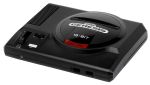
Sega Genesis – Launch Price: $189.99 – Released: 1989
It came literally out of nowhere. Back then the only place to purchase Nintendo games in the Chicago suburbs was Toys R Us – you’d go see a slew of Nintendo box art in closed plastic sleeves, remove a ticket with a large price on it, and take it up to a booth that was enclosed and caged like a casino redemption. There wasn’t a “video game” section, just a “Nintendo” section, because at that time Nintendo was synonymous with video game (and for my grandparents, it still is). On that faithful summer day in August 1989 I walked into the Nintendo section and a slot was missing from the game display, replaced by a big blue logo that read “Sega” and a television that had a commercial playing. In the commercial games like Golden Axe were getting compared to Bionic Commando, a truly unfair comparison from a graphics standpoint alone, despite hindsight revealing Bionic Commando the better title. This upbeat guy was chanting “Genesis…” and a bold deep voice finished the sentence “Does!” as the commercial cross-cut the great visuals of Sega’s new console versus Nintendo’s clearly dated NES. Then my eyes wandered down to the price: $189.99 – available soon! I immediately forgot about it.
Generation Gap Pt. 2: 8-Bit
Amidst the video game crash of 1983, it seemed pretty unlikely that home consoles would have a future. Fortunately a Japanese toy maker had figured out how to re-sell video games to the masses despite the world economy turning its back. That company was Nintendo.
8-bit Generation (1985 – 1995)
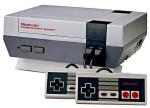
Nintendo Entertainment System – Launch Price: $200 – Released: 1985
Depending on your age, the Nintendo Entertainment System (NES) probably needs the least introduction or background, but there were many things going on behind the scenes that assisted this console in becoming the giant it was. Initially Nintendo had to figure out how to overcome the world economy’s opinion on video game consoles, which the Famicom/NES clearly was. In Japan, where personal home computers were all the rage, it was marketed as a computer for your family, hence the name Famicom (for “family computer”). In America the better way to sell it was as a toy, which everything from the console’s marketing to the simple boxy aesthetic suggests. It worked and in both regions this little 8-bit system assisted Nintendo in virtually running the 8-bit era.
 Gaming History 101