Archive for the ‘Genesis’ Category
Buying Guide: Sega Genesis (plus Sega CD and 32X)

Behold “Frankenconsole”
We all love our retro consoles, but in many cases the consoles we are buying are because they are cheap enough or we have enough money to purchase what we never were able to in our youth. Unfortunately the business of making used retro items available to the masses can at times be a money grubbing market where consumers are deceived by people they will never meet in real life. As an individual who has spent the last decade scouring the local area, conventions, eBay, and the internet as a whole I have learned many valuable lessons. For that reason I present my buying guide series, which is a handy quick guide to knowing what to purchase and what will cost an arm and a leg to replace.
We have finally come to the console I started this entire buying guide series for: the Sega Genesis (and its many add-ons). With a short period of its life having a 55 percent market share over the SNES (the year it launched, mind you), there were plenty of households who had a Sega Genesis. So many, in fact, that there were five different versions of the console and 3 iterations! Depending on the console version, your specs will vary but the list of what you need should stay the same so I’m going to run over the list.
First of all, figure out which model you want, here’s the gallery of what they look like:
Review: The Amazing Spider-Man vs. the Kingpin (Sega CD)
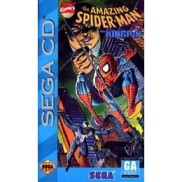 Console: Sega-CD/Mega-CD
Released: 1993
Developer: Technopop
Publisher: Sega
Instruction Manual: Helpful – Link
Difficulty: Moderate
Played it as a child? Yes
Value: $8.88 (used), $39.99 (new) (pricecharting.com)
Other Releases: Yes – Simply known as Spider-Man on Genesis, Game Gear, and Master System
Digital Release? No
 As we sometimes see in the 16-bit era, first party published titles became interesting exclusives on either side of the console wars and among the various Spider-Man titles I have to say this is my favorite. Amazing Spider-Man vs. Kingpin (or better known on all other ports as Spider-Man) tasks you with defusing a bomb set by the nefarious Kingpin within 24 hours (pretty sure that’s not real-time) by collecting keys from different foes in the Spider-Man universe. This was the first game I played that gave me exactly what I expected out of a superhero title. It allowed me to play as Spider-Man, it had solid controls that included web slinging and wall grabbing, and it did it all in a side scrolling platformer/brawler. Not only that, but the game embraces a non-linear structure where you visit locations throughout the city and face whatever is in certain locations, which felt like it freed the game up to your personal pacing, something quite uncommon in the days of early platformers. While the plot centralized around the Kingpin, you will take on almost all of Spider-Man’s key foes including Venom, Doc Oc, Lizard, and Electro, just to name a few. Graphically the game had that semi-real grit that Sega titles all seemed to offer in the early 90s with great animated storyboard art throughout.
Podcast: Game Club – Castle of Illusion Starring Mickey Mouse
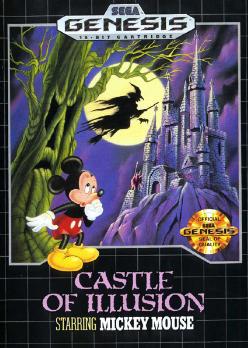
This week Fred and guest Rob “Trees” from EZ Mode Unlocked tackle November’s game club title Castle of Illusion Starring Mickey Mouse for the Sega Genesis. They get into discussions about the context of the game to the content, time period of release, individual levels, and even chime in on the soundtrack.
Download this episode (right click and save)
As an added bonus, Fred completed the campaign in its entirety on video (below):
Review: Castlevania: Bloodlines (Genesis)
 Console: Sega Genesis
Released: 1994
Developer: Konami
Publisher: Konami
Mega Drive? Yes (as Banpaia Kira Translation: Vampire Killer, Castlevania: The New Generation in Europe)
Instruction Manual: Not necessary – Link
Difficulty: Hard
Played it as a child? No
Value: $23.07 (used) $59.99 (new) (pricecharting.com)
Price: $25-$50 (used) $60-$350 (new) on eBay
Digital Release? No
Just like today there was fierce competition between the two main 16-bit consoles, SNES and Sega Genesis, that necessitated exclusive games. Aside from the first party developed titles, third-party developers could opt to either create the same game for both consoles or create completely new ones. In the case of many Disney games, like Aladdin or The Lion King, different companies developed the game on each console but the basic concepts and level design would remain consistent regardless of which version you purchased. Konami, on the other hand, would usually make completely different exclusive titles that played to the strength of the specific console it was designed on. There was no way this developer, who was free to release games on any (and every) console not to create games for both. Castlevania: Bloodlines is a side story game, much like Rondo of Blood, that played to the audiences that came running to Sega’s edgy console.
Now & Then: Mortal Kombat II (Midway)

Midway must have known it had a hit on its hands with the original Mortal Kombat because no time was wasted creating the sequel. While most of us anticipated the home release of the first title, Mortal Kombat II (MKII) snuck into arcades and blew our minds. This game literally had it all – more characters, more fatalities/finishing moves, and more violence. For most MK series fans, myself included, this is considered to be the best and it’s one of the highest grossing video games of all time.
MK Meets its Match
The original Mortal Kombat was an impressive fighter, especially for one that was developed with digitized actors in only 10 months, but creator Ed Boon wanted to do more. “[MKII] had everything we wanted to put in the original MK but didn’t have time for,” he said in an interview with EGM2 (issue 5, Nov. 1994). It does seem like there’s some truth to his claim, especially with the introduction of more stage fatalities, a second fatality for each character, and even joke finishers “friendships” and “babalities”. I’m not so sure the roster was an initial idea, nor was the background concepts of Outworld, but I can definitely see the Midway team wanting to break away from the perceived reality of the original. Not only was MKII the definitive version of the original concept, but it continues to be the template for which all other titles in the series are based on.
Now & Then: Mortal Kombat (Midway)
Last week Mortal Kombat released for the Playstation Vita and while I was playing it for review I couldn’t help but notice that the series has not changed much since it first released. Normally this is a bad thing, but in the case of this series its strength relies on its simplicity. Mortal Kombat is a game all about beating the crap out of your opponent and then topping it all off with a finishing move that is extremely violent in nature.

First Impressions
I still remember the day that I saw the first Mortal Kombat arcade out in the wild. It was 1992, I was 10 and frequented the local roller rink where I could meet up with friends and play arcade games. Yeah, even in 1992 the roller rink was still alive and well in Chicago’s northern suburbs. At that time the arcade was dominated by Street Fighter II, a cartoon-like fighter from the geniuses at Capcom, but I wasn’t all that good at it and truthfully had little interest in fighters. That is, until I walked in and saw a new game that prominantly displayed the title “Mortal Kombat” in bright yellow letters. My first thought was how stupid it was that the word “combat” was misspelled, but then I noticed that the game used digitized realistic looking actors. Even more impressive was when the first uppercut made contact and a shower of blood erupted from the opponent’s face. I was intrigued.
 Gaming History 101