Posts Tagged ‘castlevania’
Koji Igarashi is Making the Spiritual Successor to Symphony of the Night
As Konami continues to sink into the Pacific Ocean off the coast of the United States, its famous creators are coming out of the woodwork with new games. Enter Koji Igarashi – or “Iga” as we’ve come to call him – who is the man responsible not only for Symphony of the Night, but also the man who created the MetroidVanaia (or IgaVania) sub genre. Quite possibly the best Playstation game to release (we shall see when that Top 10 comes around), it’s no shock that fans were overjoyed when his newest creation, Bloodstained: Ritual of the Night, popped up on Kickstarter yesterday and fully funded the title in a handful of hours. Touted as the spiritual successor to Symphony of the Night, Bloodstained puts you in the role of Miriam, an orphan who has been cursed by an evil alchemist and is slowly becoming a crystal being. The first to receive this curse, Gebel (voiced by David Hayter thanks to stretch goals), set out to make Miriam a castle of her own to live in, but as his curse progressed he’s gone mad and filled the castle with demons and trapped her inside. As Miriam (and potential other protagonists that could become a co-op partner if the stretch goal is met) you fight through the castle in that classic style we’ve all come to love from Iga. While Fred does not participate in Kickstarter, the funding having reached triple its original request means that hopefully within the next two years we’ll all be able to get our hands on this game that is coming for the PS4, Xbox One, PC, Mac, and Linux. If you want a more tangible reward, head on over to the Kickstarter to secure your digital copy for $28 and your tangible disc copy for $60 plus plenty of other rewards for different backer amounts.
Podcast: Top Scores, Volume 2
Video game soundtracks are as varied and nostalgic as the games themselves. Sometimes just hearing a few bars from a classic tune brings the memories of playing that game rushing back. Thanks to the community and a handful of personal selections, Fred and Jam present a collection of nostalgic favorites.
Download this episode (right click and save)
Download the higher quality version (right click and save)
Subscribe: RSS iTunes Google Podbean
Track List:
Podcast: Castleroid?

This week we tackle the “MetroidVania” titles in the Castlevania franchise to follow up our initial episode (Devil’s Castle Dracula). Fred and Jam briefly define MetroidVania as a genre, discuss some titles that originated it, and discuss Symphony of the Night – the most prolific of the series – as well as the multiple portable titles that followed.
Podcast: Extra Credit – MicroSoft eXtended (MSX)

For this extra credit Fred goes solo to discuss Japan’s only semi-exclusive microcomputer, the MSX. Created by Microsoft as a computing platform, the MSX is responsible for many cart-based titles that found mass success on the NES and even today. It’s an impressive library on one of the most niche worldwide consoles/computers of all time.
Opening Song: Main Theme – Nightmare on the MSX
Sequence 1 break: Intro/Main Theme – Metal Gear on the MSX
Closing Song: Main Theme – Salamander on the MSX
Podcast: Devil’s Castle Dracula

This week Fred is joined by Allen (@tearsofafeather) to discuss the Castlevania franchise. As a fan of both this show and Castlevania, Allen assisted in talking about the vast adventures of the first six titles for the Belmont clan (Castlevania I-IV along with Rondo of Blood and Bloodlines). Join us in one of the most technologically advanced and entertaining horror action platformers ever released.
Review: Castlevania: Symphony of the Night (PS1)
 Console: Sony Playstation (also released on Sega Saturn in Japan only)
Released: 1997
Developer: Konami
Publisher: Konami
Japan? Yes (as Akumajo Dracula X: Gekka no Yasokyoku Translation: Devil’s Castle Dracula X: Nocturne in the Moonlight)
Instruction Manual: Not necessary – Link
Difficulty: Moderate
Played it as a child? No
Value: $22.87 (used) $64.45 (new) (pricecharting.com) – NOTE: There are two versions: original and greatest hits. Original is much more rare and expensive, so adjust your buying habits appropriately.
Price: $15-25 (used GH) $35-$60 (used original) $90-$130 (new GH) $400 (new original) on eBay
Digital Release? Yes – released as PSOne title on PS3/PSP and on XBLA – $10.00 for all versions. Also available with Rondo of Blood in the Dracula X Collection for PSP – $15 digital, varies on UMD.
***We also did a podcast on this and other Castlevania titles like it here.***
While Rondo of Blood may be the hidden gem of the Castlevania series, Symphony of the Night is anything but. There wasn’t a Playstation gamer around that didn’t see this release back in 1997, bringing a much-needed change to the traditional formula. Every Castlevania game that released on consoles seemed to push the hardware to do things it was never intended to do and usually had amazing results, so it was interesting that in a world consumed by 3D polygonal graphics Symphony of the Night was a 2D side scroller. In Japan, the series has a much easier way to identify the games that go together – main campaign titles often wore Akumajo in the title and in this case Dracula X – but in America we had not received (and most of us had not played) Rondo of Blood. The game starts out with you climbing the stairs to Dracula’s chamber at the end of Rondo and you re-create the final fight with Dracula (of which you cannot die). Then a long bit of lore scrolls the screen and next thing you know you’re playing as Alucard, Dracula’s son, and you’re rushing to Castlevania to rescue Richter from its curse. It was like being dropped into the middle of an epic you had not previously learned the story of. Frankly, it didn’t matter, and even today playing Rondo of Blood only assists in giving you background detail because like all other Castlevania games it’s the gameplay and level design that keeps you hooked.
Review: Castlevania: Bloodlines (Genesis)
 Console: Sega Genesis
Released: 1994
Developer: Konami
Publisher: Konami
Mega Drive? Yes (as Banpaia Kira Translation: Vampire Killer, Castlevania: The New Generation in Europe)
Instruction Manual: Not necessary – Link
Difficulty: Hard
Played it as a child? No
Value: $23.07 (used) $59.99 (new) (pricecharting.com)
Price: $25-$50 (used) $60-$350 (new) on eBay
Digital Release? No
Just like today there was fierce competition between the two main 16-bit consoles, SNES and Sega Genesis, that necessitated exclusive games. Aside from the first party developed titles, third-party developers could opt to either create the same game for both consoles or create completely new ones. In the case of many Disney games, like Aladdin or The Lion King, different companies developed the game on each console but the basic concepts and level design would remain consistent regardless of which version you purchased. Konami, on the other hand, would usually make completely different exclusive titles that played to the strength of the specific console it was designed on. There was no way this developer, who was free to release games on any (and every) console not to create games for both. Castlevania: Bloodlines is a side story game, much like Rondo of Blood, that played to the audiences that came running to Sega’s edgy console.
Review: Dracula X: Rondo of Blood (PC-E CD)
 Console: PC-Engine CD (Japan)
Released: 1993
Developer: Konami
Publisher: Konami
Japanese Title: Akumajo Dracula X: Chi No Rondo – English Translation: Devil’s Castle Dracula X: Rondo of Blood
Instruction Manual: Not necessary – Link
Difficulty: Hard
Played it as a child? No
Value: $83.00(used) Unknown – this usually indicates none have ever been sold (new) (pricecharting.com)
Price: $90-$120 (used) N/A (new) on eBay
Digital Release? Yes – Virtual Console and remake on Dracula X Chronicles (PSP) – $9.00 (VC), $15.00 (PSP) digitally
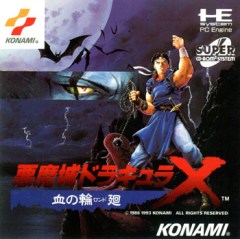
Akumajo Dracula X: Chi No Rondo is one of those games that you either know about or you don’t. As a side story to the series, appearing on the PC-Engine CD no less, I don’t think Konami ever intended the game to be popular but what it does for the Castlevania formula is worth noting. Rondo of Blood (as it is known in English) follows Richter Belmont, a descendent of Simon and Trevor, in a side story where he seeks out Dracula to recover his girlfriend Annette. It takes place in Germany, I think (I’ve never played the game in English), and the cutscenes even contain German dialogue with Japanese subtitles. Thanks to the RAM and CD format of this title, it also features amazing sound design and an anime-like style. Oh yeah, and until recently it was never released outside of Japan.
Review: Super Castlevania IV (SNES)
 Console: Super Nintendo Entertainment System (SNES)
Released: 1991
Developer: Konami
Publisher: Konami
Super Famicom? Yes (as Akumajo Dracula – English Translation: Dracula’s Castle)
Instruction Manual: Not necessary – Link
Difficulty: Mild
Played it as a child? No
Value: $22.79 (used) $189.95 (new) (pricecharting.com)
Price: $20-$30 (used) $150.00 (new) and $500 for first edition (v-seam) on eBay
Digital Release? Yes – Virtual Console – $8.00
 It’s pretty much understood that Super Castlevania IV is merely a remake of the original Castlevania, however for many reasons it is a significant game in its own right. In Japan the game held almost the same name as the original (Akumajo Dracula) and in the lore and instruction manual in Japan it literally has the same plot. For the US release, Konami attached the “IV” as well as giving a slightly different story that suggests the events of this game take place immediately following the second game, Simon’s Quest. Even though both the developers and the fans agree it’s not a sequel, the two games have little in common with one another. While it’s a cool experiment with many gameplay characteristics, some that would never return and others became series staples, Super Castlevania IV was also a flagship title for the SNES to show off all the things the various modes (including the overhyped Mode 7) could do to a game. Think of it as a fleshed out action platformer tech demo that was far more interesting in retrospect than Pilotwings.
Review: Castlevania III: Dracula’s Curse (NES)
 Console: Nintendo Entertainment System (NES)
Released: 1990
Developer: Konami
Publisher: Konami
Famicom? Yes (as Akumajo Densetsu – English Translation: Devil’s Castle Legend )
Instruction Manual: Not necessary – Link
Difficulty: Moderate
Played it as a child? Yes
Value: $12.25 (used) $172.82 (new) (pricecharting.com)
Price: $15-$20 (used) $289.00-$500.00 (new) on eBay
Digital Release? Yes – Virtual Console (NES version) – $5.00
What are you supposed to do?
Castlevania III returns to its roots and is an action platformer. Unlike the original, the game isn’t entirely linear, giving you branching paths along your way. Of the game’s 15 levels, you will play 9-10 of them depending on your decisions, eventually making your way to Dracula.
Review
As one of the later games on the NES, Castlevania III: Dracula’s Curse is surrounded by technical mastery. In fact, it utilizes such an expansive amount of supplemental hardware (ie: chips) that the Japanese version isn’t even capable of working with the NES (unless you modify it, of course) and the US version is incompatible with “famiclone” systems. For all that work, however, Castlevania III is a great title that impresses on all fronts. Back to the extra hardware – the memory management controller chip, version 5 (MMC5) allowed the game to be playable on the NES albeit at the cost of some of the impressive sounds and graphics in the Japanese version. This doesn’t mean it’s bad by any means, the game still looks and sounds better than a majority of games ever released on the console, it’s just that the Japanese version is a bit better thanks to the VRC6 microprocessor. Normally I don’t gush on video game soundtracks, because save for a select few I don’t really consider it a notable factor. This is one of those rare cases that I must say the game sounds amazing, in any form. 1up’s own Jeremy Parish captured the difference in a YouTube video that I have provided below so you can hear the difference for yourself.
 Gaming History 101