Posts Tagged ‘sega’
Podcast: The Treasure Box
This week Trees returns and we are talking about the Japanese developer Treasure, best known for some of the most impressive games on Sega’s consoles (Gunstar Heroes, Radiant Silvergun, Guardian Heroes, and Ikaruga) as well as Nintendo’s later consoles (Bangai-O and Sin & Punishment). We discuss the company origins, values, and of course the entire library of this impressive developer.
Download this episode (right click and save)
Subscribe: RSS iTunes Google Podbean
Below is a video of an unreleased (canceled) title, Tiny Toons: Defenders of the Universe. The beta that was presumably used as a trade show demo eventually leaked on the internet. We have acquired it and played it on an original, modded, PS2. Enjoy!
Podcast: Tis the Season

For our holiday show, Fred is joined by Shawn Freeman of Knuckleballer Radio and Rob “Trees” O’Connor from EZ Mode Unlocked to discuss the holiday releases of days passed. With a plan to cover 20 years of releases we only get through five (1985-1989), but plenty of fond memories are shared.
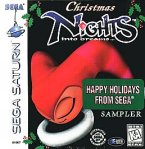
Review: Christmas Nights Into Dreams (Saturn)
 Console: Saturn
Released: December 1996
Developer: Sonic Team
Publisher: Sega
Instruction Manual: It did not have one – manual of the original game should suffice
Difficulty: Easy
Played it as a child? Yes
Value: $24.25 (used), $56.00 (new) (pricecharting.com)
Other Releases: Yes – A Japan only PS2 remake of Nights Into Dreams includes the Christmas content
Digital Release? Yes – included in the HD remake of Nights Into Dreams on XBLA and PSN, certain content removed (see below)
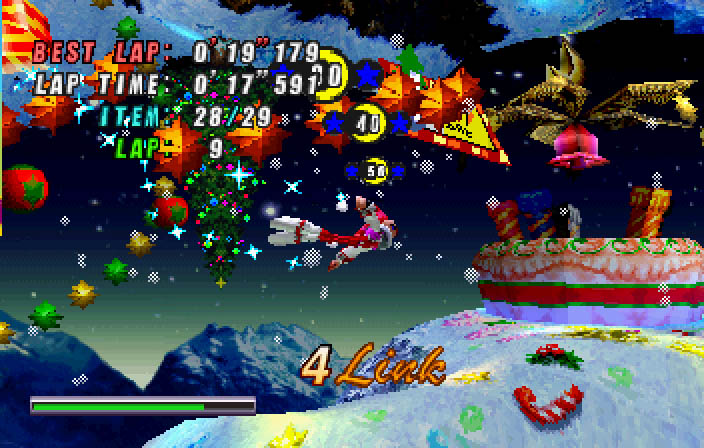
Christmas Nights Into Dreams is significant for several reasons, but most of all it’s one of the only Christmas themed games to ever come out. No, seriously, look through the vaults of retro console history, this is a holiday that is rarely celebrated save for games that focus on certain days (Animal Crossing, for example). In the winter of 1996 Sega was already in big trouble with the Saturn. At only about a year and a half old, Sony’s Playstation was killing it in terms of sales and there were few exclusive titles that generated any kind of buzz. Even Sonic, the faithful hedgehog that always seemed to sweep in and save Sega’s butt, hadn’t released a real game yet. Not only that, but this was the Christmas release of the Nintendo 64 and Mario 64 was selling out consoles nationwide. Nights Into Dreams was the only recent release on the Saturn that appealed to the typical gamer and with its colorful aesthetic, roots in platforming, and Sonic Team developer it was Sega’s best bet for the holidays. Under these circumstances Christmas Nights invaded the market in several forms from being a free pack-in with Christmas console bundles (that already included Nights), inside several magazines, a mail away/in store offer with certain game purchases, and even for rent at Blockbuster Video. This “sampler” title was everywhere, but only for about 45 days, and now it’s one of the more rare and sought after pieces of a retro gamer’s collection.
Buying Guide: Sega Genesis (plus Sega CD and 32X)

Behold “Frankenconsole”
We all love our retro consoles, but in many cases the consoles we are buying are because they are cheap enough or we have enough money to purchase what we never were able to in our youth. Unfortunately the business of making used retro items available to the masses can at times be a money grubbing market where consumers are deceived by people they will never meet in real life. As an individual who has spent the last decade scouring the local area, conventions, eBay, and the internet as a whole I have learned many valuable lessons. For that reason I present my buying guide series, which is a handy quick guide to knowing what to purchase and what will cost an arm and a leg to replace.
We have finally come to the console I started this entire buying guide series for: the Sega Genesis (and its many add-ons). With a short period of its life having a 55 percent market share over the SNES (the year it launched, mind you), there were plenty of households who had a Sega Genesis. So many, in fact, that there were five different versions of the console and 3 iterations! Depending on the console version, your specs will vary but the list of what you need should stay the same so I’m going to run over the list.
First of all, figure out which model you want, here’s the gallery of what they look like:
Buying Guide: Sega Master System

We all love our retro consoles, but in many cases the consoles we are buying are because they are cheap enough or we have enough money to purchase what we never were able to in our youth. Unfortunately the business of making used retro items available to the masses can at times be a money grubbing market where consumers are deceived by people they will never meet in real life. As an individual who has spent the last decade scouring the local area, conventions, eBay, and the internet as a whole I have learned many valuable lessons. For that reason I present my buying guide series, which is a handy quick guide to knowing what to purchase and what will cost an arm and a leg to replace.
Oh the Master System, the red-headed step child of the 8-bit era. Not only were Sega products unknown to American markets – Japan had seen several iterations of the Sega Mark consoles, the Master System known as the Mark III – but it released alongside the NES in America and had nothing to show for it. The two biggest problems with the Master System today is that it’s relatively expensive for a working consoles itself, there are ways to play many of these games on the Game Gear or Genesis (with the Power Base Converter), and not too many good games (many arcade games also got ported to Genesis with better quality). For those that aren’t aware, Nintendo also had developers and publishers locked into license agreements that didn’t allow games to be released on another console and basically had the Master System in checkmate in the US. Still, I have the console and love some of the games/ports that are available on it (like Ghostbusters) and plenty of collector’s are curious what the console looks like. Aside from the video provided below, make sure the consoles you get have the following:
Review: Sonic CD (Sega CD)
 Console: Sega-CD/Mega-CD
Released: 1993
Developer: Sonic Team
Publisher: Sega
Instruction Manual: Not Necessary – Link
Difficulty: Moderate
Played it as a child? Yes
Value: $11.99 (used), $23.50 (new) (pricecharting.com)
Other Releases: Yes – PC, PS2/Gamecube (Sonic Gems Collection)
Digital Release? Yes – Steam, Xbox 360, PS3, Android, iOS ($5 on all platforms)
Sonic CD is one of those games that it’s just popular to like. I don’t want to start on a negative note, the game does have some merit, but it’s not a particularly good Sonic game and doesn’t quite change the universe like many will claim. Before Sega decided to blitz every console on the market with the digital version, Sonic fans were gnawing at the bit for a decent port (sadly the Sonic Gems Collection ports had emulation issues). Now that it’s everywhere the gaming community seems to have adjusted to a more realistic view of the CD adventure that throws a few imaginative ideas at relatively lackluster level design.

At one point you’re forced to beat Metal Sonic in a race.
For those that aren’t up on their Sonic history, the hedgehog was co-created by Naoto Oshima and his more known partner Yuji Naka. After the release of the first game, Naka and several members of that team moved to the United States and joined with STI (Sega Technical Institute) to create Sonic the Hedgehog 2. Meanwhile the remaining developers, including Oshima, took the concepts that were in early development for Sonic 2 and expanded upon them into what eventually became Sonic CD. This is why despite coming out around the same time as Sonic 2, Sonic CD looks graphically more like the original and doesn’t seem to adapt some of the great ideas of the sequel. Still, it does feature some interesting gameplay mechanics, like the ability to move into the past and future with two full versions of the many levels. This dual expansion of the campaign does have a casualty: level design. Many of the levels in Sonic CD feature plenty of wasted real estate in the interest of moving quickly to the right, odd gimmicks that net death if you don’t tolerate the so-so platforming, and several instances where Sonic’s momentum is completely spoiled by a random ramp or springboard. Despite these layout flaws I still contest that the boss designs are superior over Sonic 2 and prove that not all of the talent in Sega’s Japanese team migrated to America.
Review: Racing Aces (Sega CD)
 Console: Sega-CD/Mega-CD
Released: 1994
Developer: Sega
Publisher: Sega
Instruction Manual: Not Necessary – Link
Difficulty: Hard
Played it as a child? Yes
Value: $4.45 (used), $9.35 (new) (pricecharting.com)
Other Releases: No
Digital Release? No
Racing Aces is another in a long line of games that came out before their time. It’s not that the concept is particularly unique – a bunch of different planes involved in a race with occasional weapon combat – but rather that it’s a fully polygonal game trying to operate on a system that just doesn’t have the power. Don’t get me wrong, I love the Sega CD, but I acknowledge that it did nothing more than add some graphical maps and sound channels to the Sega Genesis. This isn’t very conducive to a fully rendered 3D environment for racing. As a result it looks and acts much like the Genesis ports of games like Virtua Racing or Hard Drivin’, with large bare environments that are boring to look at and staggered, slow vehicles that don’t make for an exciting battle. Racing Aces moves sluggishly, the enemies have an unfair advantage, bare bones world, and is a racing game – all negative things in my book – so why do I like it so much?
 The game starts off with a training arena that gets you used to using the easiest of the four classes of airplanes, the basic bi-plane. It allows you to learn navigation, pointing the plane where you want it, and how to navigate the air before throwing competition your way. It’s during this tutorial level that I learned I had a long way to go and for some reason remained a blocked part of my fond memory of this game. Racing Aces controls like a computer that has too many processes (which may very well be what’s happening) because all of your inputs have drastic changes to the movement of your plane and come a few seconds after you press them, so it’s difficult to re-adjust yourself after an overshoot. You eventually get the hang of it but that really means you get used to tapping directions to slowly adjust your direction to just the right spot. Well until you hit a turn, that is, when everything gets thrown drastically off course and you’re again fighting to fly in a straight line. Since I’ve never flown a plane before, I guess it’s possible that this is a normal experience for pilots but for those of us just trying to play a game it was a bit specific. This speaks nothing for the other planes in each class, there are usually 2-4 different ones, which will force you to readjust to even more picky controls. It’s all worth it once you grind through the hour or so of practice to get your skills up because then you feel like this laughably sluggish race moving at stuttering speeds is actually intense. By the end of it onlookers couldn’t help but crack up as I inched my way toward a finish line.
Review: The Amazing Spider-Man vs. the Kingpin (Sega CD)
 Console: Sega-CD/Mega-CD
Released: 1993
Developer: Technopop
Publisher: Sega
Instruction Manual: Helpful – Link
Difficulty: Moderate
Played it as a child? Yes
Value: $8.88 (used), $39.99 (new) (pricecharting.com)
Other Releases: Yes – Simply known as Spider-Man on Genesis, Game Gear, and Master System
Digital Release? No
 As we sometimes see in the 16-bit era, first party published titles became interesting exclusives on either side of the console wars and among the various Spider-Man titles I have to say this is my favorite. Amazing Spider-Man vs. Kingpin (or better known on all other ports as Spider-Man) tasks you with defusing a bomb set by the nefarious Kingpin within 24 hours (pretty sure that’s not real-time) by collecting keys from different foes in the Spider-Man universe. This was the first game I played that gave me exactly what I expected out of a superhero title. It allowed me to play as Spider-Man, it had solid controls that included web slinging and wall grabbing, and it did it all in a side scrolling platformer/brawler. Not only that, but the game embraces a non-linear structure where you visit locations throughout the city and face whatever is in certain locations, which felt like it freed the game up to your personal pacing, something quite uncommon in the days of early platformers. While the plot centralized around the Kingpin, you will take on almost all of Spider-Man’s key foes including Venom, Doc Oc, Lizard, and Electro, just to name a few. Graphically the game had that semi-real grit that Sega titles all seemed to offer in the early 90s with great animated storyboard art throughout.
Podcast: Game Club – Castle of Illusion Starring Mickey Mouse
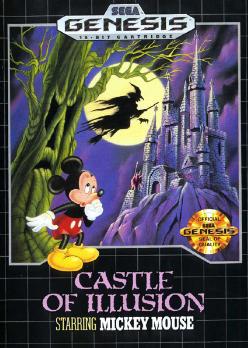
This week Fred and guest Rob “Trees” from EZ Mode Unlocked tackle November’s game club title Castle of Illusion Starring Mickey Mouse for the Sega Genesis. They get into discussions about the context of the game to the content, time period of release, individual levels, and even chime in on the soundtrack.
Download this episode (right click and save)
As an added bonus, Fred completed the campaign in its entirety on video (below):
Friday at the Movies: Jurassic Park (Sega CD)
 Console: Sega-CD/Mega-CD
Released: 1993
Developer: Universal Pictures/Amblin Entertainment
Publisher: Sega
Instruction Manual: Helpful – Link
Difficulty: Easy
Played it as a child? Yes
Value: $1.02 (used), $10.39 (new) (pricecharting.com)
Other Releases: No
Digital Release? No
When the movie Jurassic Park came out in 1993, it was an absolute phenomenon. People who had never read the book were picking it up in droves, and from what I could tell through conversation at that time almost no one actually read it. Dinosaur craze returned in full force as Michael Crichton’s novel about a genetic research company cloning dinosaurs on a Costa Rican island brought out the kid in everyone. Not only that, Spielberg’s film adaptation utilized cutting edge computer generated image technology along with stop motion and creature expert Stan Winston to create lifelike dinosaurs onscreen that amazed everyone. Jurassic Park was not only ideal for the medium it was on, the premise was tailor-made for marketing companies to merchandise the hell out of it. Back then development cycles were short and coordinating a solid game release along with a movie wasn’t so far-fetched, and honestly most home ports of the game were as diverse as it came across platforms and all pretty decent. My personal favorite has to be the Sega CD port, which merged details from both the movie and the book to create, of all things, a point-and-click adventure set on the island. The opportunity of exploring the vacant island and interacting with the dinosaurs was a great opportunity, but I didn’t come to appreciate it until I was much older due to the lack of action in the game.
 Set shortly after the abandonment of the island in the movie, you’re tasked with returning to Jurassic Park after the tragedy that befell its visitors and recover dinosaur eggs for rebuilding. Since the eggs are lost and you are unaware of Dennis Nedry’s specimen can, your only option is to sneak into the nest of the 12 given dinosaur species, recover an egg, and return it to the incubator at the visitor’s center. While locations remain in a controlled environment (you’re forced into fast travel movies that drop you into the screens you explore), there is an awful lot of freedom to roam about. What I found most iconic is the ability to explore areas like visitor center laboratory and even special access to Dr. Wu’s office, the tyrannosaur paddock and seeing the after effects of the attack on the SUVs that Tim, Lex, and Grant were in, and even a tense trip down the island river (which is never featured in the movie but a crucial part of the book’s plot) as dilophosaurs spit venom at you. While this sounds gripping and almost too high brow for 1993, you must remember that this game is a true adventure game not unlike the LucasArts and Sierra titles, which means action is few and far between. Even in the sequences where you do engage dinosaurs, the answer is always some sort of puzzle that usually has you dying quite a few times before figuring out the secret. I think most people who go into this game are imagining something that is a bit more interactive than it is, but if you approach it with an adventure game mindset it weaves an intriguing story.
 Gaming History 101