Archive for the ‘Vita’ Category
Now & Then: Mortal Kombat 3

Switching It Up
 A lot happened both in the talent pool of Mortal Kombat players and in the game design overall between the release of Mortal Kombat II and Mortal Kombat 3 (MK3). For starters there was a mass exodus of on screen talent due to royalty disputes, so almost no one from the original two games returned for the third release. In addition, Boon and his team were trying to turn Mortal Kombat into a viable fighting game with things no one had ever seen before and mechanics that could compete with the massive rush of fighters in arcades. The game was completely Americanized, with all hints of Eastern influence including symbols, locales, and the soundtrack completely absent without a trace and instead replaced by urban stages, 90s hip-hop soundtracks, and cyborgs replaced the signature ninjas. These locations were now composed of pre-rendered 3D backgrounds and the character sprites were almost totally digitized as opposed to the digitized/hand drawn hybrid of the previous games. Along with it came an overhaul of the controls, including combos and a “run” button to address rightful claims that defensive players ruled the previous title. It’s all one giant 90s metaphor but that doesn’t change the fact that MK3 (and it’s update Ultimate MK3 or UMK3) stands as the moment I felt the series went into the mainstream fighter territory. Couple this with the fact that it was on just about every console that existed at the time, still dominated arcades, and had more content than rival Street Fighter II could ever dream to do with its iterations and I see why it’s creator Ed Boon’s favorite. Mortal Kombat 3 definitely upped the ante.
Making PSN Accounts in Other Regions
We so very often recommend our listeners/viewers/readers get a foreign PSN because it’s so “easy”, but I figured with this morning’s news of Shadow Tower coming to the US PSN later today and the massive amount of games I purchase on the various PSN stores that it was high time to make it easy for you. Creating a PSN is not a difficult task, however it can be a challenge without knowing the language, written or otherwise, of the territory you seek and also knowing what you will and won’t gain from each. With the average Playstation 3 being able to tether up to 5 PSN accounts, I have chosen to dedicate one to my home base PSN, three to outside territories, and the final one to guests in my house. The best benefit of a PSN account on multiple consoles is that all accounts on that console can share installed games, so I purchase a game on my Japanese PSN only to use it on my American account for the sake of trophies and keeping my friends informed as to what I’m playing. Perhaps you don’t know how to create a PSN for another country or perhaps you don’t know the benefits, well this little article will assist you in making the proper decision.
Hotline Miami 2: Wrong Number Review
The original Hotline Miami is still a massive indie hit that has a colourful over the top retro look to it with a fantastic soundtrack to accompany it. The goal of each level was simple: kill every enemy on screen by any means necessary. Although that comes across as a very basic concept the game is very difficult and you will find yourself restarting constantly until you finally figure out the magical formula to dispatch all the bad guys in the level. I was hooked to this game instantly when I first played it, and was pretty excited to hear a sequel was on the way.
Hotline Miami Review

Getting that “retro feel” in modern games is a particular challenge that few actually nail. Sometimes the aesthetics are spot on, but at the expense of gameplay, which can feel sluggish or imprecise and the developer often sites authenticity for retro consoles or some other excuse. Many times the soundtrack is fantastic but it’s the only notable aspect of the game. By process of elimination there are those titles that get the gameplay down but at the expense of aesthetics and story a la Retro City Rampage. That’s why Hotline Miami seems such an achievement because it looks like a 16-bit top-down game, plays like a twin stick shooter from the 90s (Smash TV anyone?), and manages to pull off the unreliable narrator concept that usually falls flat. On top of that, it has a fantastic soundtrack that Dennis Wedin composed for the game and stands as the first thing you experience upon booting it up and the most notable part of the experience. All the elements are there and the result is an unforgetable title from start to finish.
Woah Dave! Review
 I first experienced Woah Dave! At EGX 2014. It was being demoed on the 3DS at the time and it was one of the few games that didn’t have a crazy long que. I enjoyed what I played but like a lot of the smaller indie games at the show I just forgot about it. Fast forward to today and we are given the game for free through Playstation plus. It’s surprising that this has released on the Playstaion Network before the Nintendo eshop. [Woah Dave! was released on the eshop in the US back in October 2014 – ed.]
Woah Dave! takes its inspiration from the original arcade classics like Mario Bros and Joust. You play a small pixel man and your objective is to collect as many pennies as you can, which then act as your overall score. To find the pennies you have to defeat enemies that start out as little eggs but soon hatch into alien looking baddies. To kill these enemies you have to pick up eggs or skulls and throw them at the target. But you have to be quick as the skulls explode after a short time and the eggs hatch. If this happens while your holding it you will loose a life. If the enemy manages to reach the lava below it will evolve into a stronger enemy. Each time the enemies reach the bottom they change into a faster and more difficult enemy until they become a flying eye ball which will literally pursue your character unless you defeat it. There is a lot of risk reward with the game. You can play it safe and destroy the eggs as soon as they drop but you will receive a minimum score. But, if you wait for the enemies to get stronger, they will drop more coins. You have to collect the coins to bank them into your score, so unless you play carefully your coins could end up in the lava and be useless. There is a single powerup which resembles the power block from Mario Bros (except it says Woah on it) that occasionally falls from the heavens. Picking this up and flinging it will destroy everything on the screen in a satisfying shower of coins.
Now & Then: God of War 1 and 2

God of War feels like a series that just exploded in popularity but has now been lost in the gaming community abyss. Last year the God of War Collection (featuring the first two games in the series) was released to the Playstation Vita to such a poor reception that a lot of friends were generally surprised it was actually released. Then again the same group of friends were gob smacked that Borderlands 2 also came out on the Vita. Now, it could be argued that this lack of enthusiasm may be due to the lack of interest in the Playstation Vita. But forgotten or not, I’ve played through both God of War games so it’s time to see how they hold up today.
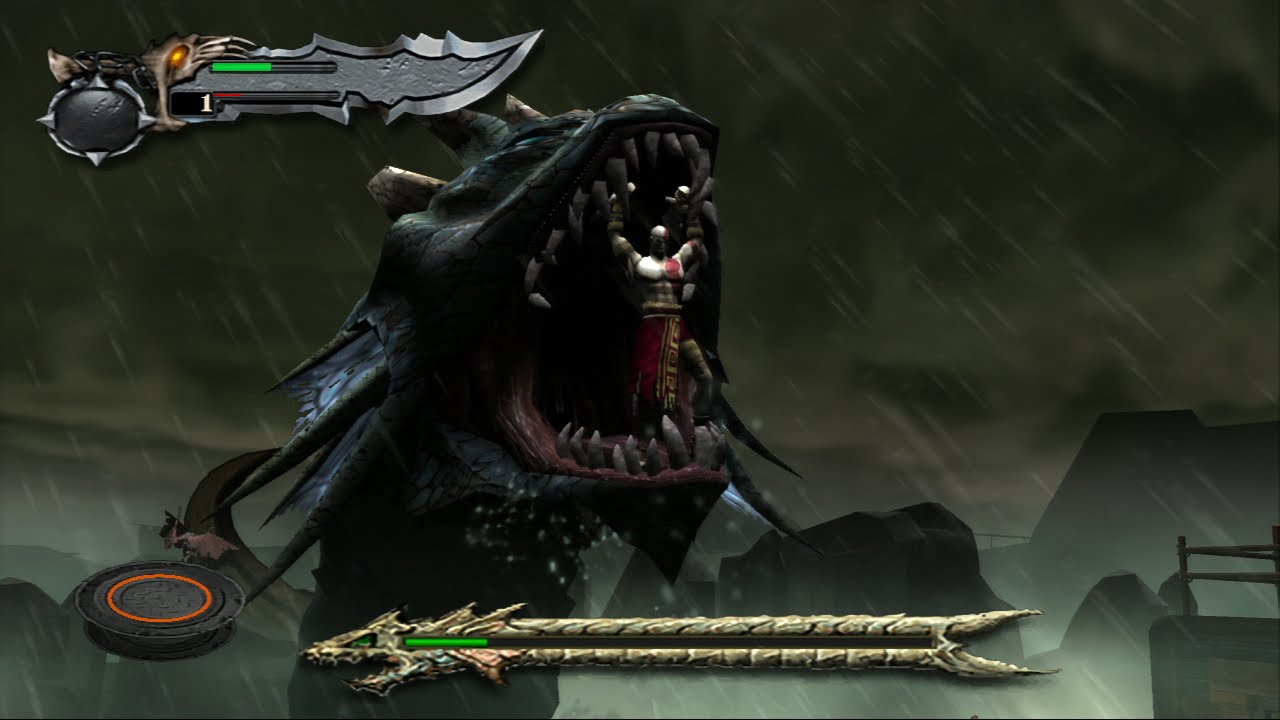 I was originally a massive fan of the very first God of War game on PS2. When I was first introduced to the game by a friend I got so into it we played through the entire game together in one single sitting, something that I rarely do with a video game. We spent a lot of the experience just gob smacked by how the PS2 was able to include great graphics and set pieces. Of course a lot of the great visuals are attributed to a fixed camera control and the set pieces being controlled entirely by quick time events (a feature I’m glad has started to disappear in the gaming industry). The game felt like a breath of fresh air. Although the game did not introduce a completely original experience it seemed to take elements that worked with other games like an anti hero storyline, hack and slash gameplay and upgrading your character with orbs. The game was not perfect, even for the time people criticised some of the challenging sections in the game most notably the infamous Hades area where you had to get pass various traps and obstacles. If you were hit just once you died instantly, leading to some massive gamer rage grinding your enjoyable experience to a complete halt. What made God of War stand out at the time was the epic adventure, where you travel into areas no man can supposedly enter (and the game clearly displays this by having dead bodies littered everywhere). You really felt like you were on this impossible quest. Every time you beat a gigantic boss or got pass a deadly trap you really felt a sense of achievement. The bosses were also enormous like the infamous hydra, a fantastic way to open the game and a design feature that seemed to carry over to all future games in the series as well. The game was well received by critics and gamers so it pretty much guaranteed a sequel. The developers seemed confident of this as well as the message “Kratos will return,” appears once the credits have finished at the end of the experience.
Podcast: Final Fantasy X, X-2, and…XII?
 This week we are an ensemble cast with Andy from 42 Level One and Agents of Shieldcast as well as Eli from Knuckleballer Radio joining to discuss the main PS2 iterations of the Final Fantasy Series: X, X-2, and XII. As with all our FF eps, it’s a broad overview, but the discussion will help you understand what to expect from each iteration and what development changes were made. With the recent HD remakes of the X titles, you may just be tempted to give these titles a second glance.
Review: Velocity (Ultra)
 Velocity is one of those games that I remember first trying on my PSP on long commutes between London to Cambridge and had I not played this game I probably would have gone insane with boredom. It released for the Playstation Network as a mini back in 2012 and then later given the HD make over and released for the PS Vita as Velocity Ultra.
Velocity is a space ship game that impressively mixes shooting, puzzles and speed all into one. Set in the year 2212 (which is rather clever as this game was released in 2012) the star Vilio has exploded causing a massive electromagnetic pulse (EMP) field, cutting the power in nearby colonies. You pilot the Quarp Jet, a teleporting spacecraft, and your job is to rescue survivors while also shooting down the invading aliens. The story is presented in nice little graphic novel style panels which are short and to the point. Velocity has fifty missions which are all pretty short – around five minutes, sometimes less – making this a perfect game for short bursts, but with its incredibly addictive nature it is very likely you will play much longer.

Podcast: Gaming History X: This is Next Gen?
This week we celebrate Jam (@Jamalais) coming on board as a permanent co-host, a slew of retro news, and onto the more modern topic of contemporary consoles. Now that the gang’s all here, we dissect the current state, conditions, and factors of the previously called “next gen” and loosely discuss the upcoming future.
 Gaming History 101