Posts Tagged ‘capcom’
Review: Strider (2014)
 Yet another in a long line of modern re-hashes on cult favorites, I went into Strider with a bit more optimism than than other titles to date. Aside from spruced up graphics the game appeared to be faithful to the arcade original, which my retrospective and the podcast last week contested is the best iteration of the series. Couple that with the development being handled by Double Helix – a very popular developer with success not only in Killer Instinct 3, but also was purchased by Amazon for an unannounced project – and the open map MetroidVania game design, things were shaping up to success. Having completed the game, I must admit that just like the anomaly of the original, Strider is a melting pot of prior series staples that gets it right from start to finish.

The scale of the overall world is massive and can be stunning.
If you sit still too long in the original arcade game, you will die. Best laid plans are to push forward (ie: to the right) and just attack anything in your path while trying not to fall off a ledge. In the new game that theme is aggressively applied with herds of enemies so thick they will literally be a blocking point for you at times in the game. As a member of the Strider clan, Hiryu is able to cut down most adversaries with the greatest of ease and the balance between enemy hit points and his acrobatic abilities result in a fast paced romp. I never had down time in Strider and felt like a masterful ninja with frantic but controlled moves as I navigated the game’s massive map. While I can concede to the basic MetroidVania label, I would say the game more closely resembles Rondo of Blood rather than the hybrid genre. Even when you have a full moves list at your disposal these hiding places are more off the beaten path rather than the wide open areas you uncover in other titles of the genre. What results is a game that is more linear than anything else, and despite it being a huge map the development team broke it up into different areas complete with a boss battle and new weapon at the core, so basically it’s just like having levels that you can return to. Strider is no stranger to this method of map design, the original NES title was quite similar and a small following prefer it to the traditional “run to the right” design of the arcade title. In the end I grew tired of looking too hard for too much because I was having such a blast following the marker to the next step of the main mission that I played it exactly like a linear game.

Two bosses on opposing sides are no problem for Hiryu.
Strider Retrospective

Starting today the reboot of Strider hits home consoles and PCs as developer Double Helix attempts to capture the charm that came with the original’s dedicated cult following. When I try to look back at Strider – and yes I grew up playing every version from the arcade at my local bowling alley that was ported to the Genesis along with the completely different NES version – it’s hard to see what exactly needs to be in the new game. Still, there’s no denying the hardcore appeal of this unique and odd addition to classic gaming that justifies looking back for those that didn’t grow up with it.
 If you haven’t played it, the original arcade version of Strider is all over the place. There are multiple languages, settings across the globe, massive mechanical ape bosses, and even lead protagonist Hiryu riding on a whale at the end. As one of the pioneer titles of Capcom’s new CP arcade platform – think of it as a cartridge-based cabinet that allowed quick swapping of games with only a few ROM changes – the graphics are indicative of the cartoon style all CP titles shared (ie: Ghouls’n Ghosts, Willow, and of course Final Fight). Graphics aside, the game is also noted for its crazy gameplay that features hanging from walls and ceilings, fighting massive enemies, and reversed gravity. To accompany this eclectic melting pot was an equally frantic soundtrack that covered all the bases from electronic progressive music to ambient classical style. While the soundtrack is uncredited to original composer Junko Tamiya (she also did the solid NES version of Bionic Commando as well as my personal favorite Sweet Home), the original versions of the arcade game didn’t feature the Aerial Battleship or Third Moon stages (replaced instead by the first stage music on a loop) so it can be deduced that someone went back and composed those additional tunes. While the game itself covers a scant five stages that will take the average person probably 60-90 minutes in total (pros can do it in half that time) the high difficulty and game design that was more indicative of home consoles was fresh. Instead of trying to rack up a high score or conquer a single mechanic over and over you were progressing through brutally difficult levels with the carrot on the stick being that provided you could afford to continue as many times as it took, you could see the ending. This is why most people who play it today will either set it to free play on the cabinet or emulator and also explains why the PS1 port flat-out gave you unlimited continues.
Polygon features “An Oral History of Street Fighter II”
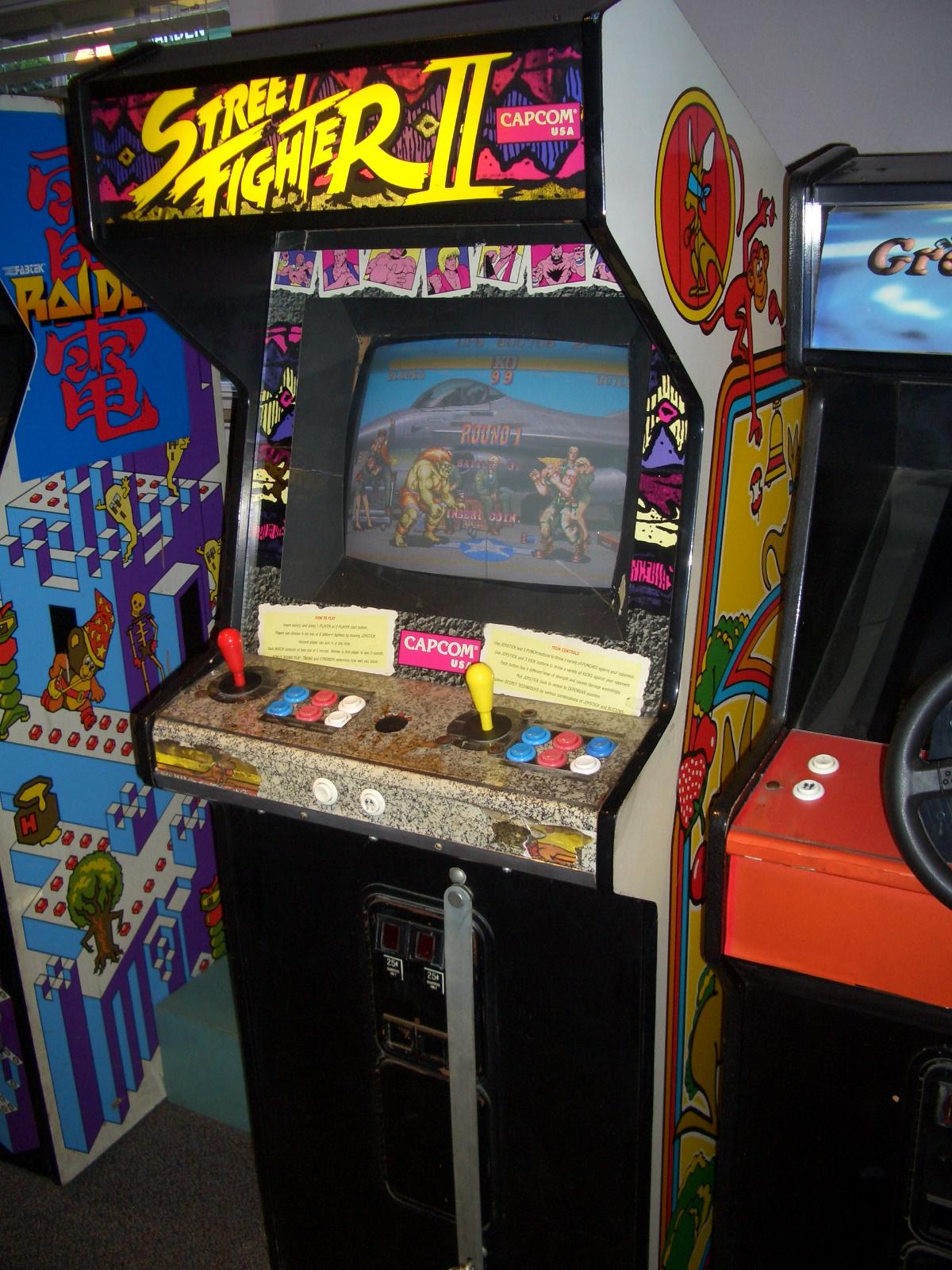 Ah Street Fighter II, how you have become a beloved fighter franchise. While the celebrated fighter may hold a special place in the hearts of arcade enthusiasts or those who were teens in the mid 90s, I am always fascinated by the stories of the game’s genesis. Since I will never have access to the veteran team responsible for Capcom’s classic, Matt Leone (formerly of 1UP and now at Polygon) has covered just that in his recent Oral History of Street Fighter II. It’s an amazing and deep read that any fan of game development should definitely take in. I swear, features like this prove that true featured articles did not die with print.
Retro Game Night: RE Gun Survivor 2 and Michigan
For this week’s video and Retro Game Night we are playing requested titles Biohazard (Resident Evil) Gun Survivor 2 (Japanese Version) and Michigan: Report from Hell (European English Version). Both titles only released in Japan and Europe so here they are in all your viewing glory. Michigan is a complete let’s play series. Due to language and violence both of the games and the commentary, viewer discretion is advised.
Podcast: Rock Man of Doom

This week Fred goes solo to celebrate Doom‘s 20th Anniversary and the Mega Man series. Keji Inafune’s legacy may live on through Mighty Number 9, but when he was a young new college grad Capcom employed him to create one of the most beloved and long running franchises of the company’s history.
Also if you want more Doom coverage, feel free to check out our podcast on Doom clones.
Retro Game Challenge: Ghosts’N Goblins (NES)
Fred tackles one of the hardest NES titles of all time: Ghosts’N Goblins.
WARNING: Due to the difficulty and nature of this challenge, there is explicit language, viewer discretion is advised.
Podcast: Silent Evil

This week Fred is joined by listeners Allen and Jamalais to discuss the Resident Evil and Silent Hill franchises. They do not get as far as planned, but the initial iterations of each series is thoroughly covered and a sequel is promised.
Review: DuckTales Remastered
 Release Date: August 13, 2013
Developer: WayForward
Publisher: Capcom
Price: $14.99
Platforms: Xbox 360 (XBLA), PS3 (PSN), WiiU (eShop), PC (Steam)
Most HD remakes require a certain degree of love for the original game, especially when you consider a brunt of them just increase the resolution on lower quality assets. In the case of NES classic DuckTales, this doesn’t really apply. It was a stunning game that had few flaws when placed up against other titles of its time. There was much work to do bringing it into modern times and if you are going to do this type of upgrade while still retaining sprites, WayForward is probably the best equipped for the job. The visual result is spectacular, justifying the somewhat melodramatic title of Remastered in a mere screenshot. Unfortunately it seems the team was so focused on keeping the aesthetics intact that they spent little time on gameplay. As a result DuckTales Remastered is a title that will tug at your nostalgic heartstrings before crushing them under the minor, but significant, tweaks of this modernization.

Podcast: Me Money Bin
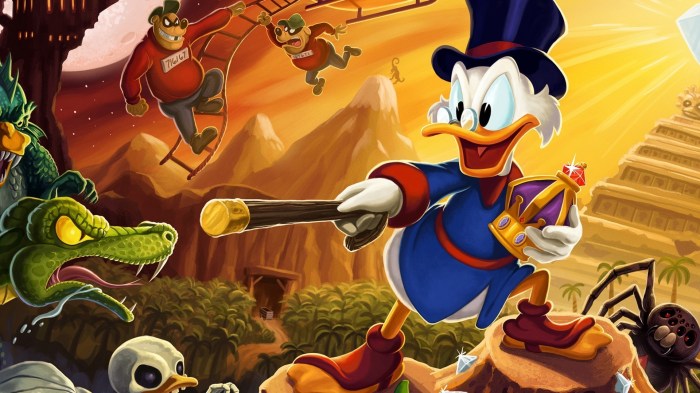
This week Fred and Trees are discussing Capcom’s Disney games. In the 8-bit era Capcom received the Disney license and created a little game called DuckTales based on the popular Saturday morning cartoon. Not only was it a mass success, but it was an excellent game that gave way to a whole slew of 8-bit and 16-bit gems on Nintendo and Sega consoles.
Review: Ducktales (NES)
 Console: NES
Released: 1989
Developer: Capcom
Publisher: Capcom
Difficulty: Moderate
Price: $14.05 (used, cart only), $48.98 (used, complete), $167.61 (new) – Please note: This is a recent spike in value with the release of Ducktales Remastered, approximately 45 percent, and may soon drop.
Digital Release? No, although a re-creation of the original, Ducktales Remastered, is now available on Xbox 360, PS3, WiiU, and PC
 Ducktales is one of those rare titles on the NES that has a universal love from anyone who talks about it. That’s because it is a perfect example of what most of us who grew up with Nintendo’s 8-bit console loved about gaming, and all with a Disney license to boot. Granted the developer was Capcom, who at the time was responsible for Mega Man and several other gems on the same console, but Ducktales proved that you could experiment and still get a game right. It was fun, it was addictive, it looked good, it sounded great (one of the signature soundtracks of that era), and of course sought after thanks to licensing deals that will surely prevent a re-release.
At face value it was a standard side-scrolling platformer where you control Scrooge McDuck as he journeys the world looking for treasure. Where it diverges from this classic formula is that of the five levels you explore (Amazon, Mines, Transylvania, Himalayas, and the Moon) you are given the option what order to complete them in. It doesn’t really matter, although from a difficulty standpoint there can be a given order, but I know plenty of fans that have played it enough to do whatever order you choose. I also think due to the various hidden items throughout each level there is a need to complete certain levels in an order if you want to collect a million dollars and get the true ending. This is all before you even start the game, where you learn about the other great mechanic: the pogo cane. Probably one of the most notable gameplay mechanics of the console, Scrooge’s pogo cane allowed him to take out enemies Mario style but also get through hazards like spike pits untouched. Later in the game it will also be the only way to traverse large pits by jumping on the heads of attacking enemies or proper placement of an enemy to reach a seemingly untouchable spot. Once you master the cane, this title is a cinch.
 Gaming History 101