Archive for the ‘PC/Mac’ Category
Podcast: It’s Pronounced La-Ra

This week Fred and Trees are talking about the Tomb Raider series and its busty protagonist Lara Croft that shadowed the video game as a pop culture icon in the late 1990s. We discuss development, creation, and production of both Core and recent Crystal Dynamics’ vision for Lara and her many adventures.
Genre Study: Roguelikes and MetroidVania Games
Lately many games that embrace former genres that had fallen to the wayside are making a comeback. As a result lots of games press and developer media contacts like to coin phrases that are based on gameplay styles not many are familiar with. When someone tells you that Tokyo Jungle is a “roguelike” or that Guacamelee is a “MetroidVania” title, it’s entirely possible you have no idea what that means. After this article, you will no longer have that problem.
Roguelikes

Original Rogue on IBM compatible
You may or may not know that the roots of the roguelike come from a 1980 computer game called Rogue, which established the dungeon crawler. This game was considered genre-changing when compared to the slower paced text adventures such as Zork and Dungeons & Dragons video game ports like Wizardry and Ultima. Developers Michael Toy, Glenn Wichman, Ken Arnold, and Jon Lane site a hybrid between both types with influences from D&D as well as the text adventure Colossal Cave Adventure, which featured a detailed description of a cave system in Kentucky that was so precise it was used by a tourist to navigate parts of the actual caves it was based on. The result was a game where an adventurer explored a multi-floored dungeon, collecting items and facing enemies, in search of a final artifact (in this case the “Amulet of Yendor”) to complete the game. Each floor was more difficult than the last, you could not backtrack to a previous floor, and if you died you got a game over, simple as that. Additionally the layout of the dungeon, items, and enemies were all randomly generated, which meant you would ideally never play the same game twice. Despite the fact that you would have to start over, the experience of playing the game assisted you in handling enemies, utilizing items, and preparing for future encounters as such that you could eventually beat the game. Needless to say the game had a tough barrier for entry and popularized itself mostly on Unix systems in colleges across the country, but the public found it too complex and difficult.
Review: Revolution X
 Console: Arcade
Released: 1994
Developer: Midway / Rage Software (console)
Publisher: Midway / Acclaim (console)
Ports: Genesis, SNES, Playstation, Saturn, PC/DOS
Digital Release? No (probably due to license issues)
There are some games you can’t help but adore, even if they are completely without merit. Revolution X is definitely one of those games. When the title released to arcades in 1994, Aerosmith’s Get A Grip album was just around a year old and with solid hits like Living on the Edge and a slew of videos featuring Alicia Silverstone (who was discovered by the band and started her career in these initial videos). What originally started as a Jurassic Park game much in the same vein as previous title Terminator 2, Revolution X had to be retooled when Sega outbid Midway for the rights to Universal’s film. The result is a game with more off-the-wall and undeveloped ideas than a season of Lost that involves helping children around the world, saving the band, and stopping the New World Order and its leader Helga – a nazi-esque goth queen.
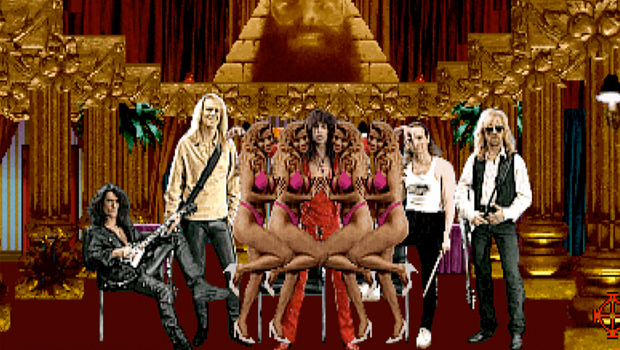 Revolution X has a hell of an intro, but as we often see in games like this it’s only a matter of time until it all falls apart. Aerosmith is performing in some drab downtown Los Angeles club (Club X) and the New World Order shows up to kidnap the band. You start off shooting the endless supply of henchmen with CDs as your grenades and large blood spatters as you take out enemies. After all, this is the team that gave us Mortal Kombat. Before even entering the club you will face literally hundreds of enemies, large security bosses with shields and bulletproof armor, and a massive tank. Once inside you will blast away at (literally again) hundreds of NWO henchmen while destroying the intro lounge, complete with Kerri Hoskins (Sonya in MK3) as thonged dancers in cages, and eventually entire the massive main area where Aerosmith is jamming away to the song Eat the Rich.
Review: Giana Sisters: Twisted Dreams (XBLA)

 For those not aware of the microcomputer craze in Europe that dominated the late 80s, the name “Giana Sisters” may not mean much. By the time the NES came out in Europe many had already invested in a microcomputer and parents were not eager to purchase a new console, so having games on popular computers like the ZX Spectrum and Commodore 64 was essential. The Great Giana Sisters was a widespread clone of Super Mario Bros. that provided a great side-scrolling platformer alternative to Nintendo’s classic. Unfortunately due to its highly similar content, including an opening level that literally cloned 1-1 from Super Mario Bros., Nintendo’s legal involvement got the game pulled off store shelves. Since then it has lived on as a rare holy grail for some gamers and having played it myself I must admit that it doesn’t steal as much from Super Mario Bros. as the initial level would suggest. Now the Giana Sisters are reborn in one of the first Kickstarter projects to benefit and release from the crowd-funding program and it is clear that Giana Sisters: Twisted Dreams is anything but a clone. In fact, Super Mario Bros. could learn a thing or two from this gorgeous modern platformer.
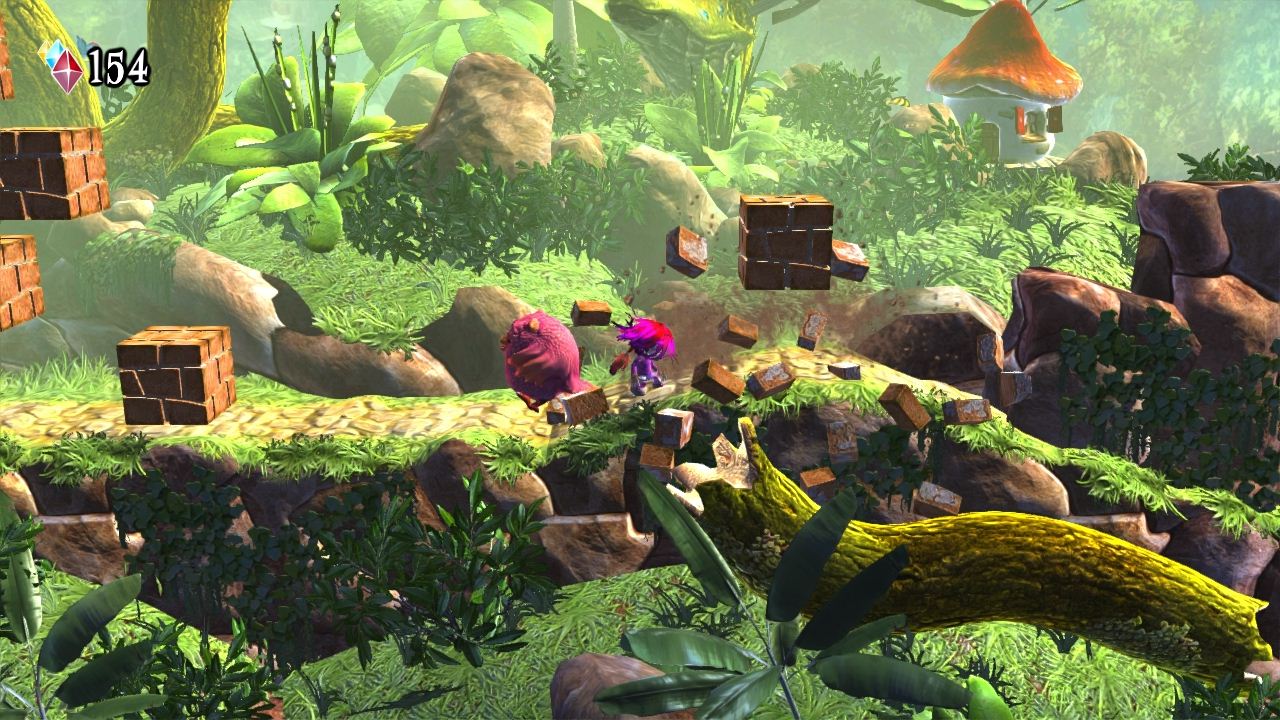 Twisted Dreams is a sequel to this controversial original, which did see a legal re-imagining on the DS in 2009, and picks up an original story that thankfully does not require knowledge of the original. Maria, Giana’s sister, has been kidnapped by an evil dragon and it’s up to Giana to enter the dream world and rescue her. Now a teenager, Giana is capable of utilizing the power of her two personalities – an interesting take on the changes one experiences in those awkward teenage years – allowing her to transform between a bright “Cute” persona and a rebellious “Punk” persona at will. Most interesting about this transformation is that it comes not only with new powers, but the entire world changes on the fly along with her. This dichotomy of not only the play style, but also the aesthetic of the entire game, creates a unique formula for each level. It allows the platformer to escape the confines of relying on level design and instead allows small simple spaces to become obstacle courses that will challenge your mind and reflexes. It’s not about dodging the pit and jumping on the enemy anymore, you need to think and think fast to make it in Twisted Dreams.
Operation Wolf (Arcade)
 Console: Arcade
Released: 1987
Developer: Taito
Publisher: Taito
Ports: NES (1989), Sega Master System (1990), DOS (1991), PC-Engine (Japan Only, 1992), Microcomputers (varies), PS2 (in Taito Legends, arcade version), Xbox (in Taito Legends, arcade version)
Digital Release? Yes – NES Version on Virtual Console (no light gun support, see below)
Operation Wolf is a game I can’t help but associate with Pizza Hut. Taito’s introduction and unique take on the light gun shooter flooded the American franchise so much in the late 80s that I can think of no other place I’ve actually played the game. Of course being a pizza franchise and not an arcade the difficulty was always cranked to the highest and I swear they timed the machine to play approximately half the time it took to cook a pizza so that families with two kids would each play one credit before the food was ready. This title brought more realism to the light gun shooter as you play a member of special forces diving behind enemy lines in Cuba to extract five hostages. Aside from the realistic violence of invading and destroying enemy encampments, this was the first light gun shooter to feature a plot and natural progression as well as a moving, scrolling stage instead of a fixed location. Did I mention it was addicting too?
 Mind you, we are still back in 1987, where arcade games were more about providing a specialized challenge with amazing graphics instead of explicitly drinking as many quarters as you’ll offer. The cabinet had a large mounted Uzi machine gun that could only swivel slightly with forced feedback to emulate gunfire kickback, pretty nifty for games of that time. At first glance it seems like a spray & pray title, but as you run out of ammo, die, and get captured you begin to realize you might need a slight bit of strategy. If you die, even if you have another quarter in the machine, you will still need to complete the current level from scratch (although you will now have full ammo and life). Innocent people are thrown into the mix, which you should not shoot, and animals, which you should shoot, for bonus items. Early on there’s not much penalty (as I prove in the video below) for blasting civilians or missing a vulture flying overhead, but by the final levels your screen will have a literal 50/50 spread of civilians and enemies with these animals being mostly your only source of ammo and power. I only do one playthrough in the video, but in truth I replayed this game for a couple of hours of fun. Unlike other light gun shooters before it, this game was less about accuracy and more used the gun as a placeholder for an invisible reticule. This is why most home ports and conversions don’t suffer from controller porting and in truth this type of game has proven to be just as effective, if not more so, with a reticule and controller as opposed to a light gun (which I cover in the home ports below).
Review: Deus Ex (PC)
 Console: PC
Released: June 2000
Developer: Ion Storm
Publisher: Eidos
Instruction Manual: Not necessary
Difficulty: Moderate
Played when it released? Yes
Other Releases: Yes – PS2 (as Deus Ex: The Conspiracy)
Digital Release? Yes – Steam ($9.99) and gog.com ($9.99), both are the Game of the Year Edition
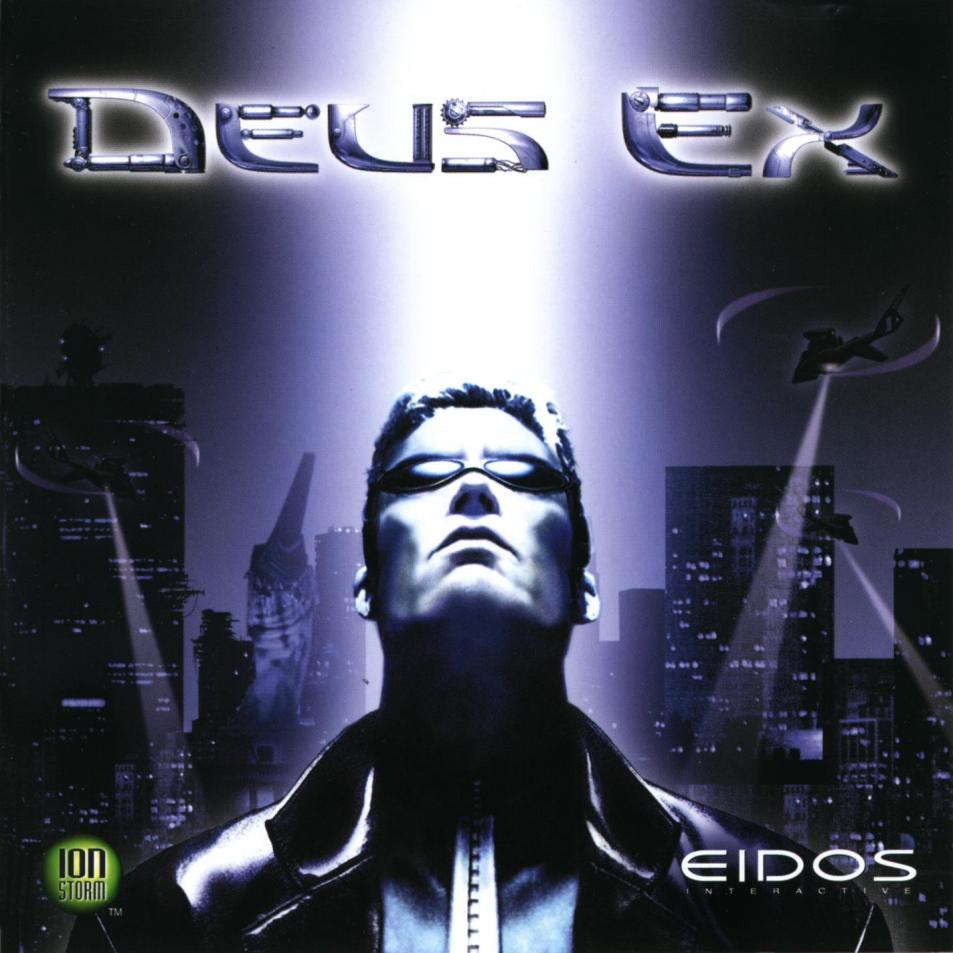
Deus Ex is an interesting game for several reasons. The way various factors all came together at its inception, it almost feels like a lucky form of happenstance that it worked at all. Those that played it when it released will tell you it’s a must play title that will blow you away with its innovation. On one hand they’re right, like other heavily influential games in history it does set precedence and introduces gaming to many staples we see today. On the other hand, it’s the earliest version of many of these ideas and will always be tied down to the conventions of gaming at the time. Those that give it a chance, grind their teeth to learn the gameplay techniques, and resist the urge to cheat will find a strong cyberpunk tale that doesn’t disappoint.

This is the typical view when playing Deus Ex
The Hobbit Review
 Console: Xbox
Released: October 24, 2003
Developer: Inevitable Entertainment
Publisher: Vivendi Universal
Instruction Manual: Not Necessary
Difficulty: Easy
Played it as a child? Yes
Value: $4-$10 (used), $10.49 (new) (pricecharting.com)
Other Releases: Yes – PS2, Gamecube, and PC and a modified version for the Gameboy Advance
Digital Release? No
No, sorry, this is not the ZX Spectrum game from 1983, but rather the more widespread console release from twenty years later, although I’ve never played the original so perhaps it’s garbage and this is the better choice. Back when the Lord of the Rings film trilogy was nearing its end, a slew of video games hoping to cash in on the wild success of Peter Jackson’s movies released. After sapping all of the film properties, the books themselves became source material for spin-offs and one of the first was based on Tolkien’s prequel book The Hobbit. As a mild fan of the series I always felt that The Hobbit was the better book and overall story, which explains the tale of how Bilbo Baggins became the first hobbit to embark on an adventure with 12 dwarves and wizard Gandolf the Grey. Not only that, but it introduces the ring, odd creature Gollum, and probably one of the only dragons in that universe, the unrivaled greedy dragon Smaug. Despite the semi-decent cartoon version of the book that I had seen in my youth, I was immediately drawn to the playful cartoon re-imagining of Tolkien’s book and despite some major snags in the gameplay department, I was pleasantly surprised.

Review: Sonic CD (Sega CD)
 Console: Sega-CD/Mega-CD
Released: 1993
Developer: Sonic Team
Publisher: Sega
Instruction Manual: Not Necessary – Link
Difficulty: Moderate
Played it as a child? Yes
Value: $11.99 (used), $23.50 (new) (pricecharting.com)
Other Releases: Yes – PC, PS2/Gamecube (Sonic Gems Collection)
Digital Release? Yes – Steam, Xbox 360, PS3, Android, iOS ($5 on all platforms)
Sonic CD is one of those games that it’s just popular to like. I don’t want to start on a negative note, the game does have some merit, but it’s not a particularly good Sonic game and doesn’t quite change the universe like many will claim. Before Sega decided to blitz every console on the market with the digital version, Sonic fans were gnawing at the bit for a decent port (sadly the Sonic Gems Collection ports had emulation issues). Now that it’s everywhere the gaming community seems to have adjusted to a more realistic view of the CD adventure that throws a few imaginative ideas at relatively lackluster level design.

At one point you’re forced to beat Metal Sonic in a race.
For those that aren’t up on their Sonic history, the hedgehog was co-created by Naoto Oshima and his more known partner Yuji Naka. After the release of the first game, Naka and several members of that team moved to the United States and joined with STI (Sega Technical Institute) to create Sonic the Hedgehog 2. Meanwhile the remaining developers, including Oshima, took the concepts that were in early development for Sonic 2 and expanded upon them into what eventually became Sonic CD. This is why despite coming out around the same time as Sonic 2, Sonic CD looks graphically more like the original and doesn’t seem to adapt some of the great ideas of the sequel. Still, it does feature some interesting gameplay mechanics, like the ability to move into the past and future with two full versions of the many levels. This dual expansion of the campaign does have a casualty: level design. Many of the levels in Sonic CD feature plenty of wasted real estate in the interest of moving quickly to the right, odd gimmicks that net death if you don’t tolerate the so-so platforming, and several instances where Sonic’s momentum is completely spoiled by a random ramp or springboard. Despite these layout flaws I still contest that the boss designs are superior over Sonic 2 and prove that not all of the talent in Sega’s Japanese team migrated to America.
Review: Double Switch (Sega CD)
 Console: Sega-CD/Mega-CD
Released: 1993
Developer: Digital Pictures
Publisher: Sega
Instruction Manual: Not Necessary – Link
Difficulty: Hard
Played it as a child? Yes
Value: $2.63 (used), $7.63 (new) (pricecharting.com)
Other Releases: Yes – Sega Saturn, PC/MAC
Digital Release? No
This is the game that brought it all together and proved that not only was a full motion video (FMV) game possible, it could be properly acted with high production values. Unfortunately, I’m pretty sure this title completely bombed on the Sega CD, otherwise there wouldn’t be so many freaking copies in the world (both used and sealed). Despite its commonality, Double Switch is like many other titles in the vast gaming world that starts off solid and becomes a veritable train wreck near the end. Honestly that’s when its commonality and subsequent low price tag come in to justify the purchase because I still really dig this title. It’s definitely not without plenty of flaws and if played in long intervals, can easily induce the need to never touch it again. If you can stomach it, this title does bring with it all the charm of a far-fetched early 90s pop film, which lead Corey Haim should suggest by the very fact he’s cast in the game. With the proper introduction, Double Switch was a fair follow-up to its much more popular, although purely due to its controversy, older brother Night Trap.
Developer Digital Pictures is solely to blame for the FMV game and it held the most firm grasp and largest library on the Sega CD. A company that started off as the lead developer for Hasbro’s canceled NEMO game system (that would do basically the same thing with VHS tapes), most of the sales celebrated by the company came from all the controversy of Night Trap. Even back then there was clear admission that Night Trap was a dated title that lacked almost any interactivity by the player and had terrible acting to boot. Double Switch, the successor that would follow the same structure without being a true sequel, hoped to address many of these complaints and did a fairly decent job of it. Unfortunately no one factored in the fact that many gamers thought they would see graphic violence or sexual themes as the sole reason for picking up Night Trap, the return on investment was hardly there. With what was surely a much higher budget than any similar title at the time, Double Switch was a big gamble that failed and not without good reason.
Feature: Max Payne – A New Perspective

Growing up, I played Max Payne for the excitement I got out of the gameplay, that slow motion diving and shooting mechanic. It felt perfect when I was in my teens playing these games for the first time. It was over-the-top action fun. I wasn’t looking for realism or a great story, I just wanted to shoot things. The Max Payne games were a perfect fit with their smooth and methodical gunplay.
I’ve played through Max Payne 1 and 2 about four times each, always playing the second title just after the first. It isn’t hard to do. Each game is only about 5 to 6 hours long. If I wasn’t completing one of the games in less than 6 hours it sure as hell felt like I was.
Other things that kept me coming back were the locales. They’re iconic and memorable – a frozen New York City, a grimy subway station, a sleazy hotel, an old church turned gothic nightclub, just to name a few.

“Life knows two miseries: getting what you don’t want and not getting what you want.”
Even though the locales were iconic, the gameplay superb, and the playtimes short, the story of Max Payne was something I had never paid attention to. I haven’t played the first two games in years, but I recently went back and finished them again before playing Max Payne 3.
 Gaming History 101